
Organizations in regulated industries such as financial services, healthcare, energy, and defense operate under a consistent mandate: they must be able to demonstrate control over who accesses their systems, when that access occurs, why it is needed, and what actions are taken. These requirements do not diminish in the cloud. In many cases, they become more stringent.
Oracle Autonomous AI Database on Dedicated Exadata Infrastructure delivers a fully managed database service with built-in automation for patching, backup, recovery, and scaling. At the same time, it preserves the level of control required for sensitive workloads. However, the managed model introduces an important consideration. Only Oracle personnel can perform operational tasks on the infrastructure, and that access must be governed in a way that aligns with regulatory expectations.
Oracle Operator Access Control addresses this requirement by providing a transparent, customer-controlled framework for managing and auditing Oracle operator access.
Regulated Environments Require Verifiable Control
Regulated organizations cannot rely solely on provider assurances. They are required to demonstrate enforceable controls to auditors and regulators. Across frameworks such as financial services regulations, healthcare compliance standards, and government security requirements, several principles consistently apply. Access must be time-bound and purpose-driven. Privileges must be limited to what is necessary. All activity must be attributable and auditable.
These principles align closely with industry standards such as NIST SP 800-53 for access control and auditability, and NIST SP 800-207, which formalizes zero trust architectures based on explicit verification and least privilege. In a fully managed Autonomous AI Database environment, these requirements must extend to the cloud provider itself. Without a mechanism like Operator Access Control, customers would not be able to independently validate or control how operator access is handled.
A Customer-Controlled Model for Operator Access
Operator Access Control introduces a just-in-time access model with no standing privileges for Oracle operators. Each access event begins with a formal request that clearly defines the scope, purpose, and duration of the work.
Customers review each request and decide whether to approve or reject it. Before making a decision, they can engage directly with the operator through the OCI console to request additional details or clarification. This interaction helps ensure that access is both necessary and appropriately scoped.
Once approved, access is granted for a limited time and is automatically revoked when the approved window expires. Customers can terminate access at any point, immediately ending all sessions and associated processes.
Oracle Operator Access Control enforces this model through a zero standing access architecture. Oracle-managed infrastructure does not maintain persistent shell accounts or pre-provisioned credentials, and no access path exists by default. When a request is approved, it dynamically provisions a temporary, per-operator account using SSH keys secured with FIPS 140-2 Level 3 hardware MFA. Each account is unique, scoped to the request, and time-bound.
When the access window ends, whether through completion, expiration, or revocation, all accounts and credentials are automatically removed, returning the system to its default state with no active access. This ensures that control remains with the customer throughout the entire lifecycle of the access event.
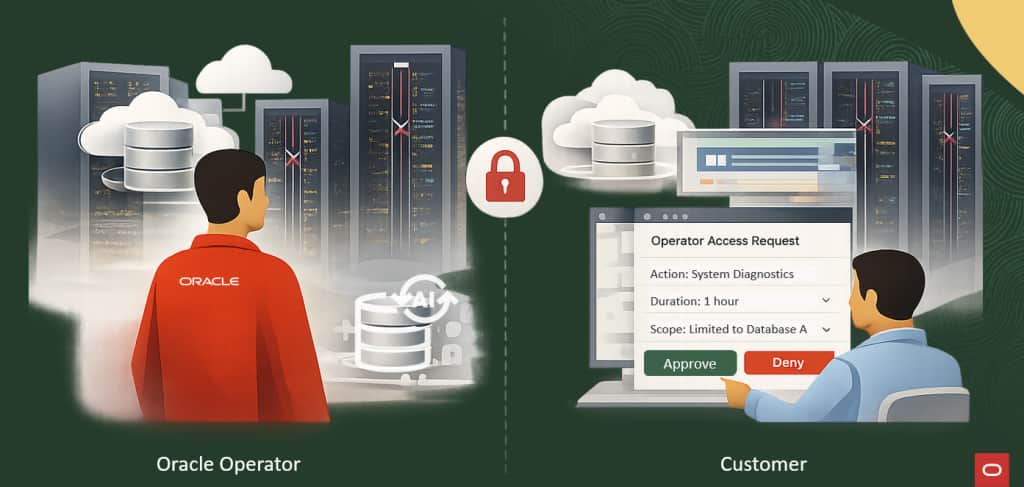
Autonomous AI Database enforces strict separation of duties, where customers retain control over database schemas and data, while Oracle access is limited to infrastructure and platform operations. Even when operator access is approved, customer data remains inaccessible. Oracle Database Vault Operations Control is enabled by default to prevent Oracle operator accounts from accessing customer database data, helping to ensure that operator activities cannot expose or retrieve customer information.
Fine-Grained Privilege Management for Autonomous Environments
A core principle of Operator Access Control is least privilege. Oracle operators request only the minimum level of access required to complete a task. Access is structured around clearly defined actions, providing consistency and enforceable boundaries.
Operator Access Control defines standardized action types that determine the level of access granted within an Autonomous VM Cluster environment. This is realized through three tiered action levels.
- System Diagnostics: Read-only access for log review and initial problem diagnosis, enabling troubleshooting and analysis with controlled, limited scope.
- System Maintenance: Extends access to allow service-related actions such as starting and stopping services, running health checks, and executing limited management commands without privileged user access.
- Full System Access: Provides comprehensive access and is used only when necessary to resolve issues that cannot be addressed through more restrictive access levels.
These predefined actions enable access requests that are consistent, transparent, and aligned with the principle of least privilege.
Customers can further limit access to specific Autonomous Container Databases within a cluster. This allows operator activity that is restricted to only the resources required for the task, reducing exposure and aligning with strict data isolation requirements. Full system access is reserved as a last resort and is requested only when lower levels of access cannot resolve the issue. This layered approach reduces operational risk while maintaining flexibility for complex scenarios.
Preventive and Detective Controls Working Together
Operator Access Control combines preventive and detective controls into a unified framework designed for regulated environments.
Preventive controls do not allow operator access without explicit customer approval. Access is time-bound, scoped to a defined purpose, and enforced through platform-level mechanisms that restrict activity to the approved actions.
Detective controls provide full visibility into operator activity. Every request, approval, and action is logged and auditable, creating a complete record for compliance and forensic analysis.
Customers can also forward Operator Access Control audit logs directly to their Security Information and Event Management (SIEM) systems in their data center. This enables centralized monitoring and correlation with other security events across the enterprise.
Key Benefits for Autonomous AI Database Customers
For organizations running Autonomous AI Database on Dedicated Infrastructure, Operator Access Control delivers measurable value.
- Provides clear visibility and control over Oracle operator access, enabling alignment with enterprise security policies.
- Supports compliance by delivering built-in capabilities for privileged access management, auditability, and separation of duties.
- Helps reduce risk by eliminating standing access and enforcing least privilege through time-bound, purpose-driven requests.
- Increases transparency, allowing customers to understand when and why access occurs and what actions are taken.
Enabling Confidence in a Managed Cloud Model
Operator Access Control is a foundational capability for organizations that must meet strict regulatory and security requirements while adopting cloud technologies.
By embedding access governance directly into the Autonomous AI Database platform, Oracle enables customers to benefit from a fully managed service without compromising on control, visibility, or accountability. Operator Access Control supports Autonomous AI Database on Dedicated deployments across public cloud environments, including AWS, Azure, and OCI, as well as Exadata Cloud@Customer.
For organizations evaluating Autonomous AI Database for sensitive workloads, Operator Access Control provides the assurance that access to their environments is governed, transparent, and aligned with regulatory expectations.