
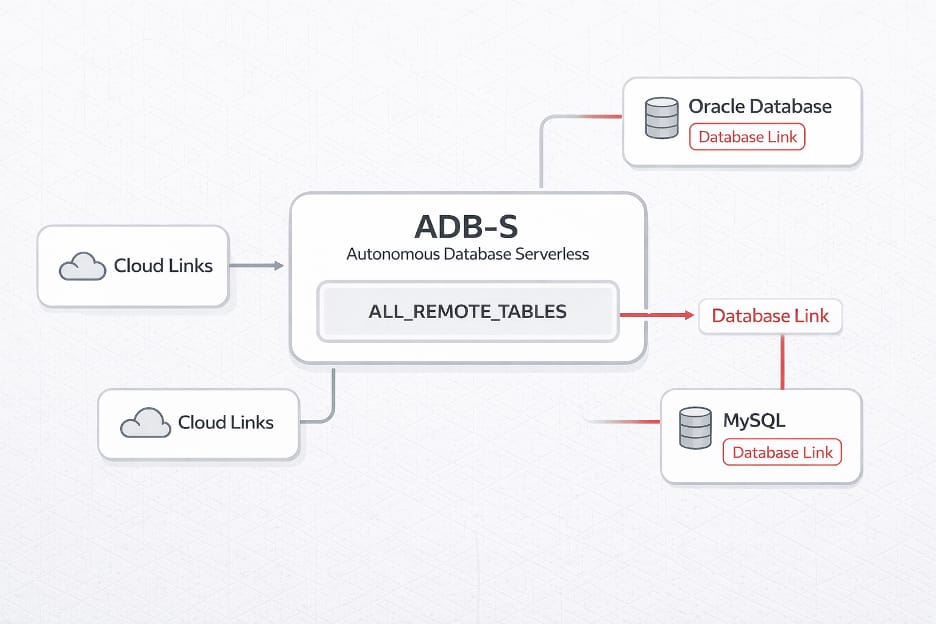
Modern data environments are rarely simple. A team may have data spread across Oracle databases, non-Oracle systems, Cloud Links, and cataloged remote assets. Even when the data is technically accessible, discovering what is available to query can still be frustrating. Users often need to know which link to check, which schema to inspect, or which remote source might expose the table they need. That creates unnecessary friction before analysis even begins.
One Place to Discover Remote Data
This is where ALL_REMOTE_TABLES helps. Oracle Autonomous Database Serverless introduces this new dictionary view to give users a centralized way to discover remote tables they can access through Database Links (Oracle and non-Oracle systems) and Cloud Links. Instead of hunting across multiple remote connections, users can query a single view and quickly understand what remote data is available to them.
ALL_REMOTE_TABLES has a column named DB$NAME. It shows the name of the DB Link (if the remote object access is through a DB Link), or the string “CLOUD$LINK” (if the remote object access is through a Cloud Link
SELECT owner, table_name, DB$NAME

FROM all_remote_tables

FETCH FIRST 10 ROWS ONLY;
The runtime behavior is straightforward and predictable. ALL_REMOTE_TABLES always goes directly to the remote source to retrieve metadata. If one remote source is unavailable, Autonomous Database simply skips that source and continues processing the remaining ones. This makes the view practical in environments where not every remote endpoint is always online.
Security and visibility are builtin by design. At a minimum, a querying user must have READ privilege on ALL_REMOTE_TABLES. The ADMIN user has this privilege by default and can grant it to other users.
In terms of coverage, ALL_REMOTE_TABLES includes tables and the namespace/name of Cloud Links. If you want to discover remote views, Oracle provides a separate dictionary view: ALL_REMOTE_VIEWS.
Conclusion
The value of ALL_REMOTE_TABLES is simple but important. It reduces the effort required to discover remote data, gives users a single place to look, and makes distributed data access easier to understand and use. In a world where data is increasingly spread across systems and clouds, even small improvements in discoverability can make day-to-day work much smoother.
To learn more – check the documentation