
Oracle Fusion AI Data Platform, is a family of prebuilt, cloud-native analytics applications for Oracle Fusion Cloud Applications that provide ready-to-use insights to help improve decision-making. It’s extensible and customizable, allowing customers to ingest data and expand the base semantic model with additional content.
The Oracle Fusion AI Data Platform data pipeline provides a powerful framework with advanced features designed to streamline and optimize data workflows. By harnessing its capabilities, you can boost operational efficiency, gain precise completion estimates, and expedite the availability of critical data for informed decision-making.
Tailored to meet diverse business needs, the Oracle Fusion AI Data Platform data pipeline allows you to combine these features strategically, delivering a customized and highly optimized experience for your organization.
Review the list below to discover how different combinations of these powerful features can unlock maximum value for your business. By strategically leveraging these capabilities, you can tailor solutions to meet your unique requirements, boost operational efficiency, enhance data-driven decision-making, and achieve optimal outcomes.
This is part one of a two-part blog article series. This article (part one) examines some of the features available for achieving full potential of the Oracle Fusion AI Data Platform pipeline in detail. The second article in the series (part two) explores practical scenarios that demonstrate how these features can be applied to address real-world business challenges.
Let’s review some of the main features/practices you can tap into today:
- Use of Prioritized Datasets
- Periodic review of Initial Extract Date
- Use of Frequent Data Refresh (FDR)
- Use of Pipeline Event Notifications
- Strategize any ad-hoc data extraction from source Oracle Fusion Application pods
- Periodic assessment of functional area activations
- Workload distribution through a secondary production instance
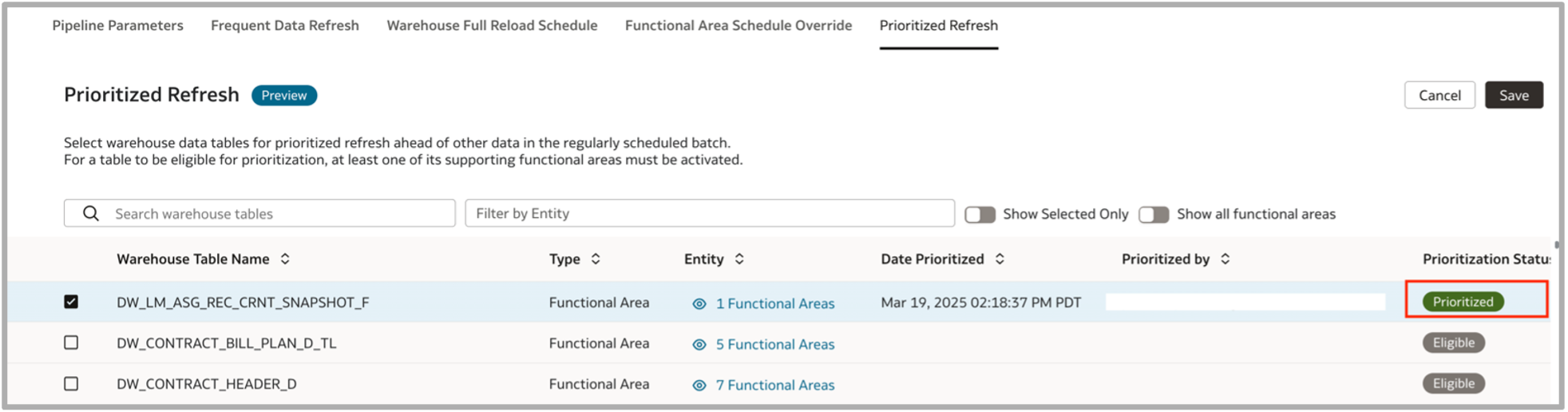
Prioritized Dataset feature
The Prioritized Dataset feature in Oracle Fusion AI Data Platform empowers users to configure specific datasets for expedited refresh during scheduled daily cycles. This ensures that critical data is refreshed and made available for analysis ahead of other datasets, supporting time-sensitive decision-making and enhancing operational efficiency.
Key benefits
- Optimized resource utilization
- Accelerated access to critical data
For more information on enabling the Prioritized Dataset feature, see the documentation.
Periodic Review of Initial Extract Date
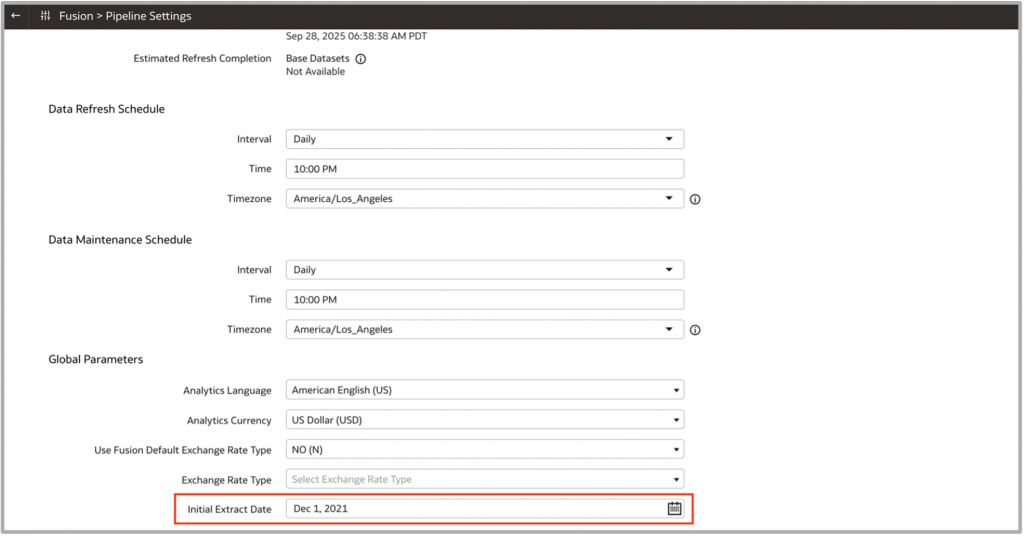
It’s important to review the Initial Extract Date periodically and follow a well-defined plan for updating it. Over time, if the Initial Extract Date is set too far back, the system may attempt to pull unnecessarily large volumes of historical data during extractions. This can increase processing time, put additional load on Oracle Fusion AI Data Platform pipelines, and impact overall performance.
Oracle recommends that you limit the Initial Extract Date to no more than two years. This strikes the right balance between retaining sufficient history for reporting and analytics, while ensuring extraction windows remain efficient and manageable.
By proactively managing and updating the Initial Extract Date you:
- Avoid excessive data pulls and resource strain
- Improve the stability and performance of extraction pipelines
- Ensure data sets remain accurate, relevant, and aligned with business needs
Key benefits
- Avoids redundant loads
- Improves pipeline performance
- Operational efficiency
Frequent data refresh (FDR)
You can select functional areas, data tables linked to them, descriptive flexfield custom configurations, and data augmentations to refresh at a specified frequency.
Considerations – Tables refreshed with FDR
- For selected functional areas, some of the tables aren’t made available for FDR due to various dependencies.
- Some tables don’t need to be refreshed every hour, for example, dimensions or snapshots that don’t change in a 24-hour period.
- Pick only modules or tables that are absolutely needed to be refreshed frequently.
Key benefits
- Timely access to critical data
- Enhanced decision-making
- Improved operational efficiency
- Competitive advantage
By leveraging frequent data refreshes, organizations can create a more agile, data-driven culture while optimizing processes to meet their specific operational and strategic goals.
Enabling frequent data refreshes
For more information, see the documentation.
Pipeline Event notifications
Oracle Fusion AI Data Platform Pipeline notifications are designed to support a wide range of events, providing you with valuable insights and alerts tailored to your needs. Whether you’re seeking advanced notifications about pipeline completion times or immediate alerts, once a pipeline is successfully processed, these notifications empower you to stay informed and proactive.
Take a moment to explore the comprehensive and regularly updated list of supported events in the Oracle Cloud Infrastructure OCI documentation to ensure you’re leveraging the full potential of these features. Enable all events relevant to your implementation to enhance monitoring, streamline operations, and maximize the efficiency of your workflows.
Enabling these events provides you with key insights to monitor pipeline performance and maintain operational efficiency.
Key benefits
- Proactive planning
- Streamlined operations
- Improved oversight
Explore the Supported events list today and enable the features that best align with your implementation needs to unlock the full value of Oracle Fusion AI Data Platform pipeline notifications.
Enabling Oracle Cloud Infrastructure notifications
For more information, see the documentation and blog article.
Timing of stand-alone data extraction from Oracle Fusion Application
If you’re extracting data directly from an Oracle Fusion Application, it’s critical to ensure that the extraction timing does not overlap with the Oracle Fusion AI Data Platform Incremental start times configured for both Daily Refresh and Frequent Data jobs.
Overlapping with Oracle Fusion AI Data Platform pipelines can
- Derail Oracle Fusion AI Data Platform pipeline performance
Key benefits
- Optimized Oracle Fusion AI Data Platform performance
- Reliable data refresh
- System stability
Periodic Assessment of Functional Area activations
The range of Oracle Fusion AI Data Platform functional offerings continues to grow with each new release, and not every module will be relevant to your unique business requirements. We have observed instances where modules are activated in production environments without a clear strategy for their use.
Enabling additional modules increases incremental load times and may affect overall system performance. To maintain an efficient environment, it’s important to periodically review your active functional modules and limit activation to only those that are essential.
Key benefits
- Improved refresh performance
- Simplified maintenance
- Reduced resource consumption
After the initial rollout, administrators should regularly use usage tracking tools to review module utilization. Establishing an ongoing process to deactivate or remove unused modules will further support your organization’s long-term efficiency and security goals.
Workload distribution through a secondary production instance
The scope of Oracle Fusion AI Data Platform functional offerings is continuously expanding, and with that growth, new business requirements and use cases are emerging. In some situations, it may be advantageous to maintain a secondary production instance to address specialized needs that cannot be fully optimized in the primary instance.
Scenarios where a secondary instance can be beneficial
- Targeted functional coverage
Certain business use cases may only require a smaller subset of Oracle Fusion AI Data Platform modules. Isolating these into a secondary instance ensures focused processing without impacting broader enterprise workloads.
- Global workforce with varying refresh requirements
Different geographies or business units may request daily refreshes at different frequencies. A secondary instance allows you to tailor refresh schedules to regional or functional requirements without creating conflicts.
- High-frequency or tme-sensitive data
Some datasets may need to be refreshed more frequently or within shorter intervals than standard refresh cycles allow. A secondary instance can be dedicated to these workloads, ensuring timeliness while reducing strain on the primary pipeline.
- Data extraction versus refresh conflicts
At times, business reporting or downstream extractions require data availability at specific times, which may clash with standard refresh schedules. A secondary instance provides flexibility to align extraction windows without disrupting refresh stability in the main instance.
Key benefits
- Improved workload distribution and performance stability
- Reduced contention between global and regional requirements
- Greater flexibility for business-critical or time-sensitive reporting
- Enhanced resilience by isolating specialized or high-frequency jobs
In Summary
By strategically leveraging the powerful features of the Oracle Fusion AI Data Platform data pipeline, businesses can significantly enhance efficiency, improve decision-making, and optimize outcomes. Whether it’s prioritizing critical datasets, scheduling frequent refreshes, enabling pipeline notifications, or utilizing a secondary instance for workload distribution, these capabilities ensure that your organization remains agile, data-driven, and prepared to meet evolving challenges.
It’s important to note that each approach isn’t mutually exclusive. In fact, Oracle recommends combining multiple practices and optimizations to achieve the desired pipeline performance and resiliency.
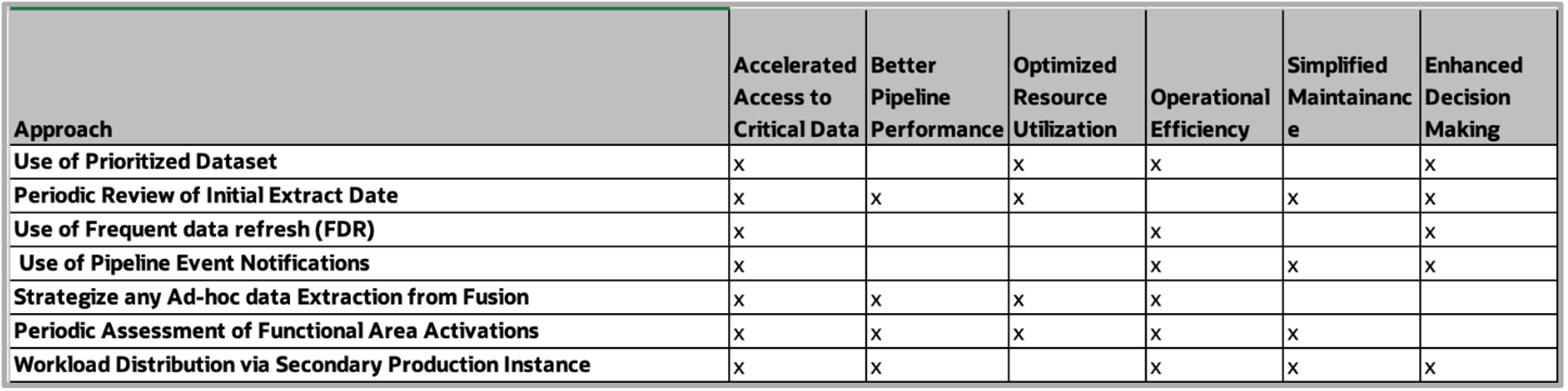
A tailored mix of these approaches—aligned with business priorities—delivers the strongest results.
Call to Action
We want your feedback! If you have a suggestion or discover an issue while working with through these, connect with your Center of Excellence counterpart to let them know. We’ll make every effort to incorporate your request. Look for our posts in the Oracle Analytics Community, where you can also ask questions and share your comments