
Churn prediction is valuable only when teams can turn its output into timely retention action. In many e-commerce environments, churn scores, customer behavior, and campaign data are held in separate systems. Connecting them often requires a combination of data science and analytics expertise.
In this blog, you will learn how Oracle AI Data Platform, combines MLOps and AI agents to create a governed churn insight system. The workflow enables teams to:
- Track and evaluate churn-model experiments
- Register and reuse an approved model version
- Generate governed churn predictions through batch inference
- Combine prediction data with customer and campaign context
- Use an AI agent to generate insights and retention recommendations
Oracle AI Data Platform brings these capabilities together through a governed data foundation, MLOps, and AI agents. It turns churn prediction into an accessible business workflow, helping campaign managers explore at-risk customers, understand the signals behind risk, and identify retention actions without requiring machine learning or analytics expertise.
The result is more than a list of customers with a high churn score. It is a practical way to understand which segments are at risk, what behavior is associated with that risk, and which retention actions may be worth exploring.
A churn score is only the beginning
A churn model can identify customers who are likely to leave, but a score alone is not a business decision.
When a campaign manager sees a high-risk customer segment, the next questions are usually more important:
- Which segments are driving the increase in risk?
- Are customers purchasing less often, disengaging from campaigns, or changing product preferences?
- Which regions, acquisition channels, or cohorts are most affected?
- Did the latest retention campaign improve outcomes?
- What intervention should be tested for each segment?
Answering these questions often requires a sequence of requests across teams. A data scientist may validate the current model and generate predictions. An analyst may combine those predictions with customer and campaign data. The campaign manager then interprets the result and develops an action plan.
This is not a lack-of-talent problem. It is a connection problem. Predictive models, analytics, campaign tools, and day-to-day business decisions often sit in separate systems and are managed by separate specialists.
MLOps and AI agents address different parts of this challenge. Together, they help close the gap between a model output and an actionable retention decision.
MLOps makes churn predictions dependable
Churn predictions support important decisions only when people trust them. That trust depends on answers to basic questions: Which model produced this score? Was it the approved version? Which experiment and data informed it? Can the result be reproduced and audited?
MLOps provides the foundation for those answers.
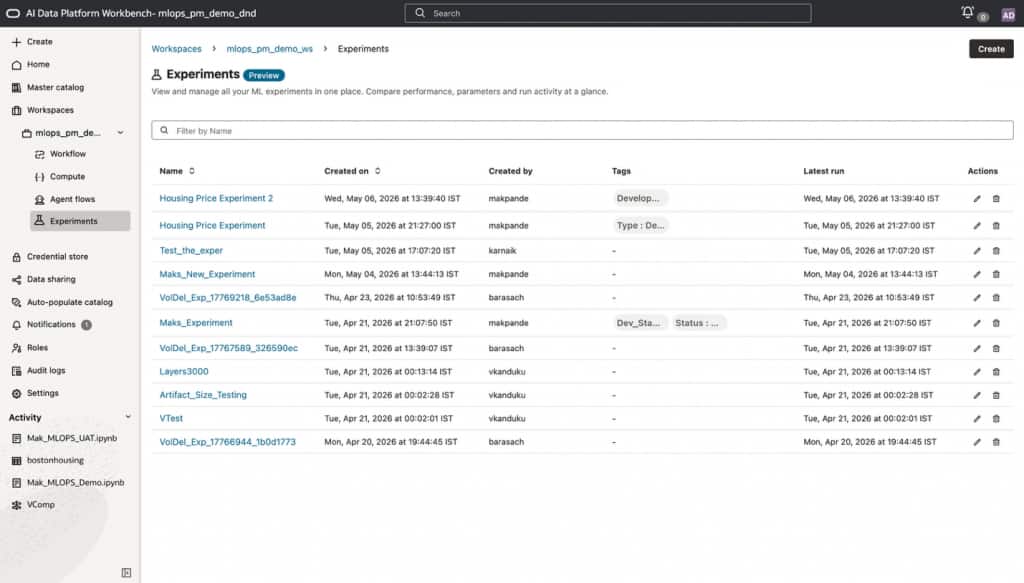
Experiments Page – See all your active experiments or create new ones
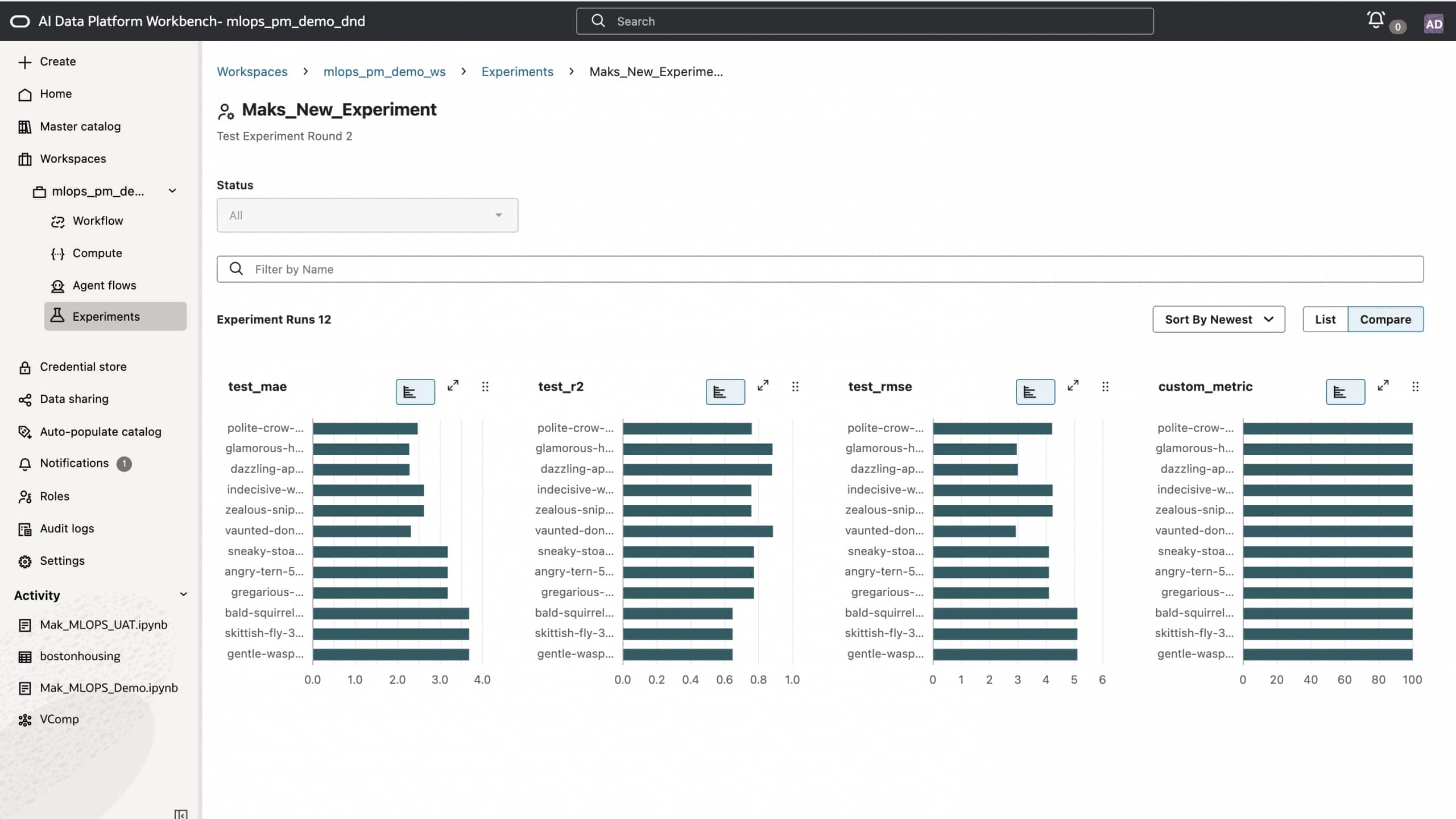
Experiment Details Page – See details of a selected experiment
Model Page – See details of a model that was distilled from an experiment
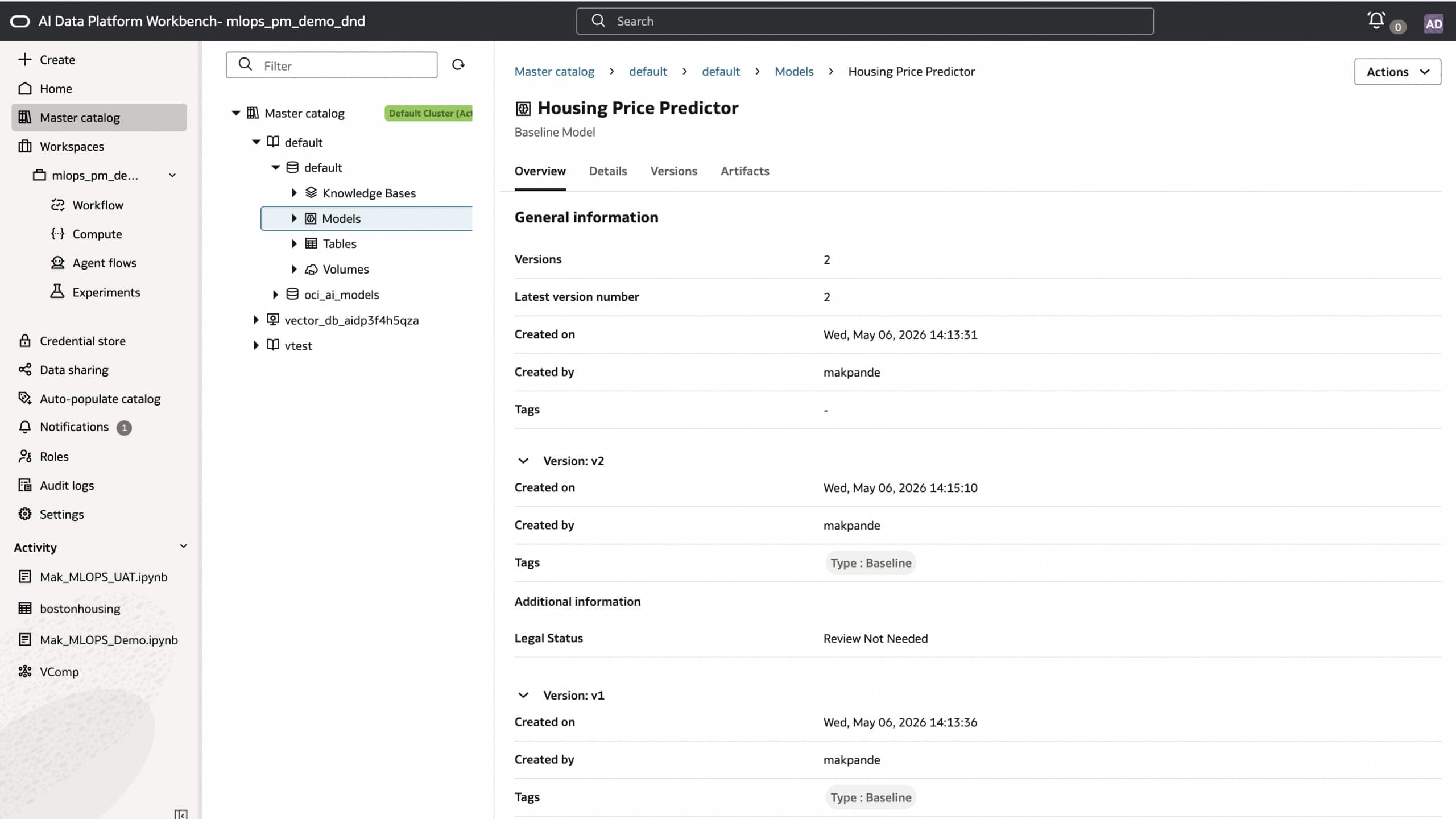
Within AI Data Platform, teams can track model experiments, compare runs, and register the selected model in a centralized model registry. The winning model becomes a governed, versioned asset rather than a file stored in an individual notebook or workspace.
This changes how the model is used across the organization. Instead of asking a data scientist to find the latest artifact or rerun a notebook, teams can use the approved model version for batch inference. Experiment history and lineage connect a prediction to the runs, parameters, and artifacts that produced it.
For churn, this means campaign decisions are less likely to be based on an old spreadsheet or an unclear model export. Fresh predictions can be generated consistently from the current approved model and made available alongside the latest customer and campaign data.
MLOps is the predictive engine of the experience. It helps ensure that when the business asks, “Which customers are likely to churn?” the response is governed, repeatable, and grounded in the best current model.
But a trusted prediction is still only part of the answer. Campaign managers also need the context that turns risk into action.
AI agents make prediction data easier to use
AI agents offer a more natural way to work with predictive outputs and enterprise data.
An agent can use governed tools, including SQL queries, knowledge retrieval, prompts, and custom logic, to answer business questions in plain language. Instead of moving among dashboards or waiting for a bespoke report, a campaign manager can ask:
“What changed in churn risk this month?”
The agent can investigate current churn predictions, compare them with historical trends, examine customer behavior and campaign performance, and provide an explanation in business language.
For example, it may find that churn risk is rising among recently acquired customers who made an initial purchase in a particular category, have not returned within 30 days, and showed limited engagement with a recent promotion. It can compare that segment with the prior month, identify where it is concentrated, and help suggest a retention experiment.
The agent does not replace the churn model. It makes the model’s output more useful by connecting it to relevant business context.
A model predicts what may happen. An agent helps teams explore the surrounding questions:
- What appears to be driving risk?
- Which customers should be prioritized?
- Which segments are changing fastest?
- What worked for comparable customers in the past?
- What action should the team test next?
The predictive model identifies risk at scale. The agent helps make that risk understandable and actionable.
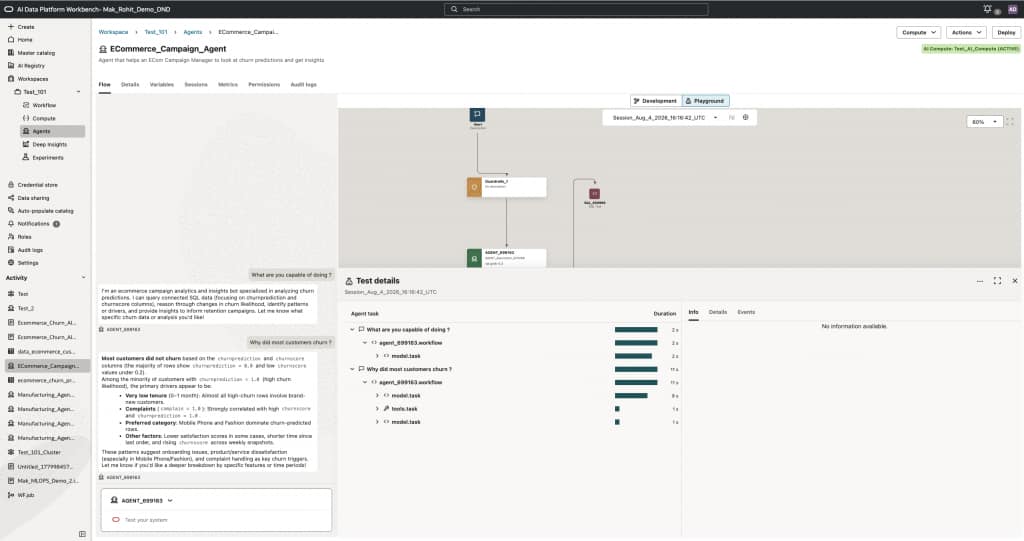
Agent Playground Page – Interact directly with the agent created for testing
See the churn insight system in action
The following demo shows how the pieces work together. An ecommerce churn model is managed through MLOps, the approved version generates predictions, and an AI agent combines those predictions with customer, campaign, and business context.
Rather than requiring a campaign manager to interpret raw model outputs or wait for a specialist-built report, the agent helps translate churn risk into practical insight. It can help identify who is at risk, what behaviors may be contributing, how segments have changed, and where a retention campaign may have the greatest impact.
Watch the demo: Churn Prediction with MLOps + Agents (Video on Oracle Community Page)
The demo captures the central idea: MLOps makes churn predictions trusted and repeatable, while the agent makes those predictions easier to explore in the flow of decision-making.
Bringing the workflow together
The greatest value comes from connecting the entire workflow on a unified foundation.
Ecommerce data is prepared for analytics and machine learning. Data scientists build churn models, track experiments, validate results, and register the best-performing model. Batch inference then uses the approved version to produce current churn probabilities.
Those predictions can sit beside customer, order, product, engagement, and campaign data. Through AI Data Platform, the agent can access the appropriate governed data and tools to investigate business questions across these sources.
Instead of treating churn predictions as the final report from a technical team, organizations can use them as a living source of insight. Campaign managers can explore current risk, historical performance, and customer context conversationally. They do not need to understand model-training frameworks or write analytical queries before asking useful questions.
Governance remains central. The agent should work with approved data, governed model outputs, and controlled tools. Access permissions, model lineage, and visibility into agent interactions help make the experience accessible without weakening enterprise controls.
A practical retention workflow
Consider a weekly retention planning meeting. The churn model has generated fresh predictions using the approved version from the registry.
A campaign manager asks:
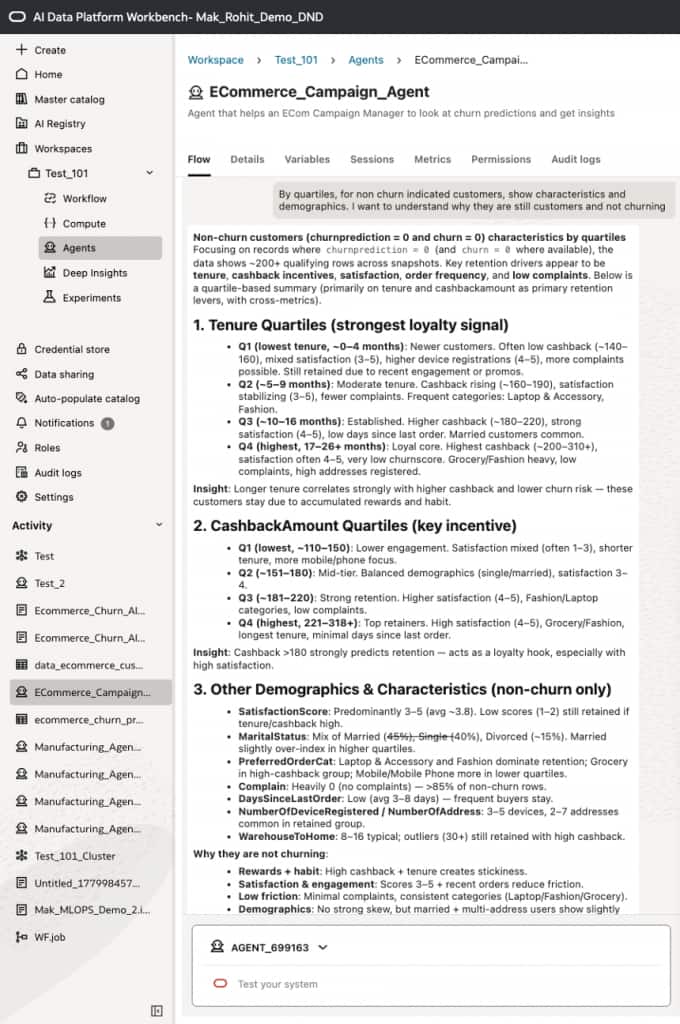
“Which high-value customer segments have the highest churn risk this week, and what changed since last month?”
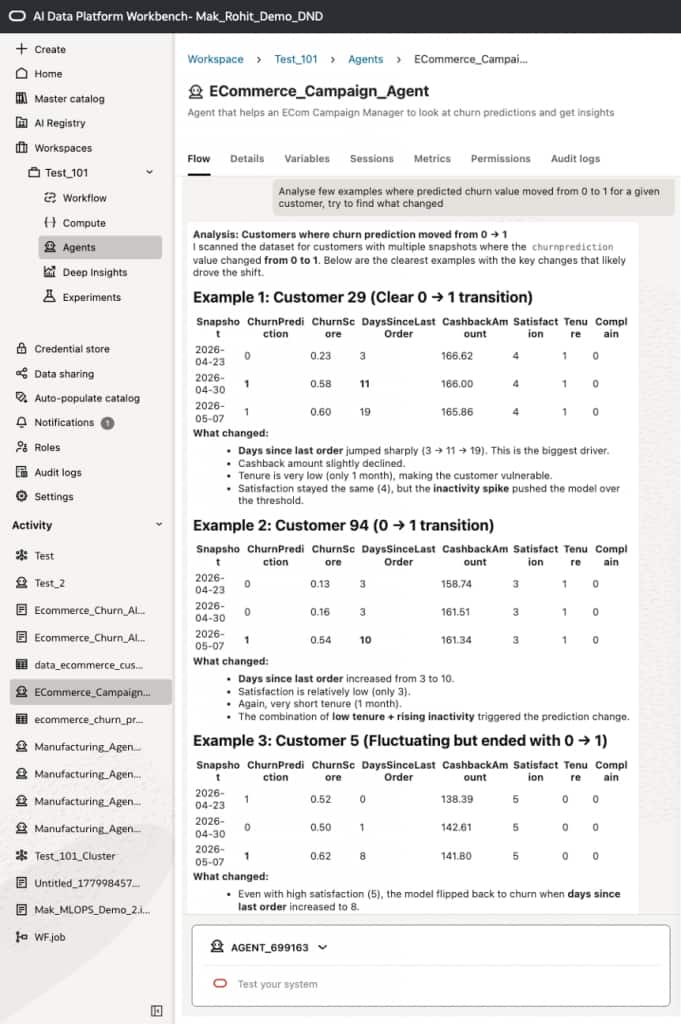
The agent can identify high-risk segments, join predictions with lifetime value and order history, compare them with the previous month, and review campaign exposure and historic results. It can then summarize the likely drivers and suggest candidate actions.
The campaign manager may follow up:
“Show me high-risk customers above our lifetime-value threshold who have not received an offer in the last 45 days.”
The agent can translate that request into a governed query and return a campaign-ready audience.
The next question might be:
“Which retention offer performed best for a similar segment last quarter?”
Now predicted risk is connected with actual campaign outcomes. The result is a faster path from inference to insight to action.
Agent Playground Page – Ask complex questions to the ecommerce insights agent
Democratizing insight, not replacing expertise
This approach does not eliminate the need for data scientists, analysts, or campaign strategists. Each remains essential.
Data scientists design, evaluate, and improve models. Analysts establish trusted metrics and investigate complex questions. Campaign managers apply judgment, customer understanding, and creative strategy.
What changes is the amount of routine translation work between these groups. MLOps helps data science teams operationalize trusted models. AI agents make model outputs and enterprise data easier to explore. Campaign managers gain more independence for common questions, while specialists can focus on deeper analysis and higher-value work.
The organization moves faster not because everyone becomes an expert in everything, but because expert capabilities are closer to the point of decision.
From reactive retention to continuous learning
Churn prevention is often reactive. A team identifies a retention decline, requests analysis, develops a campaign, and acts after the pattern has become costly.
A combined MLOps and agentic approach supports a more continuous model. As new data arrives, teams can refresh predictions, compare risk patterns, assess campaign outcomes, and ask new questions in context. The feedback loop between customer behavior, prediction, intervention, and outcome becomes tighter.
That is the opportunity for ecommerce teams: less time moving information across silos and more time designing relevant customer experiences.
The most valuable churn insight is not a number hidden in a dashboard. It is a clear, trusted answer that helps a team decide what to do next .
For more information:
- Blog: Your Data Already Knows the Answer. Now It Can Act on It.
- Blog: Why enterprise AI needs deep business semantics
- See a demo of how Oracle AI Data Platform predicts customer churn