
Oracle AI Data Platform is where teams govern enterprise data and turn it into AI-ready products. The value of that work depends on how current the underlying data is. A model trained on last week’s inventory snapshot only goes so far, and a dashboard reading from yesterday’s order table tells an incomplete story.
To keep the platform in sync with operational systems, AI Data Platform users can bring in OCI GoldenGate. Using change data capture (CDC), GoldenGate streams committed inserts, updates, and deletes from source systems into AI Data Platform catalogs and schemas as they happen. Replicated tables stay current with their sources, and teams build their bronze, silver, and gold layers on data that reflects the live state of the business.
This article explains when to use OCI GoldenGate to bring operational changes into Oracle AI Data Platform. For setup details, consult the Oracle documentation and the companion step-by-step blog linked in the reference section.
Why CDC matters for Oracle AI Data Platform users
Most AI and analytics pipelines still run on scheduled ingestion. That works well enough for historical reporting. It falls short whenever a workload needs current operational context, such as fraud scoring against today’s transactions, an agent answering questions about live inventory, or a dashboard tracking service incidents as they open.
AI Data Platform users can close that gap with CDC. GoldenGate captures committed changes at the source, and the platform receives them continuously rather than on a batch schedule. The replicated data lands as a governed asset alongside everything else in the catalog, ready to be curated into silver and gold products. Source systems carry less query load, and downstream consumers in the platform work from data that reflects the current state of the business.
Choosing between CDC and an external catalog
Oracle AI Data Platform users can connect to external sources directly through external catalogs when they need governed access to data that remains in the source system. That is often the simplest pattern for exploration, federation, and cases where the source database is the right query engine.
CDC with OCI GoldenGate is the better fit when the goal is to keep Oracle AI Data Platform itself current with operational changes. In this pattern, GoldenGate captures committed changes from the source database and applies them into an Oracle AI Data Platform catalog and schema. This reduces live query dependency on the source system, gives teams a source-aligned landing layer inside the platform, and creates a better foundation for curated bronze, silver, and gold data products used by notebooks, analytics, and AI applications.
Reference architecture: from operational change to governed data asset
The core pattern uses OCI GoldenGate to capture committed changes from a source database and replicate them into an Oracle AI Data Platform catalog and schema. A GoldenGate Database deployment connects to the source system, runs the Extract, and captures table changes into trail files. A GoldenGate Big Data deployment receives those trail files, uses OCI Object Storage for staging and supporting artifacts, and runs the Replicat that applies the changes into Oracle AI Data Platform.
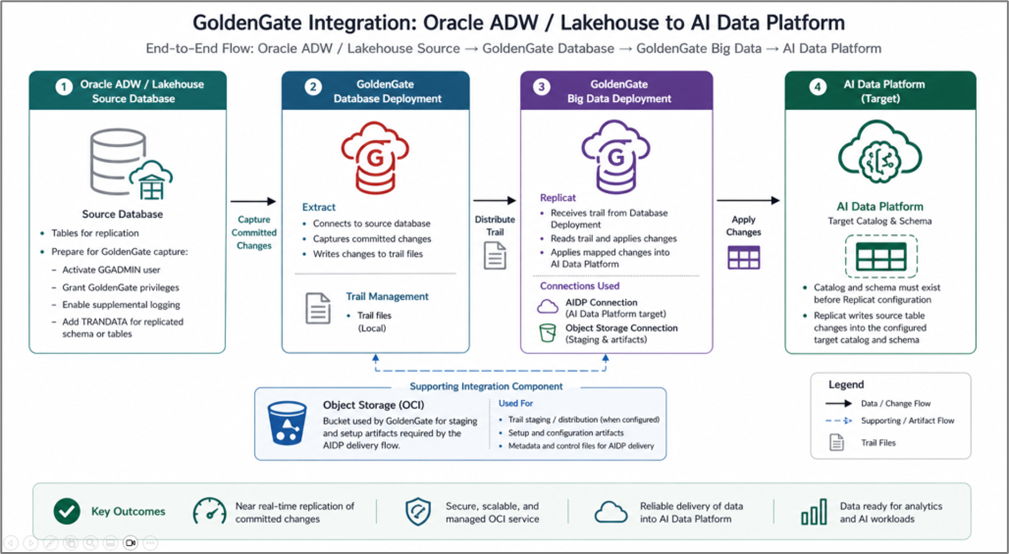
Figure 1. Reference architecture for replicating operational changes into Oracle AI Data Platform with OCI GoldenGate.
This creates a source-aligned landing area in Oracle AI Data Platform. From there, teams can govern, transform, and reuse replicated operational data across the notebooks, pipelines, and AI agents teams build in the platform.
Recommended medallion pattern in Oracle AI Data Platform
Do not treat replicated tables as the final business layer by default. A better pattern is to land GoldenGate-delivered data in a source-aligned bronze area, then use Oracle AI Data Platform to curate, govern, and publish data products for broader consumption.
- Bronze: Land source-aligned replicated tables from GoldenGate, preserving source names and structures for traceability.
- Silver: Create cleaned, standardized, and conformed datasets by applying quality checks, standardizing identifiers, joining related data, and encoding reusable business rules.
- Gold: Publish business-ready data products for dashboards, notebooks, machine learning, AI agents, reporting, and decisions.
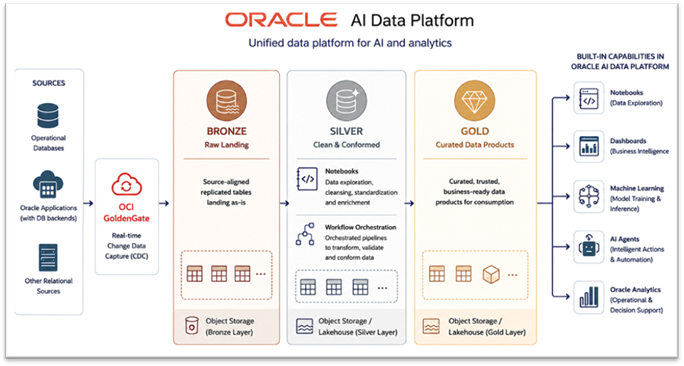
Figure 2. Medallion architecture
This keeps the replication layer simple and gives data consumers a cleaner experience. GoldenGate keeps source-aligned operational data current, while Oracle AI Data Platform provides the governed environment for transforming that data into trusted, AI-ready data products. For more information, see Governed Data Products with Bronze, Silver, and Gold Layers in the references section.
Design practices for production use
Start with the data product, not the replication scope. Before deciding which schemas to replicate into the platform, identify which AI Data Platform use cases actually need fresher operational data. Most production deployments do not need every source table replicated, and treating CDC as a blanket sync strategy creates governance and cost problems in the platform later.
Let GoldenGate keep the bronze layer current and let AI Data Platform do the curation. Silver and gold layers are where business meaning, quality checks, joins, access rules, and reusable definitions belong, rather than the replication layer.
Keep CDC artifacts out of the user’s way. GoldenGate may create technical objects that are useful for replication but distracting for analysts and data scientists working in the platform. Isolate them through catalog organization, permissions, naming conventions, or filters.
Calibrate freshness to the workload. A fraud model running in AI Data Platform might need changes within minutes, while a weekly planning dashboard built on the same source might be fine with hourly refresh. Before scaling CDC, agree on ownership, the fields that matter most, how source schema changes will be handled, and which AI Data Platform products depend on each replicated table.
Conclusion
For AI Data Platform users, CDC is about meeting a freshness bar. It keeps the platform current enough that the agents, models, and analytics built on top of it can be trusted to reflect what is happening in the business right now. Start with the AI Data Platform workloads that need that freshness most, and let the replication scope follow from there.
References
Governed Data Product with Bronze, Silver, and Gold Layers
GoldenGate Big Data with Oracle AI Data Platform
Oracle AI Data Platform with Oracle GoldenGate Integration
Real-Time Data Replication to Oracle AI Data Platform Using OCI GoldenGate