
What if the EBS data that records business activity could also help teams identify risks earlier and determine what to do next? Oracle E-Business Suite already contains the transactions, business rules, and process knowledge needed to support that shift.
The challenge is helping AI use that context securely and within established controls. Standalone tools can summarize information, but they do not automatically understand how EBS data, applications, and processes work together.
Oracle’s agents for EBS offer a more direct path. Built on Oracle AI Data Platform and designed to be adapted to each customer’s EBS environment, they help organizations modernize how work gets done without replacing the customized processes they rely on.
EBS is ready for its next chapter
For many organizations, Oracle E-Business Suite (EBS) is more than a system of record. It runs core processes across finance, supply chain, procurement, and human resources, and contains years of trusted transactional history, business rules, and customizations that reflect how the organization operates.
That context gives organizations a strong foundation for practical AI. Agents can use EBS data and process knowledge to answer business questions, flag emerging issues, and support approved actions.
For finance teams, that could mean identifying close blockers across general ledger, accounts payable, and accounts receivable so they can address them earlier. For supply chain teams, it could mean detecting slow-moving inventory or prioritizing order and shipment exceptions.
The opportunity is not to replace EBS, but to modernize how work gets done while preserving the customized processes that run the business.
Where standalone AI tools fall short
General-purpose AI tools may require additional integration, semantic modeling, and security configuration before they can support EBS-specific processes.
A standalone AI tool can summarize a report or analyze copied data, but it only sees the information provided at that moment. It does not automatically understand how EBS applications and transactions relate, which business rules apply, what each user can access, or how a process should progress.
To support an end-to-end process, finance and IT teams may need to extract and combine data, recreate EBS relationships and semantics, reapply security controls, and maintain custom integrations. The result can be another disconnected tool working from incomplete or outdated information.
What it takes to deliver AI outcomes
Delivering AI outcomes takes more than a capable model. AI must understand what’s happening and why, use business context to determine what should happen next, and support actions within established controls.
That means understanding the process behind a question, respecting each user’s authorized access, and using approved APIs when a workflow calls for action. Teams also need to test and monitor agents and define when human review or confirmation is required based on their governance policies.
For example, a sales order agent could retrieve the relevant details, prepare a proposed order, request user confirmation, and initiate an approved EBS API workflow.
Meet EBS agents
EBS agents are pre-built, customizable AI agents designed around Oracle E-Business Suite data, business processes, and workflows. Each agent addresses a defined business problem using the relevant EBS data and application context. They give customers a starting point for AI to adapt to their specific EBS data, customizations, and business processes.
Customers may be able to reduce unnecessary movement of EBS data by using integrated Oracle services, depending on their selected architecture and configuration.
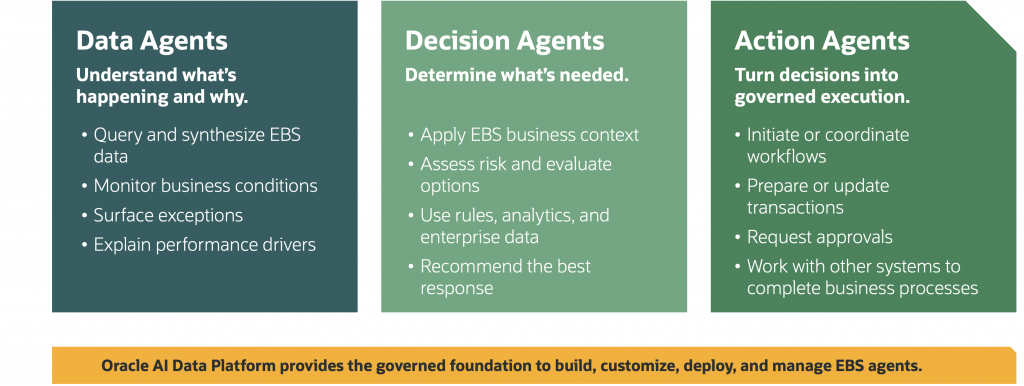
Agents support three levels of capability:
- Data Agents help users understand what is happening and why
- Decision Agents can predict outcomes, recommend options, and help determine what should happen next
- Action Agents can support or initiate configured workflows through approved application interfaces, with human confirmation based on organizational requirements.
The EBS agent portfolio spans finance, supply chain, procurement, human resources, and other business functions. Here are a few examples:
| Example agent | What it can help address | Relevant EBS applications |
| Close Monitoring Agent | Identify and prioritize general ledger and subledger issues that could delay close | General Ledger, Payables, Receivables, Subledger Accounting |
| Requisition Aging Agent | Find stalled requisitions and recommends next steps | Purchasing, iProcurement |
| Exception Resolution Agent | Prioritize order holds, pricing failures, reservation gaps, and scheduling blockers | Order Management, Advanced Pricing, Inventory, Shipping |
| Slow Moving Inventory Agent | Detect declining inventory movement and potential excess stock | Inventory |
How a close monitoring agent helps teams address close risks earlier
The Close Monitoring Agent supports month-end close across Oracle General Ledger, Payables, Receivables, and Subledger Accounting.
Across these applications, the agent finds unresolved general ledger and subledger issues, explains how they may affect the close, and keeps owners and recommended next steps visible. Finance teams receive a prioritized view of exceptions instead of manually combining reports, reconciliations, and status updates.
The agent can also support trial close analysis, helping controllers assess potential close outcomes while there is still time to address blockers. This gives finance teams earlier visibility without requiring another reporting application or recreating the EBS close process elsewhere.
Scale and govern agents with Oracle AI Data Platform
Built on Oracle AI Data Platform, EBS agents use EBS data and process context to help teams make decisions and take approved actions. Organizations can customize them for their EBS environment and extend them across Fusion Applications and third-party systems without starting from scratch on integration and controls for each new use case.
The platform gives teams one environment to test, deploy, monitor, and manage agents, including their data access, approved interfaces, and human confirmation requirements.
Build on the EBS foundation you already trust
EBS already contains the transactions, rules, and process knowledge that explain how the business operates. Pre-built agents then help teams understand operational conditions, make better decisions, and execute governed actions.
Built on Oracle AI Data Platform, they can be tailored to each EBS environment and extended across Fusion and other enterprise systems. That is the shift from legacy to legendary: helping teams identify risks earlier, make better decisions, and take coordinated action without replacing the customized EBS processes that run the business.
See how Oracle AI Data Platform turns enterprise context into action
Explore how Oracle AI Data Platform brings together trusted data, business context, and controls to help organizations move from AI experimentation to practical business outcomes.