
Updated November 2026
Oracle AI Data Platform (AIDP) helps organizations build AI solutions that understand how their business works. It connects enterprise data with shared business definitions, relationships, processes, and rules, and provides tools to build, deliver, and govern AI agents and applications. Data and AI specialists use the platform to develop solutions, while business users access approved capabilities through experiences such as Agent Hub.
Ask an agent why revenue fell last quarter. It can tell you how much it fell, but explaining why takes more context. If your company records revenue when products are delivered, orders placed in March but delivered in April would contribute to the next quarter’s revenue. The agent needs that policy and the order and delivery records to distinguish weaker demand from delayed deliveries.
AIDP could help bring those records and policies together as shared context, helping finance analysts investigate the decline and giving other agents and applications the same business understanding to work from.
Why business context matters for AI
Your applications already contain years of business knowledge: how orders are processed, which accounts belong to a customer, and when a transaction counts as revenue. Analytics models add calculations and reporting definitions, while policies and documents explain exceptions and approval requirements.
A retailer might have stock in its warehouse but none available for sale because it’s reserved for existing orders. An agent investigating falling sales needs to understand that distinction before recommending a price reduction or more promotion.
When building an agent, a developer can work with a business expert to establish those definitions. As more agents are built, repeating that work becomes harder to maintain. A reporting change could leave several agents working from outdated instructions.
Keeping that knowledge in a shared System of Context lets agents and applications reuse the same business definitions, relationships, processes, and rules, rather than relying on separate instructions for each agent.
That’s where AIDP comes in, helping organizations ground AI in enterprise data and shared business context.
Ground AI in enterprise data and business context
Before an agent can investigate why revenue changed, it needs relevant data in a form it can use. Data engineers may need to connect sales and finance systems, prepare transaction data, and make supporting documents available. AIDP’s lakehouse and data preparation capabilities support this work, while AIDP’s AI Data Catalog helps identify relevant sources and trace where data came from.
Once the data is prepared, an enterprise ontology can capture its business meaning. This shared model describes concepts such as customers, orders, and revenue, including how they relate and which processes and rules apply. Oracle plans to add AI-assisted capabilities in AIDP to help create the models from existing application knowledge, schemas, analytics models, and documents. Business experts will then review and refine the results.
The ontology gives agents a reference for which data to use, how to interpret it, and which business rules to apply, where supported. For the revenue question, this means applying the appropriate calculation and reporting period, then examining the factors behind the change.
Together, prepared data and shared business meaning provide a foundation developers can use across AI solutions.
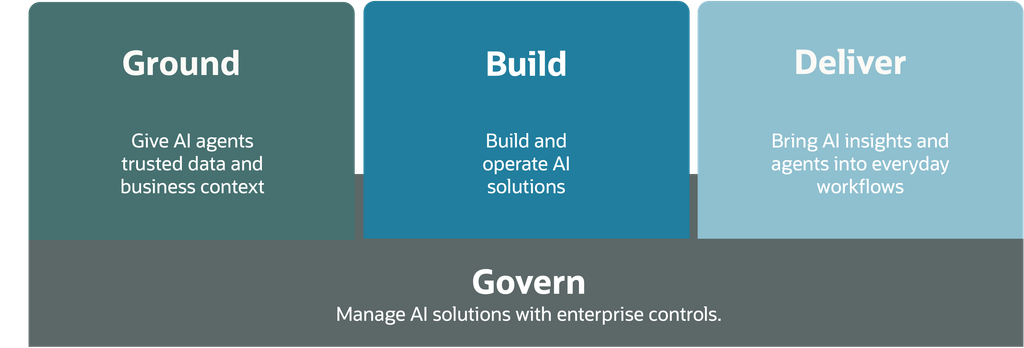
Build and operate AI solutions
With relevant data and business context in place, developers can focus on how the solution should work.
Developers can build agents visually in AI Data Platform Workbench or use code-based approaches, including AI coding tools such as Codex and Claude Code through supported integrations. Notebooks support data preparation and model development, while workflows coordinate repeatable tasks such as refreshing data or running an analysis on a schedule.
Organizations using Oracle E-Business Suite (EBS) can also start with prebuilt, extensible agents built on AIDP. These agents use EBS data and process context while leveraging applicable EBS security and governance controls. They can help address tasks such as identifying slow-moving inventory or prioritizing order exceptions.
Test and refine before deployment
Testing helps developers check how the pieces work together. Does the agent select the right tool, handle missing information, and provide useful evidence? An integrated testing environment and traces help developers inspect activity, diagnose problems, and refine the solution before deployment.
Bring AI into everyday work
A production planner assessing whether a shipment delay puts customer orders at risk needs a way to ask questions, examine the findings, and decide what to do next. Agent Hub provides a conversational experience for working with approved agents and tools, without requiring the planner to open a developer workspace or know how each agent was built.
Organizations can also make AI capabilities available through supported business applications, analytics, and assistants. This gives employees different ways to use approved capabilities within their existing work.
When available, Deep Insight Agents aim to use business context and approved analytical methods to reason through complex questions, identify contributing factors, compare forecasts and scenarios, and recommend next steps for business users to review.
For the revenue investigation, an analyst could ask which products or customer segments account for the decline. They can then examine the evidence and ask follow-up questions before deciding how to respond.
Govern AI with clear ownership and access controls
As developers build more agents, administrators need to understand what exists, who maintains it, and who can use it. That visibility also helps developers find approved capabilities they can reuse instead of building another agent or connection for the same task.
AI Registry provides a central place to register approved, compatible agents that support the Agent2Agent (A2A) protocol and MCP servers. Administrators can describe their capabilities and configure role-based access controls.
For the revenue investigation, an analyst might be authorized to view results for one business unit but not another. Permission to investigate a discrepancy also doesn’t automatically give an agent authority to change a transaction. Data access and permission to take action need to reflect those distinctions.
You define the policies, roles, and approval requirements. AIDP provides controls to help apply them, while administrators and business owners remain responsible for reviewing access and keeping those arrangements aligned with the work.
Who is AI Data Platform for?
AIDP supports data and AI specialists building solutions for their organization, alongside the business experts and employees who help shape and use them.
Data engineers can prepare data for analytics and AI, while data scientists and developers build ML models, agents, and AI-powered applications. Enterprise architects and business experts establish shared definitions and rules, and administrators manage access and platform resources.
For IT and AI leaders, the platform provides a way to connect these efforts across projects. Business users access the resulting agents and analysis through supported applications and experiences, helping them investigate questions and make informed decisions.
Get started with Oracle AI Data Platform
Start with a business problem you want to solve, whether that’s investigating revenue changes, reducing manual reconciliation work, or identifying supply risks. Then define what improvement would look like: less time spent explaining financial results, fewer manual reconciliation tasks, or earlier warning of shortages that threaten customer deliveries. Agree who owns the outcome, how you’ll measure success, and which data and business expertise you’ll need.
You can then choose how to build and operate the solution:
Use the platform with your own specialists and partners. Develop, deploy, and manage solutions using AIDP’s data, AI, and governance capabilities.
Have Oracle deliver and operate the solution. Oracle AI Data Platform Innovation Service combines the platform with engineering and managed operations. Oracle’s forward-deployed engineers work with your specialists to design, build, validate, deploy, and operate the agreed solution. Your organization retains authority over business definitions, policies, and approvals.
Both approaches build on the same platform, so the data, business context, and capabilities established for one solution can support additional use cases.
Explore what you can do with AI Data Platform
- Manage Enterprise AI Capabilities and Access with AI Registry
- Oracle AI Data Platform Agent Updates
- How AI Extends the Value of Oracle E-Business Suite
Future Product Disclaimer
The preceding is intended to outline our general product direction. It is intended for information purposes only, and may not be incorporated into any contract. It is not a commitment to deliver any material, code, or functionality, and should not be relied upon in making purchasing decisions. The development, release, timing, and pricing of any features or functionality described for Oracle’s products may change and remains at the sole discretion of Oracle Corporation.