
Oracle AI Data Platform helps organisations unlock the value of their data with a modern, AI-ready foundation. It unifies data storage, cataloging, ingestion, preparation, AI enrichment, AI Agent development, and analytics in one platform, enabling teams to transform raw enterprise data into actionable insight faster.
With AI Data Platform, users can create secure AI environments, manage access with RBAC, build rich catalogs, work with Spark-powered data pipelines, and publish business-ready datasets for analytics and AI consumption. You can also build AI agents directly in AI Data Platform over curated data sources, enabling conversational access across the data and AI lifecycle.
For many Fusion Data Intelligence(FDI) customers, enriching FDI with external enterprise data is essential for building enterprise analytics and AI use cases. In this article, we will show how AI Data Platform can be used to extend Fusion Data Intelligence with operational data, AI enrichment, and conversational intelligence to deliver account payable(AP) Invoice Intelligence.
Business Challenge
Fusion Data Intelligence provides a trusted, curated view of enterprise business data for analytics and reporting. However, many business scenarios also require operational context from additional enterprise systems to provide a more complete view for business users. For an Accounts Payable use case, finance teams often need to correlate invoice data with workflow events, approval SLAs, operational notes, and enterprise policies before making decisions. Bringing these different sources together helps create a richer operational intelligence experience.
Some of the common challenges include:
- Operational information is distributed across multiple enterprise systems.
- AP teams spend time reviewing workflow status and operational notes in addition to invoice data.
- Business users need a unified view of invoice facts, workflow risk, and recommended actions.
Solution Overview
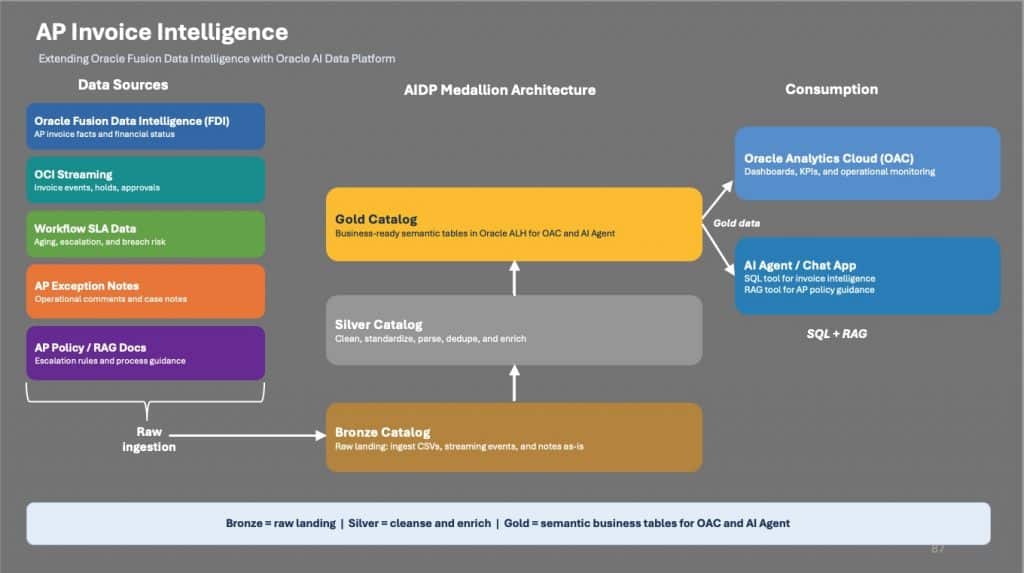
To address these challenges, we built an AP Invoice Intelligence solution using AI Data Platform and Fusion Data Intelligence. The solution extends FDI with operational workflow data, AP exception intelligence, AI-generated summaries, and enterprise policy guidance to provide a unified operational view of invoice processing.
AI Data Platform serves as the integration and AI layer, combining structured financial data from FDI with operational signals and unstructured business context. The resulting intelligence is exposed through Oracle Analytics Cloud(OAC) dashboards and an AI Agent that enables business users to interact with invoice data using natural language.
Implementation Approach
The solution was implemented using the following AI Data Platform capabilities:
- Integrate data from multiple sources:
- Fusion Data Intelligence (FDI) for AP invoice and financial data
- OCI Streaming for invoice workflow events
- Workflow SLA monitoring data
- AP exception notes
- Enterprise AP policy documents
- Connect Fusion Data Intelligence to AI Data Platform using the native AIDP connector
- Process data through the Medallion Architecture:
- Bronze Catalog: Raw operational data ingestion
- Silver Catalog: Data standardization and enrichment
- Gold Catalog: Business-ready semantic tables stored in Oracle Autonomous Database
- Apply Generative AI to summarize AP operational notes into concise business insights
- Build Oracle Analytics Cloud dashboards for operational monitoring and KPI tracking
- Create an AI Agent using SQL and RAG tools to provide conversational access to invoice intelligence and AP policy guidance
Establishing a Native Connection Between Fusion Data Intelligence and AI Data Platform
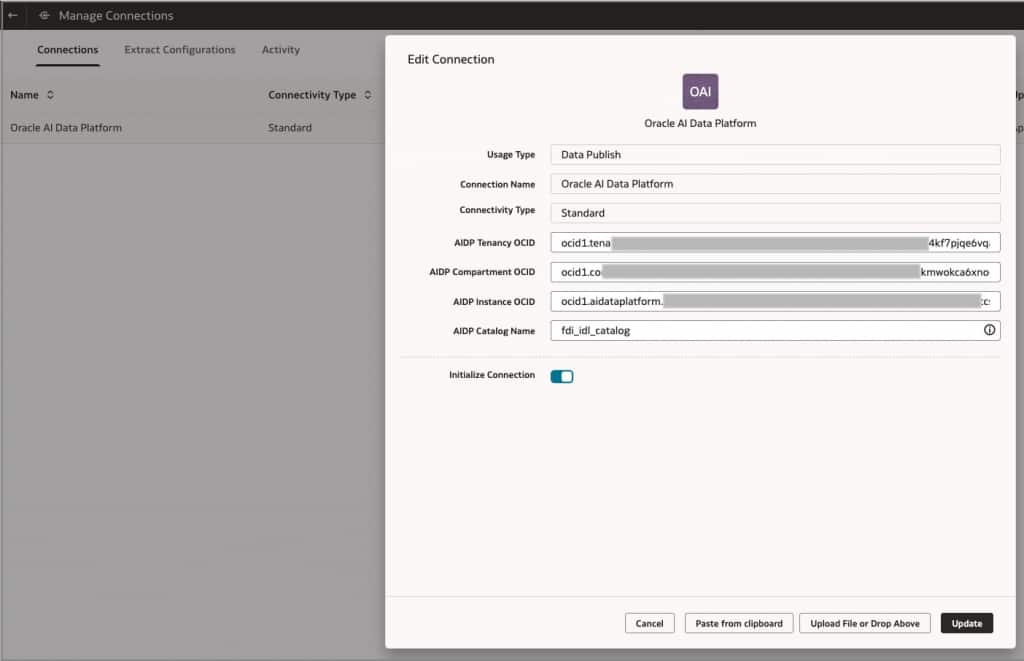
The AI Data Platform connector in Fusion Data Intelligence is currently available through a limited availability program. The screenshots below illustrate this capability.
One of the key advantages of AI Data Platform is its native integration with Fusion Data Intelligence. Using the built-in AI Data Platform connector available within FDI, organizations can securely share curated warehouse tables directly into AI Data Platform without building custom integration pipelines.
The integration process is straightforward:
- Create and configure an AI Data Platform connection from Fusion Data Intelligence.
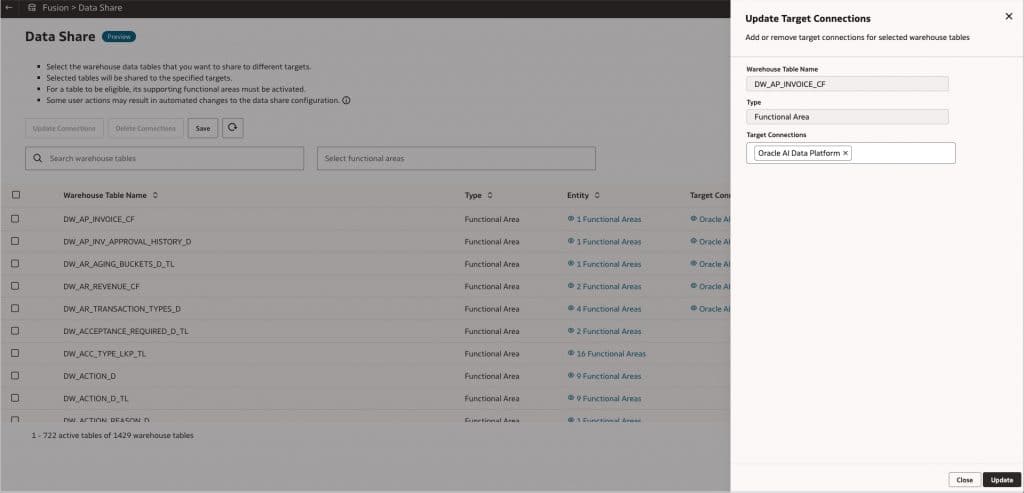
- Select the required logical warehouse tables through Data Share.
- Publish the selected datasets.
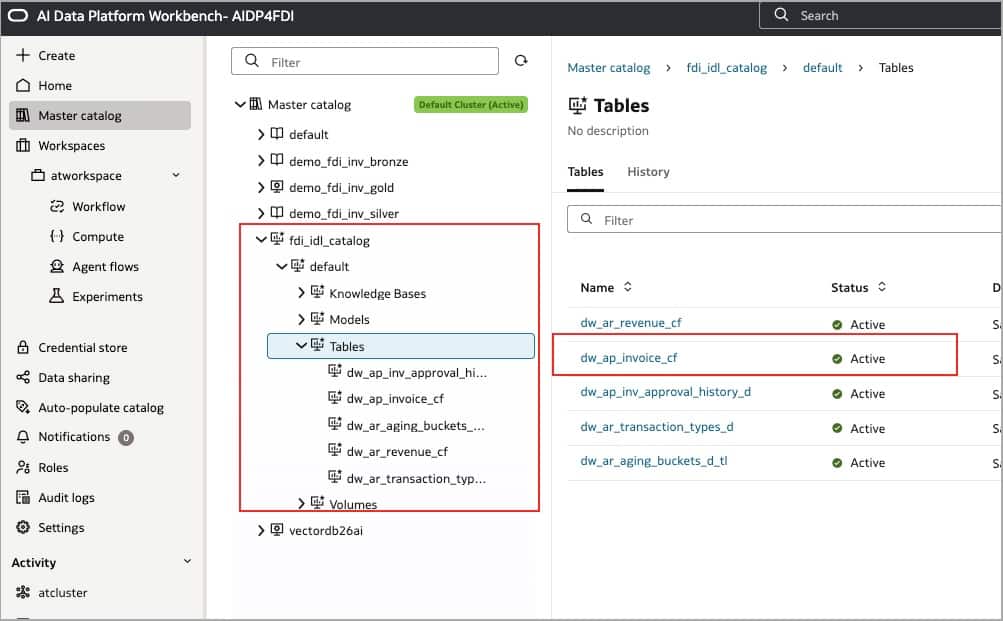
- The shared datasets become available as catalogs within AI Data Platform.
For this use case, we shared the AP invoice warehouse table from FDI, which serves as the trusted financial source for invoice intelligence.
Once the data is published, the curated FDI datasets are available within AI Data Platform and can be combined with additional enterprise and operational data sources.
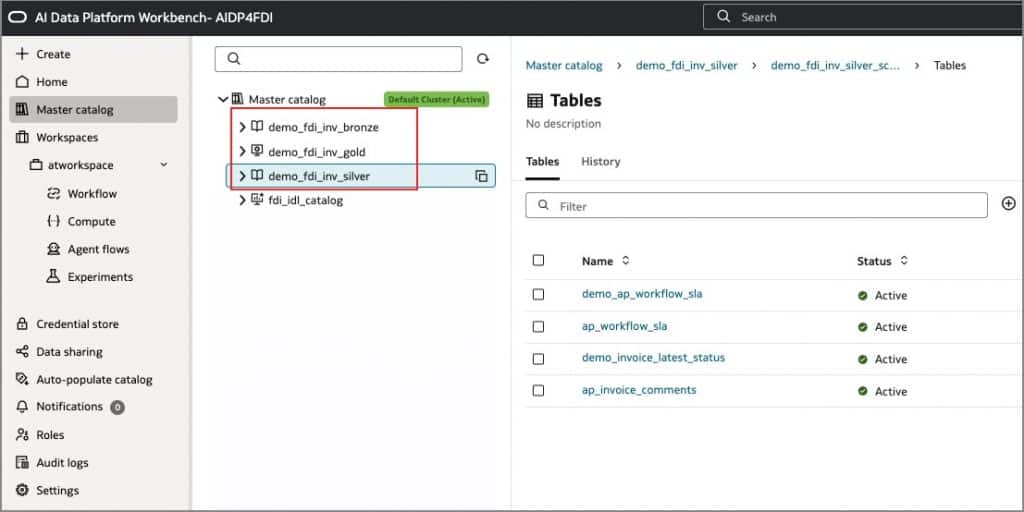
Medallion Architecture
After the curated FDI data is shared into AI Data Platform, we use a medallion architecture to organize and process the additional operational datasets used in this solution.
The medallion approach helps separate raw ingestion, curated transformation, and business-ready intelligence into distinct catalogs, making the pipeline easier to manage and scale.
- Bronze Catalog In the bronze catalog, we ingest curated FDI invoice data along with external operational data such as workflow events, workflow SLA files, and AP exception notes. The raw data is stored as-is in the bronze catalog in OCI Object Storage to preserve the original source information and provide a landing layer for downstream processing in notebooks and workflows.
- Silver Catalog :In the silver catalog, we use notebooks to combine curated FDI invoice data with external operational files such as workflow SLA data and AP exception notes, extract the required attributes, and perform the necessary data type conversions. The cleaned and transformed data is then written to the silver catalog in OCI Object Storage in Parquet format. External tables are also created on this curated data to enable seamless access for further processing and analytics
- Gold Catalog :In the gold catalog, we merge transformed invoice data from Fusion Data Intelligence with workflow SLA data and AP exception intelligence, and calculate the required business metrics such as blocker flags, priority bands, and invoice risk indicators. We also apply LLM-based summarization to AP operational notes to generate concise business-friendly insights. All the resulting analytics-ready data is then stored in the gold catalog — an Autonomous AI Database — in the form of structured tables, making it ready for reporting, visualization, and AI-driven insights.
This layered approach provides a clear path from raw data to actionable invoice intelligence.
Data Pipeline Implementation
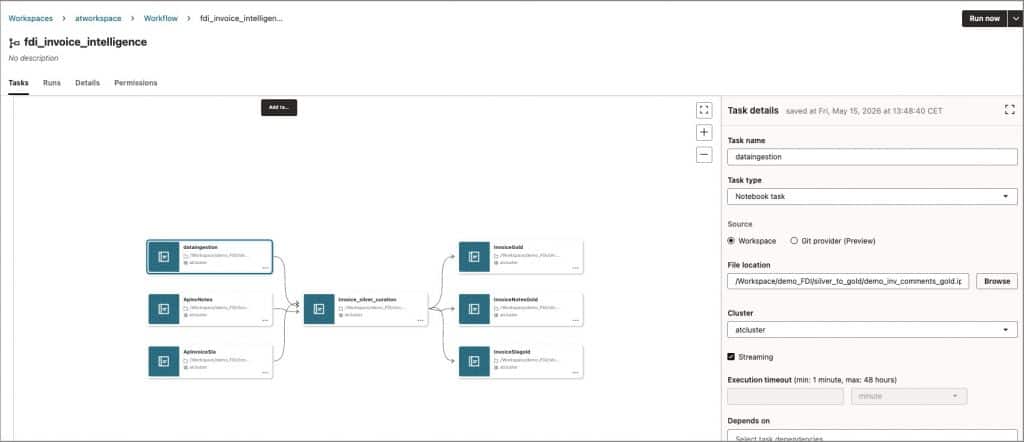
To turn raw FDI and operational data into business-ready invoice intelligence, we used notebooks and workflows in AI Data Platform. The pipeline moves data from Bronze to Silver and then from Silver to Gold, where it is cleaned, enriched, and prepared for analytics and AI consumption.
- Bronze to Silver migration: This set of notebooks handle the cleansing, subsetting, and transformation of raw data from the Bronze catalog, including invoice events, workflow SLA files, and AP exception notes, and loads the cleaned data into the Silver catalog.
- Silver to Gold preparation: The second set of notebooks prepare analytics-ready invoice intelligence by merging curated FDI data with workflow SLA data and AP exception notes, calculating key KPIs such as blocked invoices and SLA risk, applying LLM summarization to AP comments, and loading the curated data into the Gold catalog.
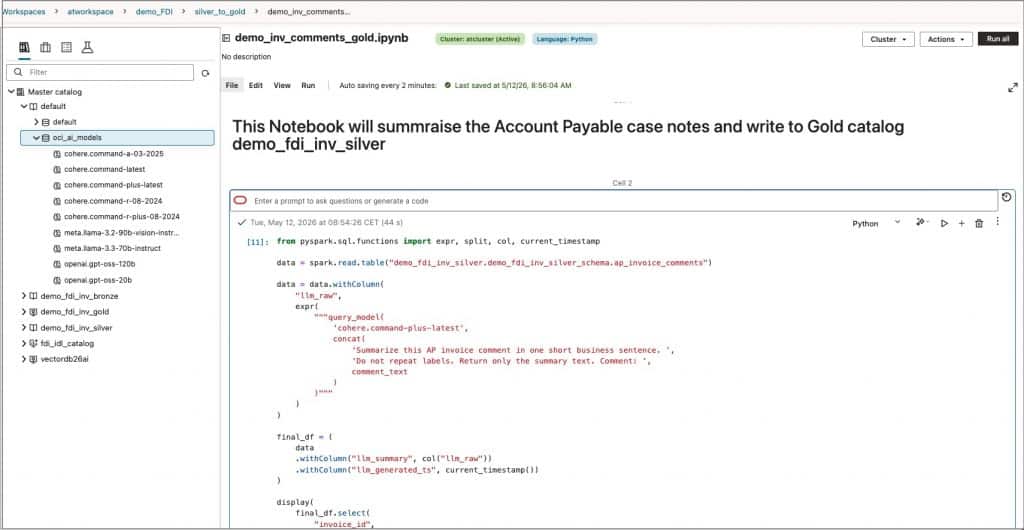
At a high level, the notebooks perform the following steps to transform raw data into business-ready invoice intelligence:
- Ingest curated FDI and external operational data
Bring in invoice facts from FDI along with workflow events, SLA data, and AP exception notes from external sources. - Clean and standardize the data
Use notebooks to extract the required attributes, convert data types, and normalize the datasets for downstream processing. - Enrich invoice records with workflow context
Join invoice data with SLA and exception information to create a more complete operational view of each invoice. - Apply LLM summarization
Use Generative AI to convert long AP operational notes into short, business-friendly summaries that are easier for users to consume. - Write curated output to the Gold layer
Store the transformed and enriched data in the Gold catalog so it is ready for analytics, dashboards, and AI agents.
Conversational AI with AI Agent
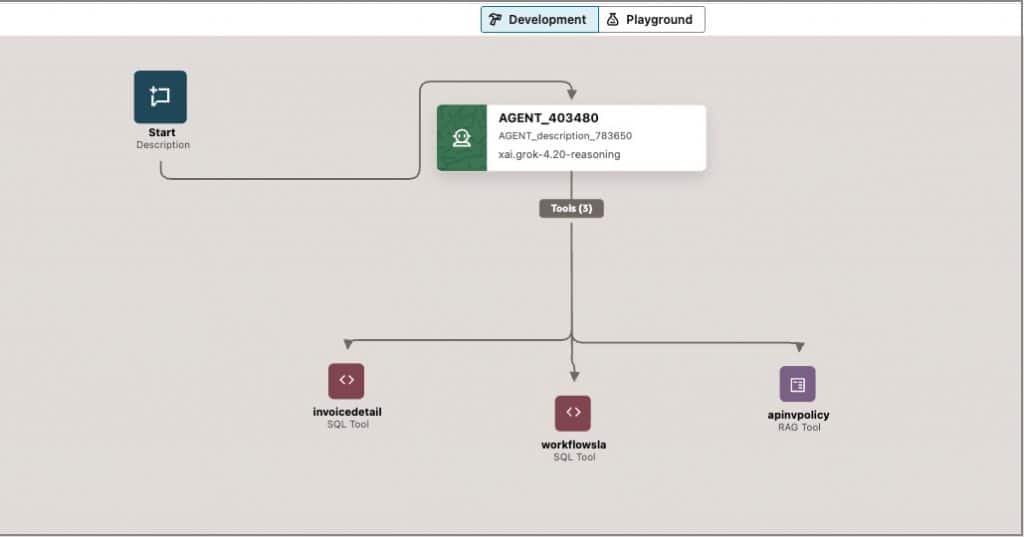
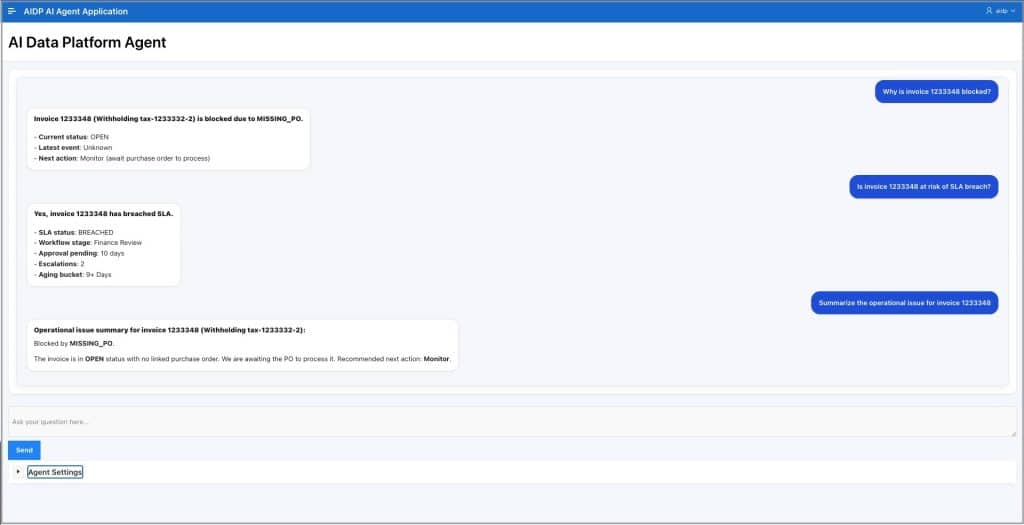
To provide business users with a conversational experience, we built an AI Agent in AI Data Platform. The agent combines structured invoice intelligence from the Gold catalog with enterprise AP policy guidance, enabling users to interact with invoice data using natural language.
SQL Tool
The SQL tool connects directly to the curated Gold semantic tables and provides access to invoice intelligence, workflow SLA information, operational events, and AI-generated summaries. This allows the agent to retrieve accurate, business-ready insights from structured data.
RAG Tool
The RAG tool uses enterprise AP policy documents as a knowledge management and provides contextual guidance for invoice exception handling, escalation rules, workflow procedures, and recommended actions. By combining retrieval with large language models, the agent can answer policy-related questions using trusted enterprise content.
Together, these tools enable business users to access both operational insights and policy guidance through a single conversational interface.
Example questions include:
- Why is invoice 1233348 blocked?
- Is invoice 1233348 at risk of SLA breach?
- Summarize the operational issue for invoice 1233348.
- What should AP do for invoices with missing purchase orders?
- When should approval delays be escalated?
- What is the current workflow status of invoice 1233348?
Business Insights
To provide business users with a unified operational view, we built an Oracle Analytics Cloud dashboard on top of the Gold catalog. The dashboard consumes the curated invoice intelligence prepared in AI Data Platform and provides near real-time visibility into invoice operations, workflow performance, and business KPIs.
The dashboard combines invoice facts from Fusion Data Intelligence with workflow SLA information and AI-generated summaries, allowing finance teams to monitor invoice processing from a single interface.
Some of the key dashboard capabilities include:
- Operational KPIs – Monitor blocked invoices, approval SLA risks, and overall invoice processing health.
- Workflow Intelligence – Identify approval bottlenecks, workflow aging, and escalation trends.
- Exception Monitoring – Analyze invoice processing issues such as missing purchase orders, approval delays, and other operational exceptions.
- AI-generated Insights – View concise business summaries generated from AP operational notes, reducing manual investigation effort.
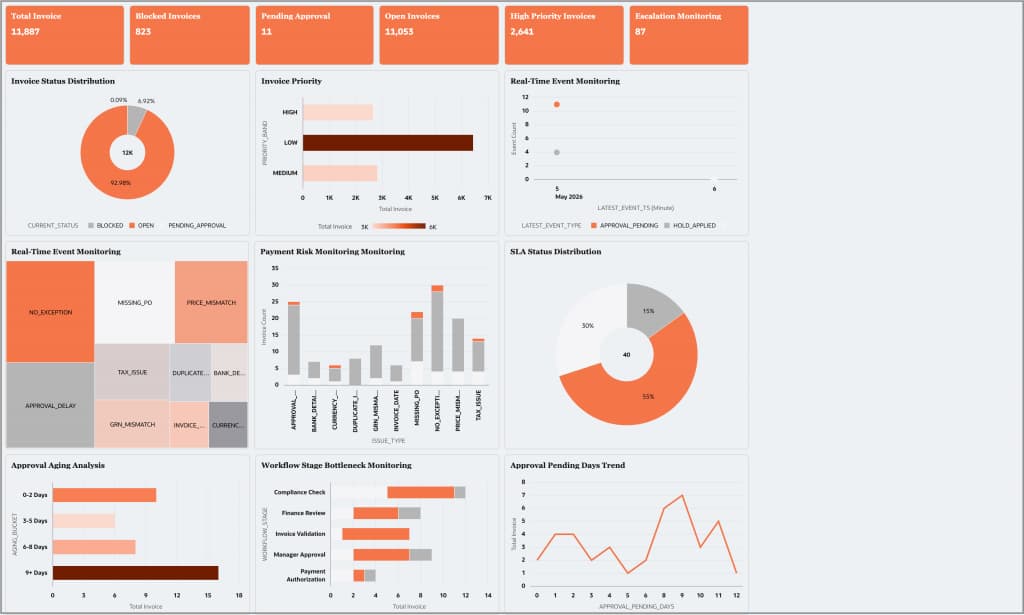
The dashboard enables finance users to proactively identify operational risks, prioritize invoice resolution activities, and improve overall AP operational efficiency.
AI Data Platform extends Fusion Data Intelligence by integrating operational data, AI enrichment, and conversational AI to deliver intelligent business solutions. In this article, we showcased how to build an AP Invoice Intelligence solution that combines FDI with external operational data, AI-generated insights, and natural language interactions. The same approach can be applied to many other Fusion Data Intelligence use cases to accelerate analytics and AI adoption across the enterprise.
For more information
To explore more about the Oracle AI Data Platform, check out these resources:-
- Oracle AI Data Platform
- Oracle AI Data Platform Documentation
- Oracle AI Data Platform Github Repository
- Oracle AI Data Platform Community
Future Product Disclaimer
The preceding is intended to outline our general product direction. It is intended for information purposes only and may not be incorporated into any contract. It is not a commitment to deliver any material, code, or functionality, and should not be relied upon in making purchasing decisions. The development, release, timing, and pricing of any features or functionality described for Oracle’s products may change and remains at the sole discretion of Oracle Corporation.