
Enterprise AI has reached an inflection point. Models are powerful, infrastructure is abundant, and experimentation is widespread—yet real business impact remains uneven. The blocker is no longer technical capability, but trust, governance, and adoption: despite unprecedented investment, most enterprise AI initiatives stall in pilots, prove costly to scale, and fail to reach everyday business users.
While many factors contribute to successful enterprise AI—from governance and security to operating models and talent—three tenets consistently determine whether AI scales into durable business impact.
|
What is Enterprise AI? Enterprise AI = Private Data + Business Semantics + Workflow Embedding Enterprise AI is built to operate inside real businesses—not demos or chatbots. It runs on trusted private enterprise data, understands business and industry context, and is embedded directly into the workflows where decisions are made, with governance applied by default. Unlike consumer or experimental AI, Enterprise AI is secure, explainable, and scalable—turning intelligence into daily business outcomes, not isolated insights. |
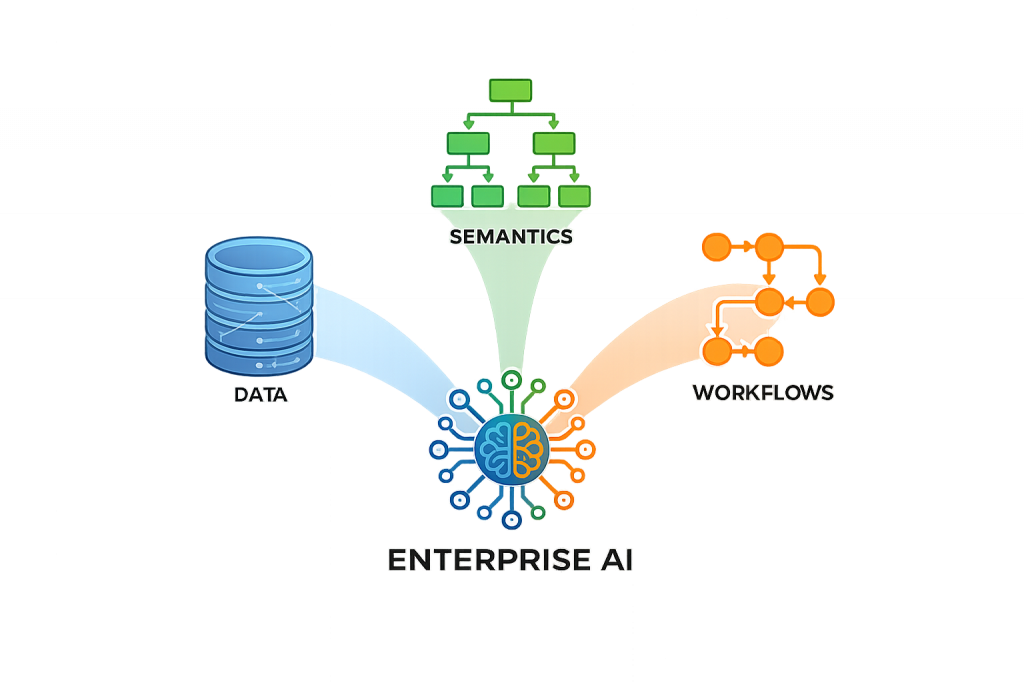
Data: AI Built Where Enterprise Trust Already Exists
Enterprise AI only works when it operates on authoritative, governed data. Oracle already runs mission critical systems for many of the world’s largest enterprises—financials, supply chains, HR, manufacturing, and core operations. Companies’ private data should not generally need to moved, duplicated, or re-governed just to make AI viable.
Instead, zero‑copy and zero‑ETL access patterns should be used wherever possible—allowing AI to operate directly on data where it already resides, across databases, warehouses, and lakehouse architectures. This avoids unnecessary data movement, reduces duplication and latency, and preserves existing governance, security, and compliance controls.
Trust, security, lineage, and performance are inherited from the platforms enterprises already rely on to run their business. As a result, AI should operate directly on real enterprise data—reducing architectural friction, lowering risk, and accelerating time‑to-value.
Semantics: Business Meaning Is Native, Not Guessed
Most AI platforms attempt to infer business meaning after the fact. Oracle doesn’t have to.
Through its market‑leading enterprise applications—spanning ERP, HCM, SCM, and CX—Oracle already defines the business models, metrics, and relationships enterprises use to operate. As the #1 ERP vendor globally, Oracle is trusted to run the financial and operational backbone of the world’s largest organizations, establishing clear authority in how businesses actually work.
That horizontal depth is complemented by decades of vertical expertise through Oracle’s industry applications in sectors such as construction, retail, finance, and manufacturing, where data models and operational semantics are highly specialized.
Together, these horizontal and vertical application portfolios encode a field‑tested understanding of business operations—across core functions like finance, HR, supply chain, and customer engagement, as well as industry‑specific domains such as projects, assets, contracts, inventory, pricing, compliance, and risk. Oracle AI Data Platform natively uses these existing semantic models rather than attempting to reconstruct them through inference or laborious manual effort.
The result is AI that reasons with real business context without relying on complex, brittle ontologies—remaining explainable, auditable, and aligned with how organizations already define and run their business.
Workflows: AI Embedded Where Work Gets Done
Enterprise AI adoption stalls when users are asked to change how they work. Oracle AI Data Platform is built on the opposite principle: AI should adapt to existing workflows.
Oracle AI Data Platform enables AI to be embedded into any application or digital experience—Oracle or non‑Oracle—through an agentic framework that allows AI to reason, plan, and act across systems, so intelligence appears directly in the flow of work. AI shows up at the moment of decision, grounded in the data and context of the task.
This dramatically increases adoption. When AI is ambient, contextual, and actionable, usage becomes habitual rather than experimental. And when adoption scales, ROI follows—through faster decisions, reduced manual effort, and consistent outcomes across the enterprise.
From AI Pilots to Real Business Value
Enterprise AI fails when it remains experimental—isolated from real data, disconnected from business meaning, and separate from how people work.
By grounding AI in trusted enterprise data, authoritative business semantics, and embedded workflows—with governance applied by default— Enterprise AI can move from pilots into production and be delivered repeatedly and reliably across the business, driving sustained adoption and measurable value.
For more information: