


A GPU-accelerated path from overnight route planning to minute-scale optimization
Route planning affects fuel cost, driver overtime, delivery windows, service levels, and customer experience. When planning takes hours, operations teams lose flexibility before the day even starts.
The Oracle AI Accelerator Pack for Vehicle Route Optimizer uses NVIDIA cuOpt open-source GPU-accelerated optimization engine on OCI GPU infrastructure to help customers move large routing problems from overnight planning cycles to minute-scale optimization.
How this creates business value
The business value is simple: faster plans, more replanning options, and more time for operations teams to act. Logistics, field-service, utility, retail, grocery, parcel, and public-sector teams all face the same challenge: build feasible routes quickly while respecting real-world constraints.
Those constraints include time windows, vehicle capacity, driver hours, multi-depot planning, pickups and deliveries, and EV charging requirements. When a CPU-based planning cycle takes all morning, teams have limited ability to test scenarios or respond to changes. When a solver returns in minutes, routing becomes an operating capability rather than a batch job.
Why an OCI-first deployment matters
Route optimization is not only a solver problem. Production teams need a repeatable way to load planning data, run scenarios, persist results, connect with downstream systems, and set realistic service levels.
The pack provides that pattern on OCI. It combines NVIDIA cuOpt with OKE, OCI GPU infrastructure, a route-planning interface, REST APIs, sample problems, sizing guidance, and integration points for services such as OCI Object Storage, Streaming, and Database.
That gives customers a practical way to test their own data without building the full optimization platform first.
What the benchmark results show
Testing focused on a practical operations question: How quickly can the system solve large route plans?
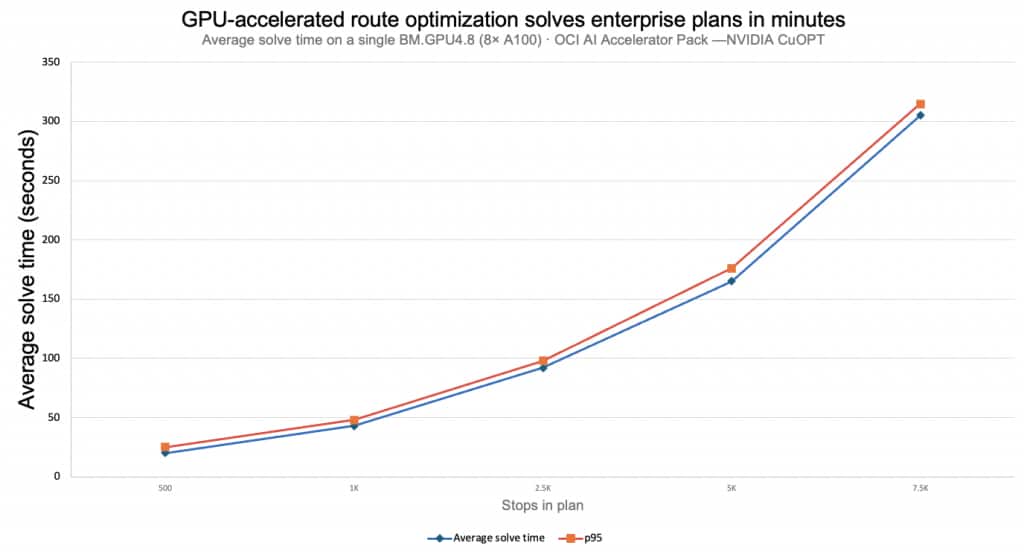
Figure 1: solve time versus stop count – NVIDIA cuOpt.
Benchmark anchor points:
- 2,500 stops solved in about 90 seconds.
- 5,000 stops solved in 2 to 3 minutes.
- 7,500 stops solved in 4 to 5 minutes.
The tested curve stayed well behaved through the operating range, which matters for customers because planning teams need a number they can use in a service-level discussion, not only a best-case demo result.
The pack also supports parallel scenario work. On a BM.GPU4.8 shape, eight A100 NVIDIA GPUs can run independent jobs in parallel, which is useful for multiple regions, shift plans, or what-if scenarios.
Where customers can start
The strongest use cases are tied to measurable operating outcomes:
| Use case | Customer outcome |
| Next-day delivery planning | Reduce the time needed to generate dispatch-ready plans |
| Field-service scheduling | Absorb urgent jobs and technician changes during the day |
| EV fleet planning | Include range, charging stops, and charger constraints in planning |
| Scenario analysis | Compare depot, fleet, and demand scenarios without waiting overnight |
The same pattern can also support dynamic replanning. In one benchmark scenario, a 1,000-order, 75-vehicle replan with 5% order churn averaged about 72 seconds. That kind of response time gives operations teams room to react to late orders, driver absence, or traffic disruption.
How Oracle helps simplify the path
Customers adopting GPU-accelerated optimization do not need to become CUDA or solver-platform experts before they can test value. They need a clean way to bring their real planning data, compare results with the current baseline, and understand the production shape required.
The Oracle AI Accelerator Pack helps by packaging the deployment pattern, sample assets, sizing guidance, and evaluation flow. That moves the conversation from “will it scale?” to “which planning SLA do we want to commit to?
What comes next
The next stage for many customers is integration: warehouse management, transportation management, dispatch, electronic proof of delivery, customer ETA systems, and replan audit history. For EV fleets, the next step may include charger availability, time-of-use tariffs, and rolling-horizon planning.
Over time, GPU-accelerated optimization can become a repeatable operating model that dispatch teams use throughout the day, not only a batch job that runs before the morning shift.
Conclusion and next steps
The strongest customer story is not the solver alone. It is that daily route planning can move from a blocking overnight process to a minute-scale workflow that gives operations teams more options.
Read more on the Oracle AI Accelerator Packs page, or contact your Oracle account team or the OCI AI Centre of Excellence to scope a routing pilot.
References
- Oracle AI Accelerator Packs: https://www.oracle.com/artificial-intelligence/ai-accelerator-packs
- NVIDIA cuOpt: https://developer.nvidia.com/cuopt
- NVIDIA cuOpt documentation: https://docs.nvidia.com/cuopt
- Oracle Container Engine for Kubernetes: https://docs.oracle.com/en-us/iaas/Content/ContEng/home.htm
- OCI Compute GPU shapes: https://docs.oracle.com/en-us/iaas/Content/Compute/References/computeshapes.htm