

Introduction
Modern security operations require faster situational awareness, intelligent threat detection, and reliable response systems capable of operating in both connected and disconnected environments. Organizations across defense, transportation, retail, healthcare, and public infrastructure increasingly need AI-powered systems that can identify potentially dangerous objects in real time and trigger immediate operational workflows.
Why High-risk object detection matters
Traditional surveillance systems often depend heavily on manual monitoring, which can delay response times and increase operational risk. The HROD platform combines AI-powered object detection with Oracle service integrations and edge computing infrastructure to accelerate threat detection and improve operational response.
Organizations operating in high-security environments require systems capable of identifying threats in seconds while reducing the burden on operational teams. Real-time AI inference enables proactive response workflows instead of reactive investigations.
Architecture overview
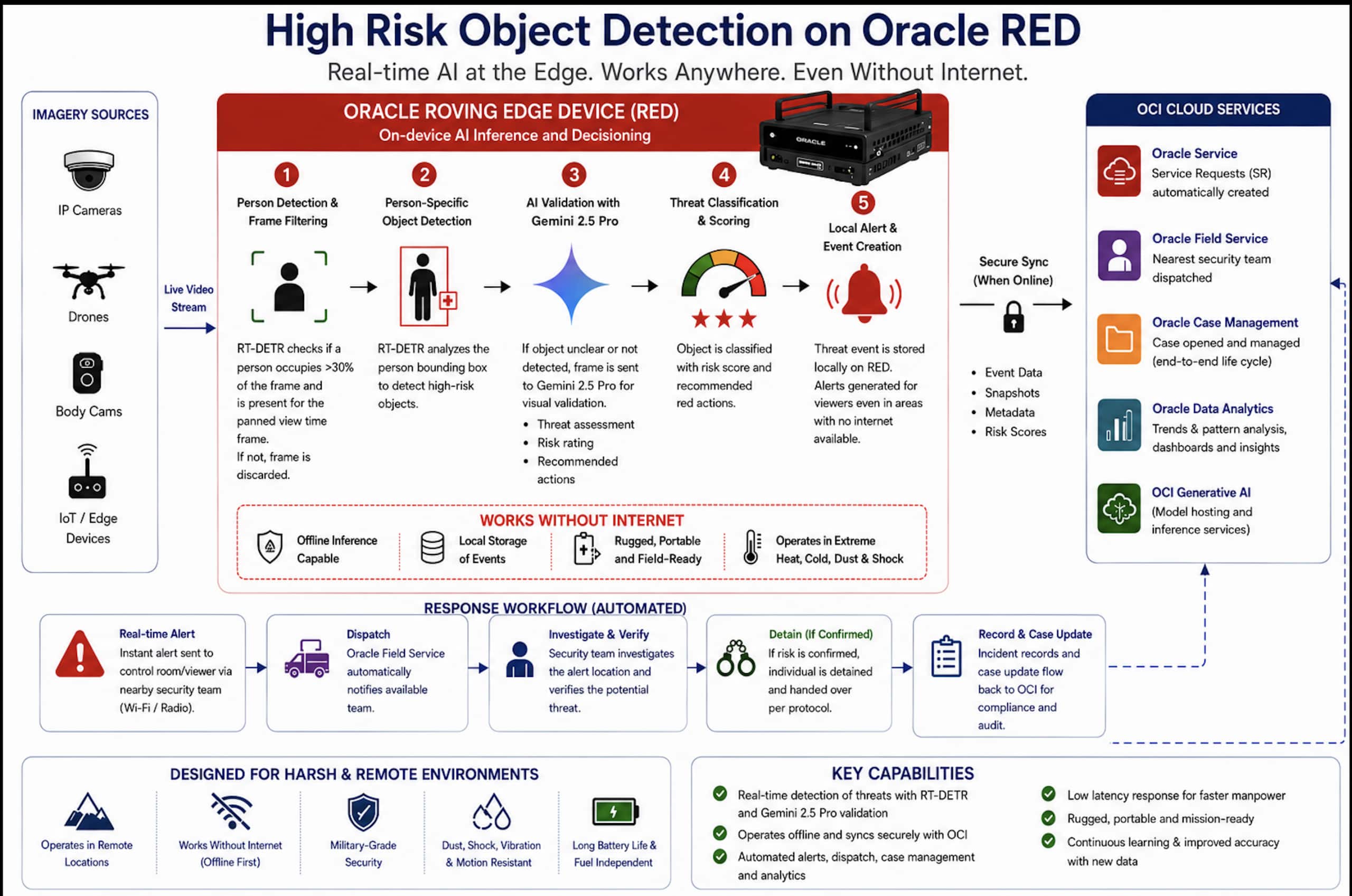
Traditional surveillance systems often depend heavily on manual monitoring, which can delay response times and increase operational risk. The HROD platform combines AI-powered object detection with Oracle service integrations and edge computing infrastructure to accelerate threat detection and improve operational response.
Dataset curation and engineering
One of the most important aspects of the HROD implementation was dataset engineering and curation. Generic object detection datasets were insufficient for the target use case because defense-oriented deployments require significantly higher precision and contextual awareness than standard object detection systems. To improve operational reliability, the training pipeline combined curated weapon datasets, COCO-based object detection samples, Defense and Security Equipment International (DSEI UK) imagery, and images captured from industrial, laboratory, and office environments. The dataset intentionally included both threatening and non-threatening object classes to reduce false positives and improve real-world operational behavior. Threat-related classes included handguns, rifles, shotguns, ammunition, explosives, knives, drones, and tactical equipment, while contextual classes included tablets, cameras, mugs, pens, medication, USB flash drives, books, and other common personal items. This mixed-class strategy helped the model learn contextual differentiation between genuine threats and everyday objects frequently encountered in operational environments.
Model training and fine-tuning
The HROD detection pipeline was built using the RT-DETR Large (RT-DETR-L) architecture, selected for its strong performance in real-time multi-object detection and complex object localization. The model was trained using GPU-enabled infrastructure with the Ultralytics RT-DETR framework and iterative fine-tuning workflows optimized for edge deployment on Oracle RED devices. Training included transfer learning, multi-class balancing, validation-based checkpointing, and extensive data augmentation techniques such as scaling, rotation, lighting variation, occlusion simulation, and perspective adjustments to improve robustness across real-world environments. Earlier YOLO-based implementations were evaluated during the prototype phase, but RT-DETR-L provided better scalability for contextual learning and specialized weapon detection. Incremental learning strategies were also applied to preserve generalized object awareness while improving precision on high-risk classes. Throughout the training process, the dataset was continuously refined to improve performance across varying lighting conditions, object scales, viewing angles, and partially occluded scenes while maintaining low-latency inference suitable for Oracle RED edge deployments.
RT-DETR + Gemini 2.5 Pro Threat Detection Pipeline
This workflow illustrates a real-time edge AI threat detection pipeline that combines RT-DETR for person and object detection with Gemini 2.5 Pro for intelligent threat validation and security assessment. The system filters irrelevant frames, detects potential threats, and returns actionable security insights through an automated low-latency inference pipeline.
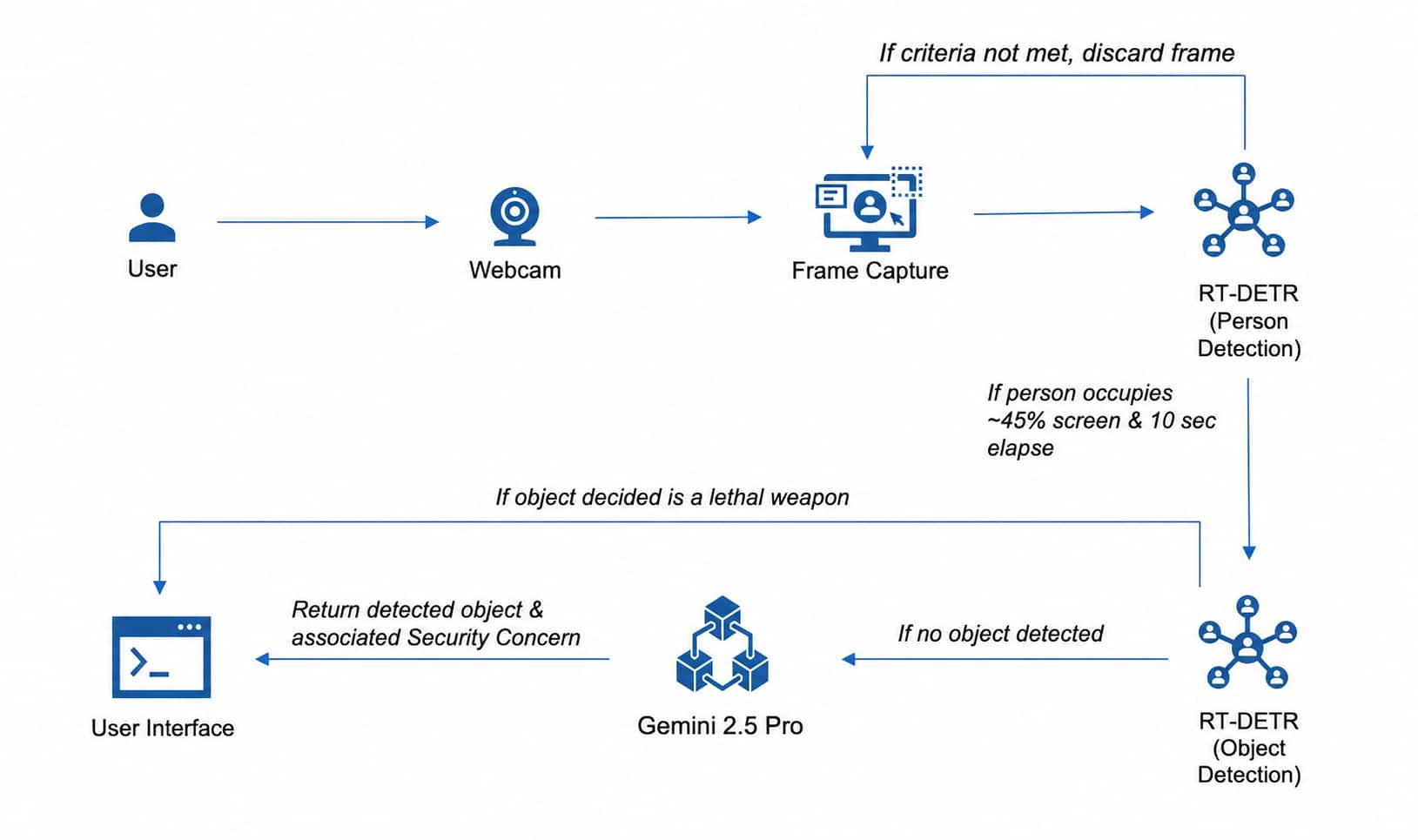
Multi-modal AI inference Pipeline
The system continuously captures imagery from connected devices and evaluates frames in real time. RT-DETR (Real Time Detection Transformer) analyzes the frame and performs person-specific object analysis. If the detected object is ambiguous, OCI Gen AI vision capabilities validate the classification and generate contextual threat insights and recommended actions.
The multi-model pipeline improves overall detection accuracy while minimizing false positives. Combining deterministic detection models with generative AI validation enables more intelligent operational workflows and richer threat context.
The inference workflow includes:
- Real-time frame capture
- Person detection and filtering
- Person-specific object analysis
- OCI Gen AI validation
- Threat classification and scoring
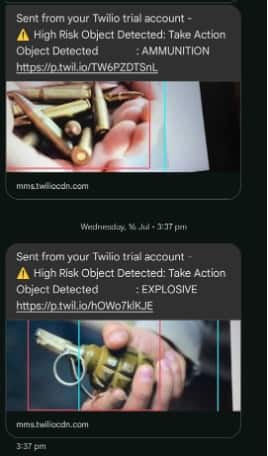
- Local event creation and alerting
- OCI synchronization and analytics
Why Oracle RED devices are important
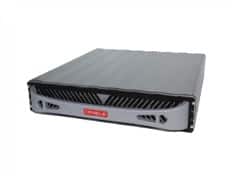
Oracle Roving Edge Devices (REDs) extend OCI compute and storage capabilities directly into the field, enabling ultra-low latency inference and disconnected operations. RED devices allow the HROD platform to continue functioning in remote or mission-critical environments where connectivity may be unreliable.
Unlike traditional cloud-dependent deployments, RED devices provide localized AI inference capabilities that reduce latency and support operational continuity even without internet connectivity.
RED devices are particularly valuable because they:
- Support edge-native AI processing
- Operate in disconnected environments
- Enable rugged field deployments
- Reduce cloud dependency
- Synchronize with OCI services when reconnected
- Provide low-latency threat detection and response
The ability to continue running AI workloads without internet access makes RED devices especially important for defense operations, remote industrial facilities, disaster response scenarios, and mobile command environments.
Connecting to RED and deploying the solution
The deployment process uses secure SSH connectivity and port forwarding to access the application dashboard and inference services running on the RED infrastructure.
SSH commands
ssh -L <local-port>:localhost:<remote-port> -X <username>@<red-device-ip> -i <path-to-private-key>
where
<username> → Remote RED device user
<red-device-ip> → Oracle RED device IP address
<path-to-private-key> → SSH private key location
<local-port> → Local machine port
<remote-port> → Application port running on RED device
This SSH workflow enables secure remote deployment, dashboard access, and monitoring of inference services running directly on the RED device.
Deployment workflow
- Connect securely to the RED device
- Transfer the AI inference application and dependencies
- Activate the runtime environment
- Start the RT-DETR and OCI Gen AI inference services
- Launch the local dashboard or UI
- Validate camera feed and detection results
- Trigger event workflows and check for real time alerts
The deployment architecture keeps inference close to the camera source while maintaining the ability to synchronize with Oracle Cloud Infrastructure services whenever connectivity becomes available.
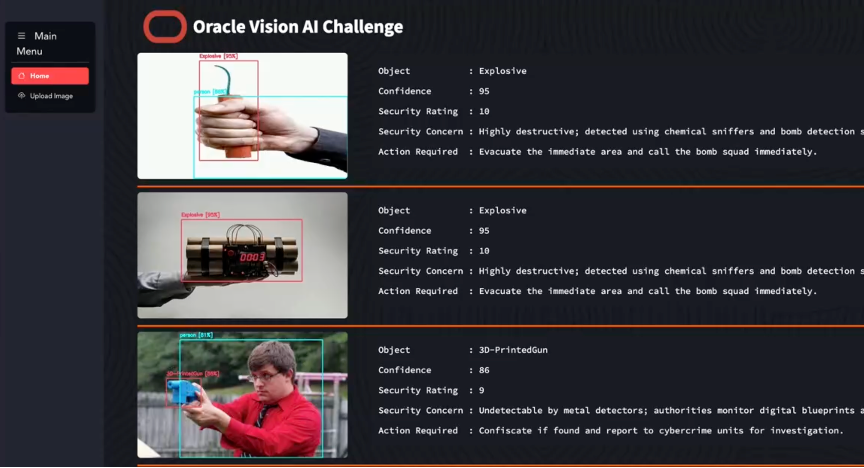
Potential industry applications
The HROD framework supports defense, law enforcement, retail, healthcare, and transportation use cases including perimeter surveillance, crowd monitoring, suspicious behavior detection, and operational analytics.
Potential use cases include:
- Defense perimeter monitoring
- Drone-based surveillance
- Public safety operations
- Retail loss prevention
- Transportation hub monitoring
- Smart city security operations
- Healthcare facility protection
- Industrial site monitoring
Conclusion
The deployment of the High-Risk Object Detection model on Oracle Roving Edge Devices demonstrates how edge AI, real-time computer vision, and Oracle Cloud Infrastructure services can work together to deliver intelligent security operations.
By moving inference closer to the source of data, Oracle RED devices enable:
- Faster operational response
- Reduced inference latency
- Offline resiliency
- Rugged field deployment capabilities
- Secure OCI synchronization
- Real-time AI-driven situational awareness
As organizations modernize security infrastructure, edge-native AI architectures like HROD will become increasingly important for enabling autonomous response workflows, operational resilience, and real-time decision-making in remote and mission-critical environments.