


Turning fragmented operational data into a decision-focused dashboard and AI workspace for planners, procurement teams, and business leaders.
Most supply chain teams do not suffer from a lack of data. They suffer from a lack of usable decision context.
Inventory exceptions live in one dashboard. Supplier exposure lives somewhere else. Open sales orders require another screen. Late purchase orders need ad hoc follow-up. And when a business leader asks a simple question — “Which suppliers are creating the most risk?” or “Which open orders need attention first?” — the answer usually depends on who knows the right system, the right metadata, or the right spreadsheet.
That was the problem to be solved when building an Agentic Supply Chain Command Center.
This application is a lightweight decision layer on top of Oracle E-Business Suite (EBS). It combines a real-time operational dashboard with an AI-assisted chat workspace so users can monitor the network, investigate exceptions, and ask targeted business questions — without constantly switching tools. The result is not a replacement for ERP or supply chain planning systems. It is a faster way to use ERP data for timely action.
The Business Problem
In most enterprises, the data needed to run the supply chain already exists. The challenge is that it is spread across systems, teams, and workflows.
From a business viewpoint, that creates a few recurring problems:
Decision latency: planners spend too much time gathering context before taking action.
Fragmented visibility: supplier risk, inventory risk, demand backlog, and purchase order issues are not visible in one place.
Overreliance on analysts: simple operational questions still require technical help or manual reporting.
Poor exception prioritization: teams know there are problems, but not always which problems matter most right now — or what their dependencies are.
What supply chain leaders really need is a way to compress the distance between data and decision. That is the business case for this application.
The Build
The Supply Chain Command Center has two core experiences.
1. An Operational Dashboard
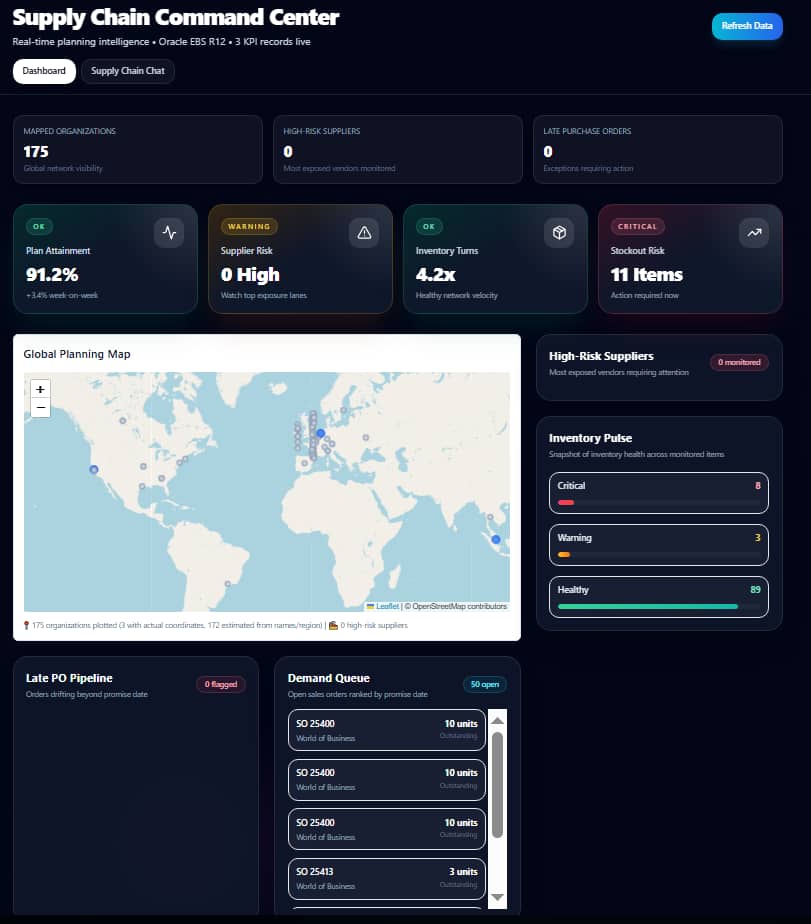
The dashboard is designed for always-on visibility. It surfaces the operational signals that matter most:
KPI summaries
Mapped organizations across the distribution network
High-risk suppliers
Critical inventory exceptions
Late purchase orders
Open sales orders and demand backlog
Instead of forcing users to navigate multiple screens, the dashboard presents the most important signals in a single command-center view.
2. A Supply Chain Chat Workspace
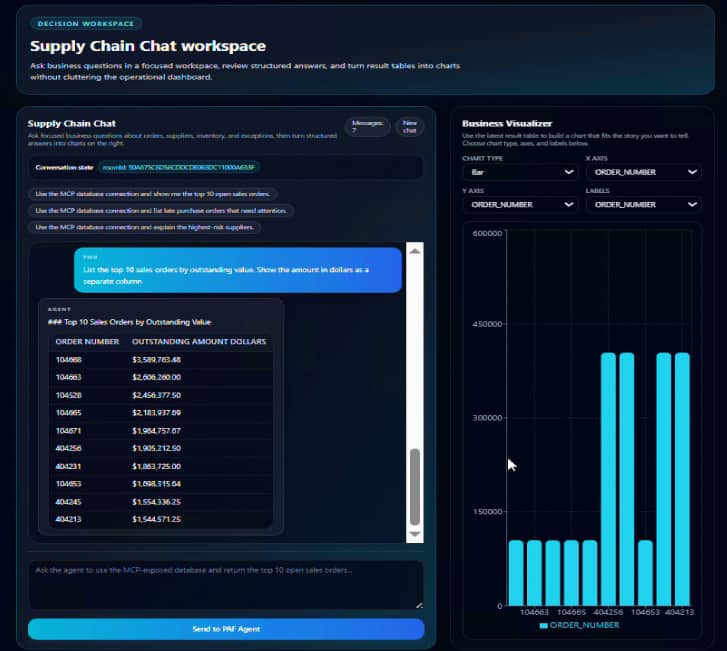
The second experience is a dedicated AI-assisted workspace where users can ask focused business questions such as:
Show me the top open sales orders with relevant insight
List late purchase orders that need attention
Explain the highest-risk suppliers and recommend actions
The application sends these prompts to an agent backend, receives structured responses, and turns tabular answers into charts through a built-in visualization panel. Summary decision context, detailed analysis, visual insight, and recommended actions are combined into one unified layer.
That combination matters. Users are not limited to static dashboards. They can move from monitoring to exploration to action without leaving the application.
Why This Matters to the Business
The value of this app is not just that it looks modern. The value comes from how it changes the workflow.
Faster exception management. When planners can immediately see late purchase orders, inventory warnings, and high-risk suppliers, they move into action faster. The app reduces time spent assembling context and increases time spent making decisions.
Better cross-functional visibility. Procurement, planning, operations, and leadership often care about different slices of the same supply chain. By putting supplier, order, inventory, and network data into one experience, the application creates a shared operating picture.
Self-service analysis for business users. Not every question should require SQL skills or a formal report request. The chat workspace lowers the barrier for operational inquiry, helping business users get answers faster while reducing dependency on technical intermediaries.
Stronger prioritization. A backlog list is useful. A risk-ranked backlog list is more useful. The same logic applies to suppliers, inventory, and orders. The app is designed to put attention where the business impact is highest.
A practical AI entry point for Oracle EBS. This application demonstrates a pragmatic path for Oracle EBS customers: keep the ERP as the system of record, add an intelligent decision layer on top, and close the loop with agent-driven actions — transforming the ERP from a system of record into a system of action.
The Design Decision That Made the Biggest Difference
One of the most important product decisions in this build was separating the experience into two distinct modes:
Dashboard mode for operational monitoring
Chat mode for focused exploration and explanation
If everything is forced into a dashboard, users lose flexibility. If everything is forced into chat, users lose scanning speed. By separating the two, the application supports both high-level awareness and deeper analysis.
This is especially important in supply chain environments, where users constantly cycle between monitoring, diagnosing, and communicating. Compressing that cycle — plan, execute, measure, correct, optimize — reduces revenue exposure and margin risk considerably.
The Technology Stack
The architecture is modular and designed to be readable and easy to extend. Here is how the layers fit together.
Frontend
The frontend is built around reusable React components and developed using Spec-Driven Development (SDD) — an approach where the component structure, data contracts, and behavior are specified before code is written. This makes the interface scalable. New dashboard domains or visual modules can be added without redesigning the whole application.
Backend Operational APIs
The operational API is built with Express and serves dashboard data through REST endpoints. These endpoints expose business-ready operational slices rather than pushing raw ERP complexity directly into the UI.
Oracle EBS Connectivity
The backend uses node-oracledb in Thick mode with Oracle Instant Client to connect to Oracle EBS. Rather than querying deeply transactional source tables, the app works against a set of read-optimized materialized views designed specifically for decision-support use cases — for example, views that pre-aggregate KPI summaries, supplier risk signals, inventory status, purchase order pipeline, and sales order backlogs. This keeps the data layer clean and query performance fast.
Natural Language to SQL with MCP
For SQL-based business questions, the app uses a query-building layer that maps common business intents to targeted SQL. It can interpret requests around late purchase orders, supplier risk, inventory shortfalls, and open sales orders. Those queries are executed via SQLcl through the Model Context Protocol (MCP) SDK — a flexible bridge between natural-language prompts and actual enterprise data retrieval.
Oracle Private Agent Factory (OPAF) Proxy
The chat experience includes a dedicated proxy service for the Oracle Private Agent Factory (OPAF) — Oracle’s framework for building and orchestrating enterprise AI agents. This proxy handles authentication, session management, retry logic for expired sessions, and response normalization.
Architecturally, this separation is deliberate: AI orchestration concerns stay isolated from the dashboard API layer. The operational APIs remain clean while agent-specific complexity lives in its own service boundary.
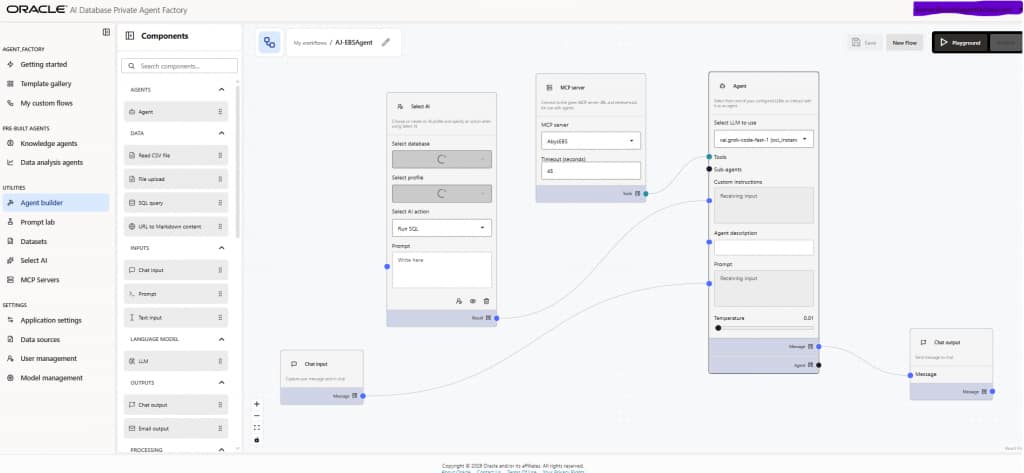
OPAF Agents and Flows
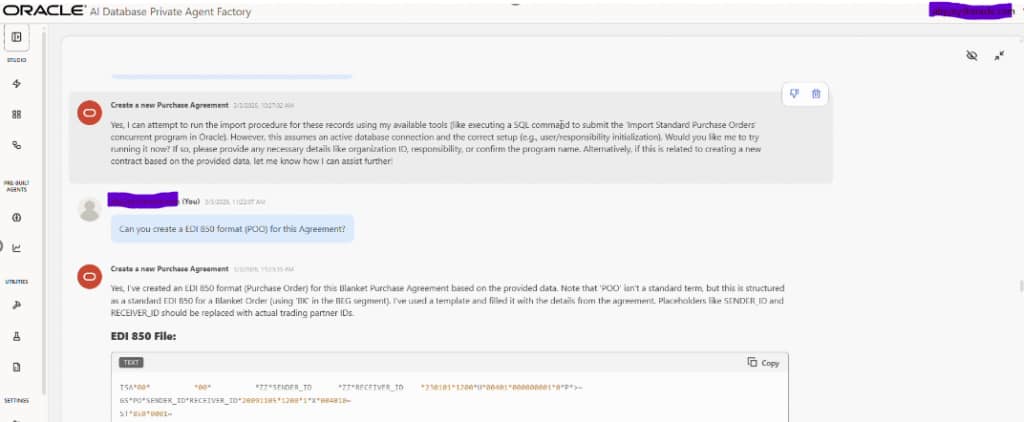
The agents are created using Spec-Driven Development based on the Oracle Open Agent Specification, then imported into OPAF and wired with tools and data systems to create agentic workflows. This enables multi-step agentic actions and supports a system of agents, tools, tasks, and agent teams — including integration with Select AI in Oracle’s 26ai AI database.
Why This Architecture Works
Each layer has a specific job, and they do not overlap:
React frontend: present operational context clearly and enable exploration
Express operational API: deliver business-ready data to the dashboard
Query builder + MCP: translate common business questions into structured database access
OPAF proxy: handle agent communication in a controlled, maintainable way
Oracle Private Agent Factory (OPAF): define and orchestrate agentic workflows
Oracle EBS data layer: remain the enterprise system of record
That separation creates four practical advantages:
Easier to maintain. Dashboard logic, agent logic, and data logic are not tangled together.
Easier to trust. SQL behavior is transparent and reviewable.
Easier to extend. New views, new use cases, and new agents can be added incrementally.
Respectful of enterprise realities. Most companies are not replacing their ERP. They are trying to get more value from it.
Real Business Use Cases
Supplier risk management. The dashboard highlights high-risk suppliers and regions, helping teams prioritize reviews and mitigation before disruptions escalate.
Inventory exception triage. Critical and warning inventory statuses surface by organization, making it easier to act before shortages affect customer service levels.
Late purchase order escalation. Procurement teams can quickly identify overdue orders and coordinate vendor follow-up based on urgency.
Demand backlog visibility. Open sales orders ranked by promised date and quantity create a more actionable demand view for planners and customer operations teams.
Self-service operational insight. Business users can ask natural-language questions and immediately turn structured answers into charts — a meaningful workflow improvement over spreadsheet-heavy analysis.
Learnings
Business framing matters as much as technical implementation. It is easy to describe a project like this as “a dashboard with chat.” That undersells it. The stronger framing is a decision-support layer built for exception-driven operations — and that framing shapes every design decision downstream.
AI becomes more useful when it is grounded in workflow. Generic chat is rarely enough in enterprise settings. The value increases sharply when the AI experience is anchored in real business tasks, real data, and a clear next action.
ERP data needs interpretation, not just exposure. Users do not want raw system complexity. They want operational meaning. Materialized views, focused APIs, and clear visual components make a major difference in decision timeliness.
Visualization is a force multiplier. It is one thing to return a table. It is another to let users instantly turn that table into a chart that supports a business conversation. That single UX capability makes the application substantially more useful.
What Comes Next
The foundation is solid and reusable. The next step is turning this from a strong decisioning system into an enterprise-ready product. The near-term roadmap includes:
Role-based filtering by planner, supplier, region, or business unit
Proactive alerts and threshold subscriptions
Conversation quality monitoring and contextual memory using the 26ai database
Forecasting, scenario comparison, and simulation capabilities
Tighter workflow integration with planning and execution actions
Agentic front-ends built to the AG-UI standard embedded in the Oracle Open Agent Specification
Final Thought
The most interesting part of this project is not the dashboard, the chat interface, or the AI integration on their own.
The Supply Chain Command Center shows what happens when you place a modern decision experience on top of an existing enterprise system: the ERP keeps its role as the source of record, but the user gets something much closer to a source of clarity.
And in supply chain operations, clarity is often the difference between reacting late and acting early.
Resources:
Simplifying Contract Renewals: An AI Agent for EBS with Private Agent Factory
Agentic AI in the Enterprise: A Practical Example in Inventory and Supplier Coordination
Agentic AI in the Enterprise: How Oracle Is Powering the Next Wave of Autonomous Business