
Most Siebel CRM deployments accumulate years of historical data – which whilst important, may no longer support day-to-day business operations. Although this data is rarely accessed, it continues to impact system performance, increase operational costs, and complicate system updates.
In this article, we explore how Siebel Intelligent Data Archival (iDA) enables organizations to manage Siebel CRM data growth strategically—improving performance, reducing total cost of ownership (TCO), and modernizing Siebel CRM environments without compromising compliance or data accessibility.
Why data archival is no longer optional for CRM
Across industries, Siebel CRM thrives as a mission-critical system supporting sales execution, service operations, workflows, and regulated business processes. Over time, the CRM database continues to grow as transactional and historical records accumulate.
In most mature Siebel CRM deployments, 80–90% of data becomes inactive, for example: closed service requests, completed orders, historical activities, and aged transactions. Although this data is seldom used, it can significantly affect system health by increasing database size, slowing down queries and batch jobs, extending update timelines, driving up storage, backup, and operational costs.
This growing gap between mission-critical business application performance and inactive data makes intelligent data archival a strategic requirement, not a one-time cleanup exercise.
Introducing Siebel Intelligent Data Archival (iDA)
Siebel iDA introduces a superior and more cost effective solution, enabling our customers to have a productized, enterprise-grade archival solution, built natively for Siebel CRM.
Siebel iDA is not a one-time cleanup utility, it is designed as a strategic capability to continually help organizations:
- Continuously optimize database footprint
- Improve system performance and responsiveness
- Reduce update effort, downtime, and risk
- Lower overall Total Cost of Ownership
- Stay compliant without compromising data accessibility
- All of this—without breaking Siebel’s business logic, security or data relationships.
Business outcomes that matter
Tangible TCO reduction
By offloading inactive CRM data, organizations can reduce database size, lower backup and storage costs, and decrease ongoing administration effort. Smaller databases help control run costs year after year.
Faster updates with reduced risk
Leaner databases simplify schema migration, shorten testing cycles, and reduce downtime during updates and patching. This makes continuous innovation more practical and manageable.
Performance where it counts
Keeping only relevant, active data in the core CRM database improves query performance, UI responsiveness, and batch job execution—enhancing the end-user experience.
Archiving inactive Siebel CRM data can reduce database size by up to 80–90%, significantly improving performance while lowering operational costs.
Simplicity by design: Archiving without complexity
A core design principle of Siebel iDA is administrative simplicity.
Rule-based archiving configured in Siebel
Archiving rules can be defined using standard Siebel Administration screens. Key functionality includes:
- Choose the business entity (e.g., Service Requests, Orders, Activities, etc.).
- Define business-friendly criteria (e.g., closed SRs older than two years).
- Select the execution frequency (e.g., daily, weekly, monthly).
- Set execution windows (e.g., 10PM to 4AM).
- Choose whether to archive with delete, archive without delete, or delete only.
The solution differentiates from custom solutions. No custom scripting, no external schedulers, no brittle SQL.
Parent–child and attachment-aware
Siebel iDA automatically preserves parent–child hierarchies, referential integrity, and file-system attachments, ensuring archived data remains complete, trustworthy, and restorable.
Flexible archive destinations
Archive data to database targets or file systems, aligning with enterprise data management and compliance strategies.
Intelligent retrieval: Archiving data does not mean it’s lost
Archived data remains visible and usable, which means:
- Summaries (Field based and AI based summaries) or full records can be retrieved on demand
- Archived records can be shown contextually under parent entities in Siebel.
- With optional AI-based summarization, users can quickly understand historical context without loading full datasets, further improving productivity
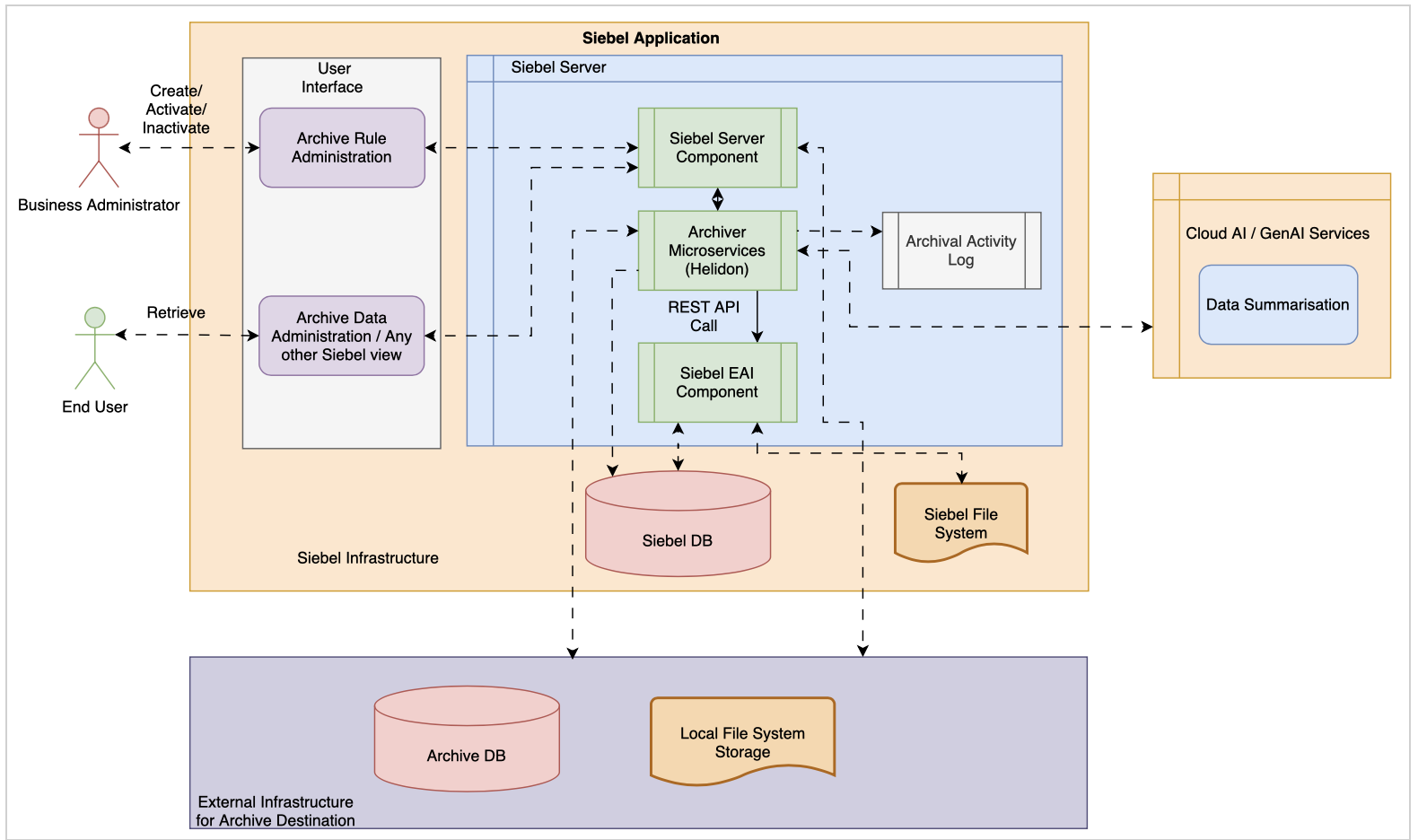
High-level architecture of iDA
The high-level architecture of iDA and its integration flow with the Siebel platform is illustrated below.
Strategic value for customers and partners
For our Customers, Siebel iDA can help you realize immediate and long-term business benefits:
- Reduce database maintenance costs and infrastructure spending
- Accelerate system performance and update cycles
- Maintain compliance without sacrificing data accessibility
- Future-proof your Siebel investment with continuous optimization
- Achieve measurable TCO reduction year over year
For our Partners and System Integrators, Siebel iDA can open up new opportunities and deepen customer relationships:
- Proactive performance optimization and health assessments
- Update readiness and modernization roadmap planning
- Managed archival services as part of run and operate services
- TCO reduction and compliance advisory services
- Long-term customer retention through continuous value delivery
Why now is the right time to adopt Siebel iDA
Siebel iDA reflects continued investment in making CRM environments simpler, smarter, and more cost-effective to operate. As data volumes grow and update cycles accelerate, a strategic approach to CRM data management becomes essential.
If you’re looking to control data growth, improve CRM performance, and reduce long-term operational costs, now is the time to make archival a strategic advantage.
Want to see how Siebel iDA fits into your CRM roadmap?
Register for the upcoming Customer Connect webinar scheduled for 12th January 2026 to learn more.