
In Siebel pricing, discounts rarely work in isolation. A single quote or order can include volume discounts, promotions, aggregate discounts, attribute-based adjustments, and manual price changes. When multiple adjustments apply simultaneously, the order in which they are processed becomes a strategic decision. Each adjustment can change the base value used for the next calculation, so sequence directly shapes the final price.
In Siebel Dynamic Pricer, this sequence defines how pricing moves from starting price to final net price. The order matters to anyone involved in pricing because it influences revenue, margin, consistency, and how clearly a final price can be justified.
Discount sequencing is the logic that controls which valid adjustment applies first, which follows, and how multiple discounts interact within the same transaction. That makes it more than a system configuration. It becomes part of pricing policy.
How Siebel Dynamic Pricer applies pricing adjustments
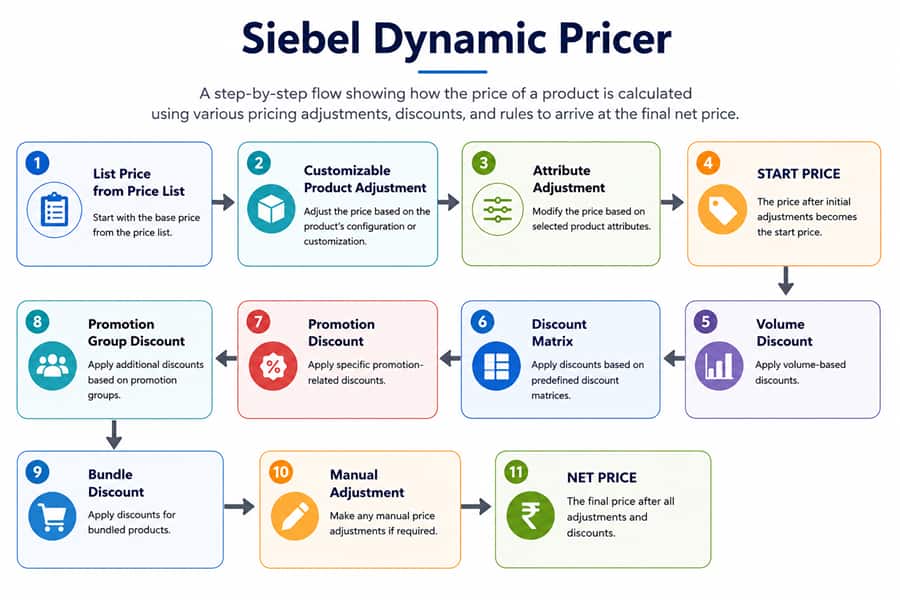
Siebel Dynamic Pricer starts with a base price and then runs a pricing procedure that can apply multiple adjustments before calculating the final net price. Those adjustments can include attribute-based adjustments, volume discounts, discount matrices, promotions, aggregate discounts and manual adjustment.
The pricing waterfall makes that sequence visible. It shows the list price, each adjustment in the order applied, the price after each step, and the final net price. That visibility helps pricing teams understand not just what changed, but why the final number landed where it did.
A simple example shows why order matters
Consider a company selling a tablet device with these pricing rules:
- List Price: $1,000
- Attribute Adjustment: Discount of $200 for a basic configuration
- Volume Discount: 5% for purchases above 10 units
- Product Based Adjustment: 10% for preferred customers through discount matrix
Now compare two valid discount sequences.
Sequence 1: Attribute adjustment, then volume, then discount matrix
| Step | Pricing Action | Price |
| Initial List Price | Starting price | $1,000 |
| Attribute Adjustment | -$200 adjustment | $800 |
| Volume Discount | 5% discount | $760 |
| Discount Matrix | 10% discount | $684 |
| Final Price | $684 |
Sequence 2: Discount matrix, then volume, then attribute adjustment
| Step | Pricing Action | Price |
| Initial List Price | Starting price | $1,000 |
| Segment Discount | 10% discount | $900 |
| Volume Discount | 5% discount | $855 |
| Attribute Adjustment | -$200 adjustment | $655 |
| Final Price | $655 |
The second sequence produces a price that is $29 lower per unit. On a single transaction, that may look small. Across larger volumes, customers, or channels, that gap can create a meaningful revenue and margin impact. This is why discount sequencing needs to be defined deliberately, not left to chance.
Why this matters for pricing governance
The first impact is on final price. The next is on margin, because later discounts may be calculated on an already reduced amount. Sequence also affects consistency. Similar transactions can produce different outcomes if discount logic is applied in a different order.
Just as important, sequencing affects explainability. When a quote is reviewed, challenged, or audited, the order of adjustments becomes part of the business story behind the number.
How Siebel Dynamic Pricer helps teams stay in control
Siebel Dynamic Pricer gives pricing teams a structured way to manage this complexity. Pricing procedures define how adjustments are processed. Aggregate discount sequencing helps control order, stacking, and exclusivity. Pricing waterfalls show the result in a way that can be reviewed and explained.
That combination helps turn pricing behavior into something predictable and governable. Instead of relying on implicit rule interactions, teams can define the intended sequence and verify that it is working as planned.
Take a fresh look at your Siebel pricing configuration and confirm that discount sequencing is aligned with your pricing strategy, governance, and revenue goals.
It’s helpful to use pricing waterfalls more actively during testing and review. In practice, they are one of the clearest ways to confirm that discount sequencing is aligned with pricing intent and that the final price can be defended with confidence.