
Siebel CRM Universal Customer Master (UCM) provides a Publish/Subscribe service, a business service that orchestrates and determines the details on how external systems receive critical customer data updates from Oracle Customer Hub. It is common for organizations to want to publish updates to multiple systems simultaneously but these systems don’t always use the same integration protocols.
Modern integration is rarely a clean break from the past. Most enterprises need to support legacy SOAP-based systems, modern REST applications, and a growing mix of middleware platforms—all at the same time. That creates a common challenge: how do you modernize without disrupting what already works?
Siebel UCM Publish in Hybrid Mode addresses that challenge by making it easier to publish updates to multiple middleware and edge systems in parallel.
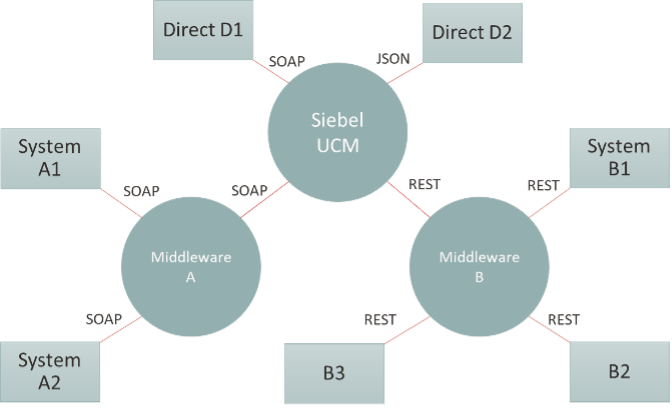
With Siebel CRM Release Update 26.3 and above, Siebel UCM provides support for multiple middleware and publishes the messages in hybrid mode in that, UCM can publish the messages to multiple middleware systems, with cross reference information for its own set of subscribed child systems. In addition, UCM publishes the messages directly to each subscribed stand-alone system.
The result is a more flexible integration model that helps organizations modernize at their own pace, onboard new applications faster, and continue supporting existing investments without forcing a single protocol or platform strategy. The image below illustrates the ability to publish in hybrid mode.
Why this matters
For many organizations, integration landscapes evolve over time rather than being redesigned all at once. Legacy applications may still rely on SOAP or MQ/JMS-based communication, while newer digital platforms increasingly expect REST and event-driven patterns. In these environments, the real value is not just supporting old and new systems—it is doing so in a way that reduces complexity.
With Publish in Hybrid Mode, Siebel UCM can publish messages to multiple configured middleware systems and/or edge systems simultaneously, regardless of protocol. That means customers can support hybrid architectures more naturally, without being constrained to a single middleware path or limited publishing model. This is a meaningful step forward for organizations that need to support:
- SOAP-based legacy integrations alongside REST-based digital ecosystems
- Multiple middleware platforms introduced over time
- Phased modernization programs where not every system changes at once
- Complex topologies that combine centralized integration and direct connections
Key benefits for customers
The ability to publish to multiple systems gives organizations several immediate benefits:
- Greater architectural flexibility by removing single-middleware constraints
- Faster onboarding of new applications and channels
- Cleaner modernization paths without disrupting existing integrations
- Parallel support for existing and modern systems across SOAP, REST, and other protocols
- A consistent master source in UCM across complex enterprise landscapes
A practical way to modernize
Instead of forcing protocol consolidation or redesigning the entire integration landscape, organizations can use Publish in Hybrid Mode to evolve more incrementally. That means you can continue supporting existing enterprise applications while enabling newer channels and services to connect in the format and path that make sense for them. UCM remains the consistent customer master, while publishing becomes more adaptable to the realities of hybrid enterprise architecture.
Join our Customer Connect Webinar
Discover how Siebel UCM can help you support legacy and modern integrations with more flexibility. Join us on April 14, 2026 for a focused session on this topic and learn how to simplify hybrid publishing across middleware and edge systems.