
What problem is your business facing today? Rising customer expectations, fueled by digital disruptors like Amazon, Google, Apple, Shopify, etc. compel businesses to innovate with new services and products. To remain competitive, they must:
- Innovate with new services and products
- Automate capabilities for cost reduction
- Reduce time-to-market for new offer introduction
One area that continues to be a challenge for service providers is product lifecycle management (PLM). Most of our customers have complex processes, disparate systems that are not integrated, and resource limitations that make time to market lengthy and cumbersome. PLM poses significant challenges:
- Multiple catalogs and products as well pricing models that reside in various systems
- Manual processes prevail with reliance on tools like spreadsheet
- Lack of integration between different applications that require product data
- Redundant product data entry across applications that need to be kept in sync
- Insufficient product insights result in misaligned marketing strategies
- Lack of standardization increases integration costs and time.
Many customers who have tried automating PLM have failed due to inadequate capabilities and lack of support for best-practice business processes by underlying products. In this blog we will explore how Oracle’s Concept-to-Market (C2M) processes accelerate innovation, streamline development and enhance competitiveness
How Oracle’s OBMP C2M Solution can Benefit Your Business
With industry and market leaders regularly challenged by innovative service providers offering new products and services enabled by new technologies, there is a need to rethink whether established common practices are truly best practices. Oracle Modern Best Practice (OMBP) illustrates common business processes optimized to take advantage of Oracle’s latest applications and technologies. This enables organizations to stay ahead of change by leveraging new capabilities, integrating cutting-edge cloud, analytics and AI capabilities.
Oracle OMBP Concept-to-Market for Communication, part of the Oracle Digital Experience for Communications solution, standardizes and automates the entire new product introduction process, from original concept (ideation) to implementation of the service in the network and offering it to customers. The solution reduces costs while significantly accelerating offer design processes, all without requiring major system transformations or ongoing IT involvement. By integrating Launch Experience Cloud, Siebel CRM, CX Unity, Marketing Cloud, OCI AI, and Oracle Analytics Cloud, our customers can establish a data-driven best practice approach to bringing products to market. This enables product marketers and managers to craft targeted offers that drive business success and market penetration.
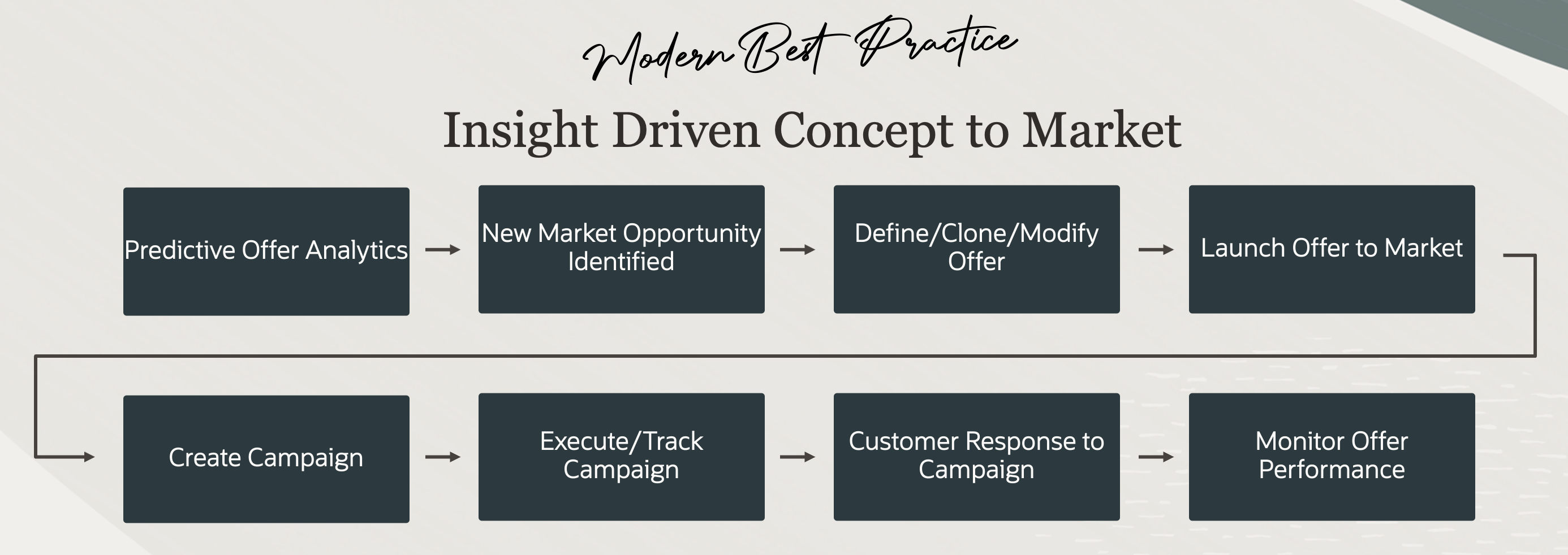
The image below illustrates the key activities that comprise modern best-practice business processes for Concept to Market. Product marketers will gain clarity into each offer’s performance. With performance dashboards in place, product managers can access predictive performance analytics. These analytics aid in offer design by identifying the likelihood of meeting predetermined Key Performance Indicators (KPIs). Recommended promotions for the target market can be easily created by cloning and tailoring existing product offerings. Once an offer is deployed, you can execute campaigns and track the offer’s performance through data analysis. Product managers can then evaluate the offer based on factors like revenue, margin, customer segment penetration, and churn reduction. When KPIs aren’t met, product managers can use data-driven insights to take corrective actions, such as pricing adjustments, bundling changes, etc. By analyzing offer performance metrics (e.g., target market sales, customer churn reduction, sales by channel, campaign effectiveness), product marketers and managers can optimize future performance when designing and launching new offers.
Solution Features
- Predictive offer analytics: Review the performance of current offers in the marketplace and leverage predictive analytics to forecast the potential reception of new offers and promotions.
- New market opportunity: Using data driven insights identify new market segments that can be targeted with similar offers or variations.
- Product recommendaions: Use predictive insights and AI to create offers that maximize alignment with key business KPIs like revenue, margin, customer segment penetration, and churn reduction.
- Define/Modify/Clone offer: Efficiently clone and customize existing product offerings with updated components, features and the right pricing for targeted promotions.
- Launch offer to market: Integrated design and runtime catalog, publish new offers across sales, billing and service catalogs, enabling instant availability through both unassisted and assisted channels.
- Create campaign: Craft targeted customer segments, curate audiences, develops personalized email content and amplify engagement through multichannel campaigns spanning email, SMS and social media.
- Execute / Track campaign:Leverage data visualization dashboards to assess campaign effectiveness, generate tailored reports by audience, segment or individual for actionable insights.
- Customer response to campaign: Target customers with new campaign, offer various promotion (like online discounts to redirect customer traffic to low-cost channel), embeding links with the email campaign, guided navigation to Oracle eCommerce storefront for completing purchase.
- Monitor offer performance: – Create offer performance dashboard to track revenue, margin, customer segmentation and churn reduction, aligning marketing strategies with key business objectives. If KPIs have not been met, get recommendations on pricing adjustments, product modifications, etc.
- Artificial intelligence: Generate product ideas, modeling recommendations, product configuration and pricing optimization.
- Generative AI: Create personalized email content & marketing, optimize the product based on its current performance to enhance market penetration and increase adoption
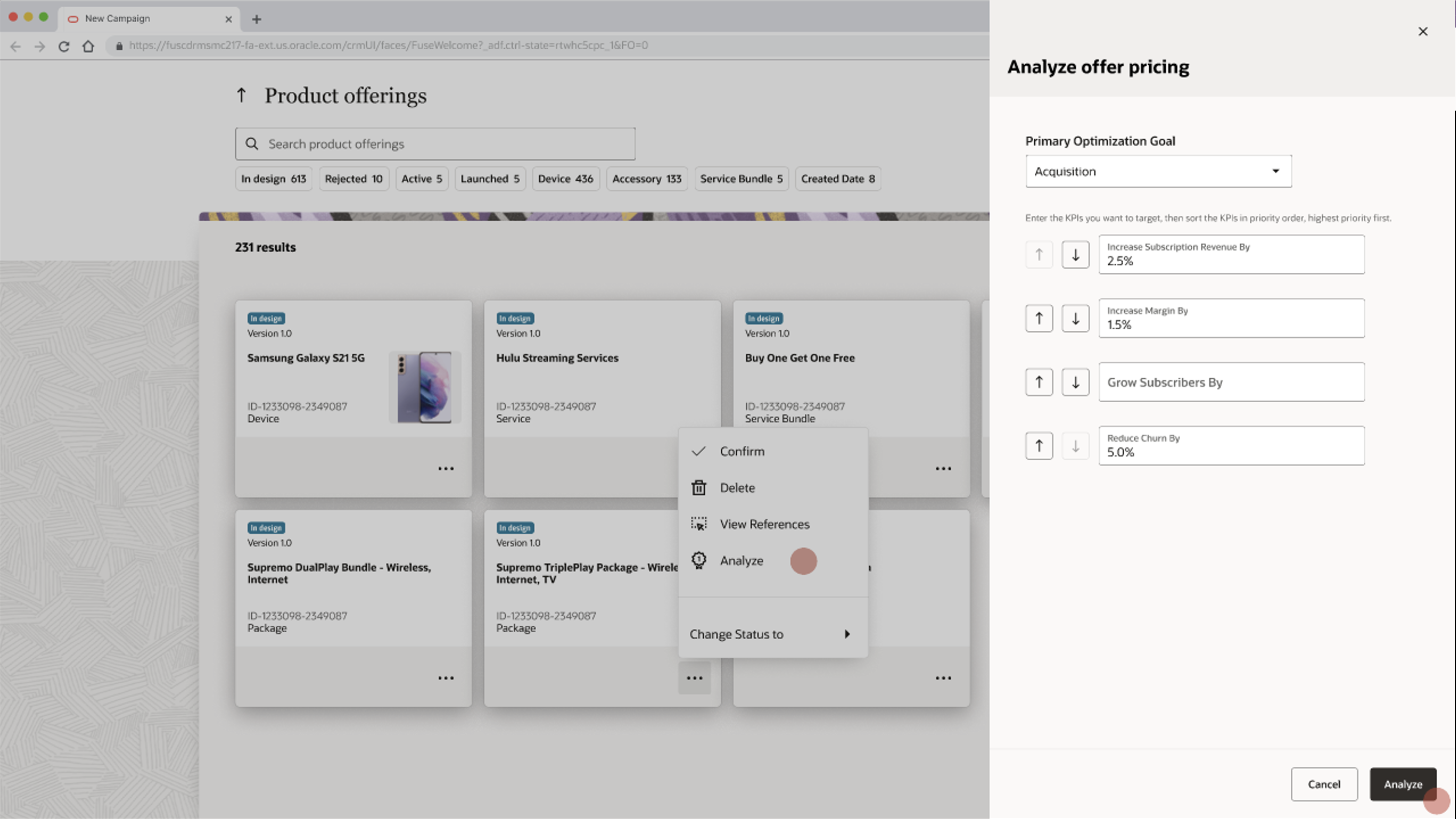
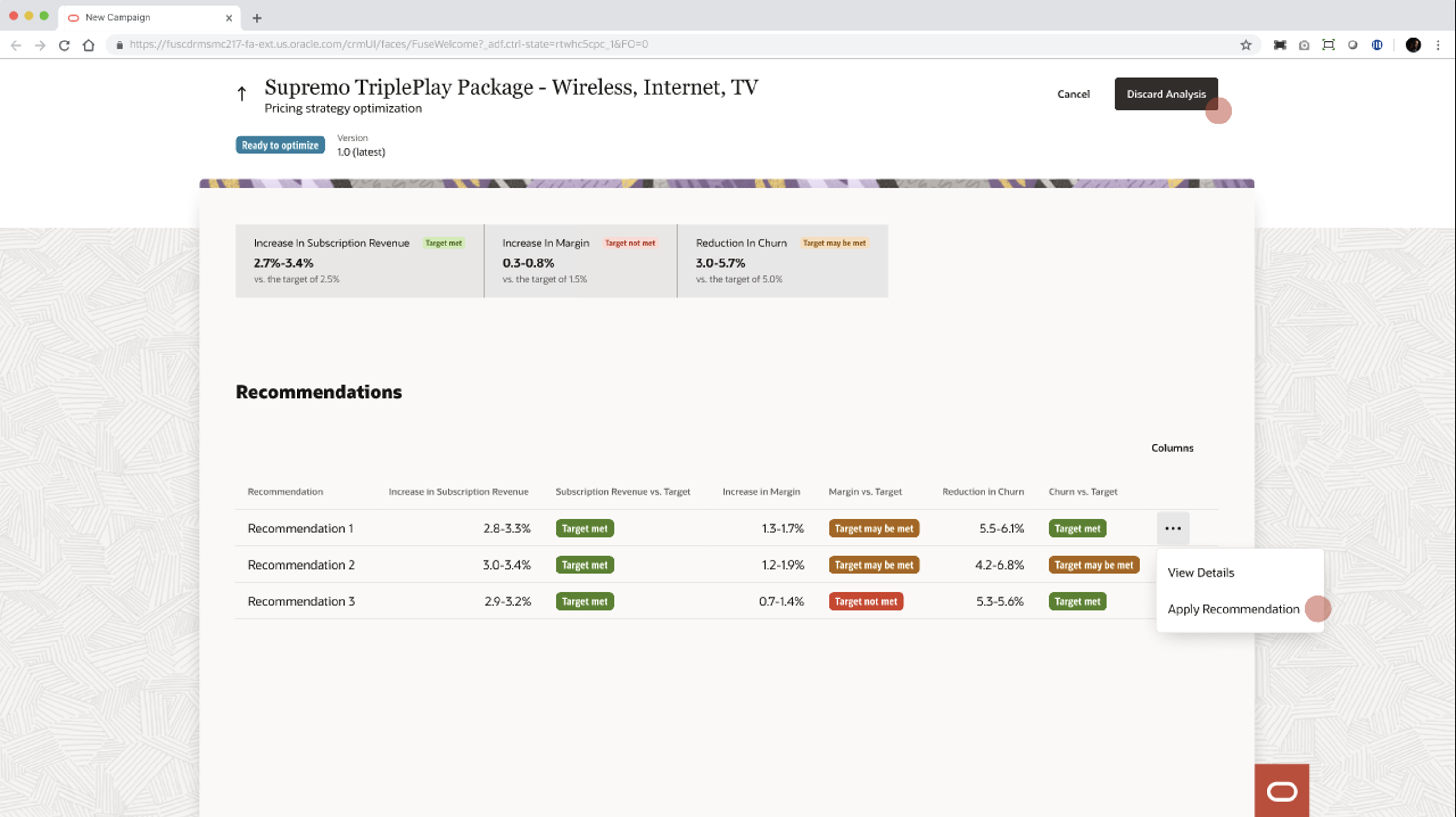
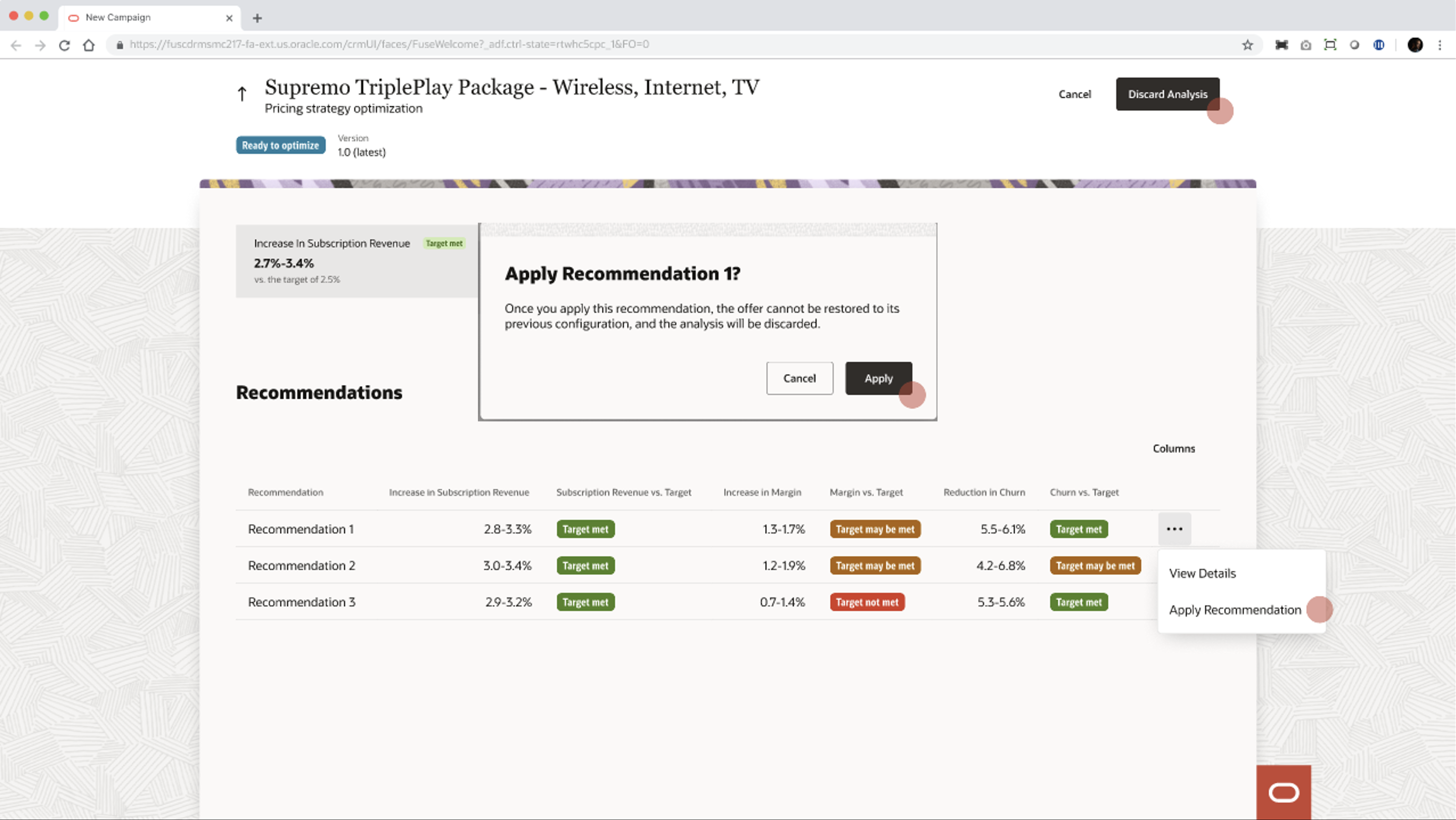
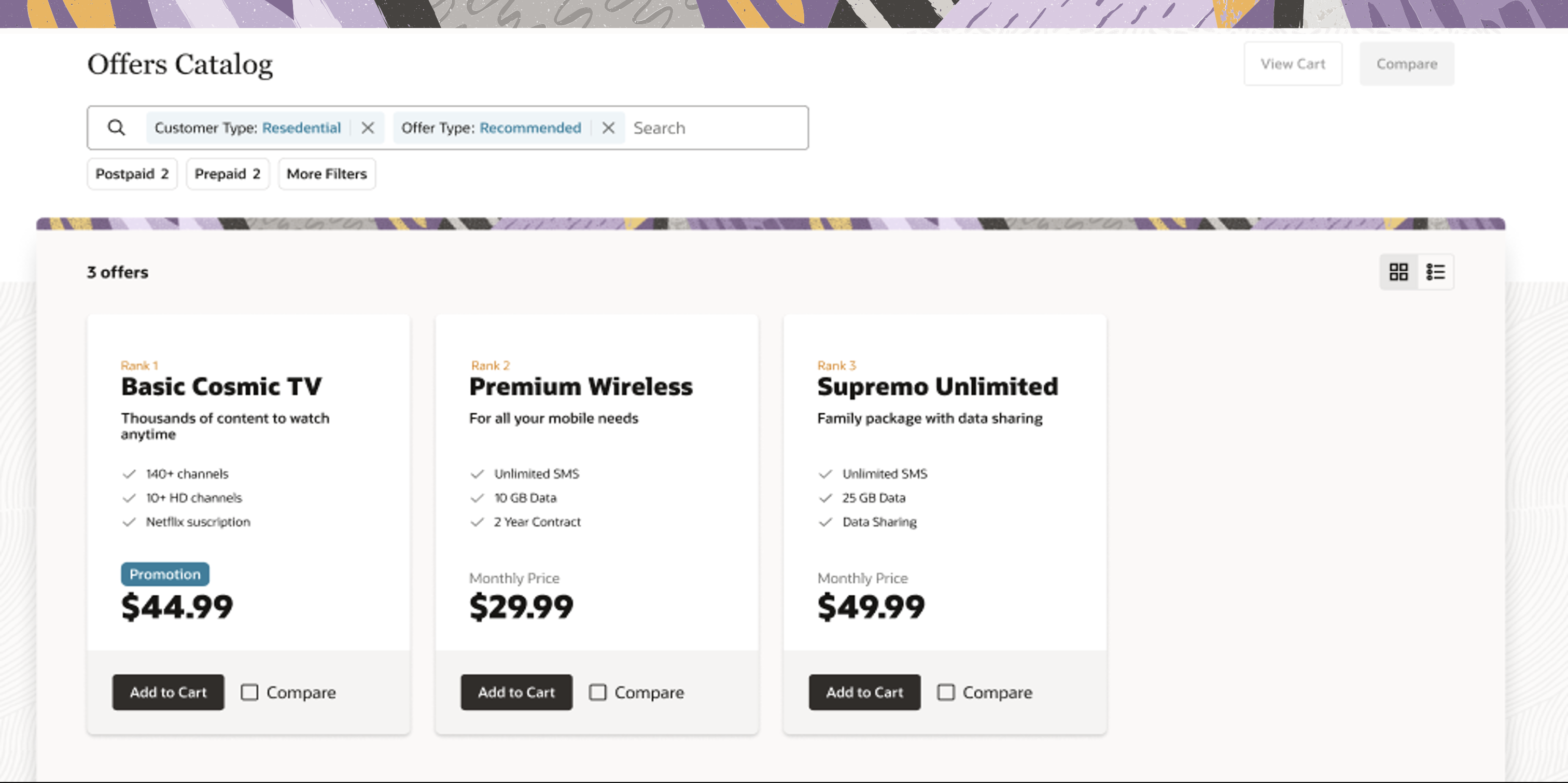
The screenshots below illustrate how a product marketer can analyze and optimize an existing offer using data-driven insights. By setting targets for key business KPIs such as reducing churn, increasing margin, subscription revenue, and subscriber base growth, the marketer can receive AI based recommendations for optimizing the offer. These recommendations can then be reviewed, applied, and used to automatically reconfigure the product.
Business Benefits of the Solution
- Reduced time-to-market: Quickly launch innovative products to capture market share.
- Increased revenue growth: Drive revenue through successful product launches.
- Data-Driven intelligence: Predictive, self-learning, and adaptive intelligence to build products that would meet business KPIs
- Competitive advantage: Establish market leadership through innovation and agility.
- Enhanced customer satisfaction: Deliver products meeting customer needs and expectations.
- Improved operational efficiency: Streamline processes, reducing costs and optimizing resources.
For more information, see: