


This is part 1 of a two-part series; go here for part 2.
As enterprises increasingly distribute their mission-critical workloads across diverse environments, the architecture of observability has become a primary concern for technical architects and senior database administrators (DBAs). The introduction of Oracle Database@AWS provides a powerful convergence of Oracle’s database performance and AWS’s infrastructure flexibility; however, this multi-cloud evolution introduces a new layer of complexity around end-to-end visibility.
Maintaining consistent performance across a hybrid estate requires more than service-level monitoring; it demands a tiered strategy that bridges the gap between infrastructure health and deep database internals. This two-part blog series is intended to help teams implement that tiered approach:
Part 1 covers the options available for monitoring Oracle Database@AWS and the deep observability capabilities you can use to troubleshoot performance with database-level telemetry.
Part 2 provides practical, step-by-step guidance on how to put those options into practice.
For organizations running high-performance workloads, there is a fundamental distinction between foundational monitoring and comprehensive observability:
Foundational monitoring confirms that a system is “up” and highlights resource consumption spikes.
Comprehensive observability explains why a workload is underperforming by correlating database-specific telemetry such as wait events, session activity, and SQL execution plans with underlying infrastructure signals.
Available baseline monitoring
In the Oracle Database@AWS ecosystem, Amazon CloudWatch serves as the primary tool for resource-level visibility, allowing customers to use it as a core part of their database monitoring operations alongside the other applications and systems they already monitor in CloudWatch. OCI publishes database and infrastructure metrics to AWS EventBridge, which CloudWatch consumes to provide basic monitoring and alerting capabilities. CloudWatch is well suited for tracking overall health and resource utilization, enabling teams to quickly identify anomalies and respond to operational events. From a DBA’s perspective, CloudWatch provides the “outer shell” of performance. It lacks the internal visibility required to perform deep-dive analysis on Oracle-specific structures. It cannot, for instance, interrogate the Active Session History (ASH) to identify which specific session is blocking an application, nor can it visualize SQL execution behavior over time. For high-stakes environments where a sub-second delay in query response can impact the business, CloudWatch serves as a baseline, not a complete solution.
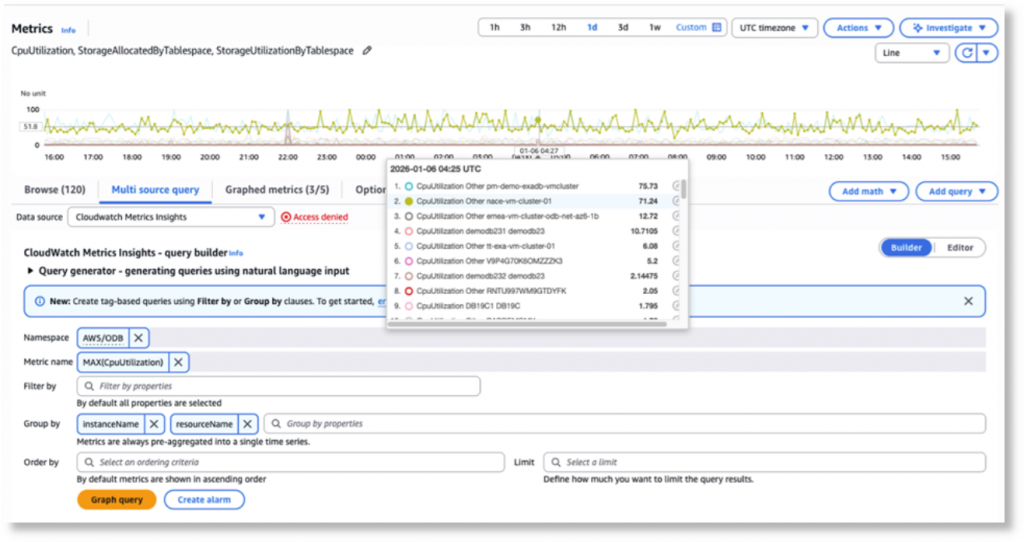
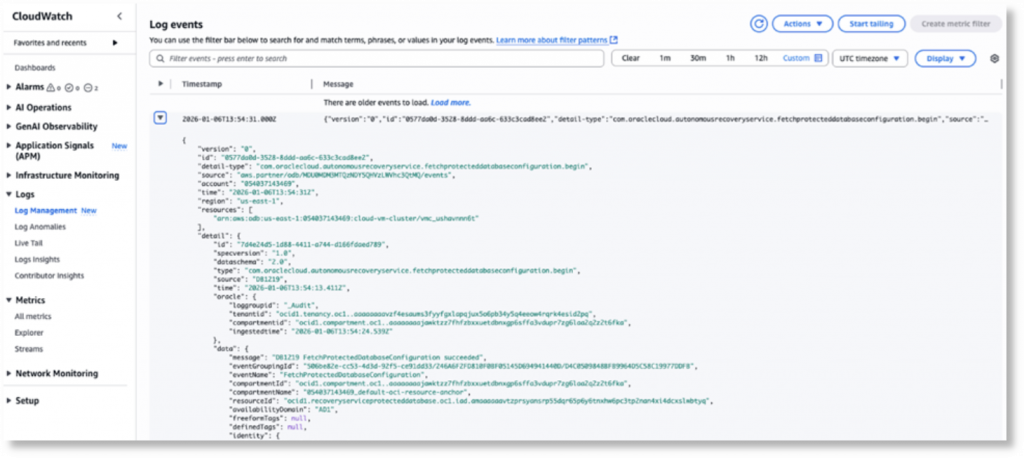
Transition: Moving beyond basic health checks
Foundational monitoring is a prerequisite for cloud operations, but it is rarely sufficient for the rigorous demands of enterprise Oracle workloads. A common scenario illustrates this: a baseline monitor alerts a DBA that CPU utilization on a production instance has reached 90%. While this information is vital, it is insufficient for remediation. The DBA must determine if that CPU spike is caused by a legitimate workload increase, a poorly optimized SQL statement that recently changed its execution plan, or a specific wait event causing resource contention.
To bridge this gap, organizations must transition from reactive resource tracking to proactive management and advanced troubleshooting. This requires an observability toolset capable of surfacing the “why” behind the performance data. By leveraging Oracle-native tools like OCI Database Management and Ops Insights alongside AWS CloudWatch, architects can ensure their teams have the specialized diagnostics required to optimize SQL execution behavior and manage historical wait event patterns effectively.
Oracle-native tools for deep observability
Oracle provides a suite of purpose-built tools designed to complement AWS-native monitoring, offering the granular telemetry required for mission-critical database administration.
OCI Database Management: DBA’s command center
OCI Database Management is designed to lower infrastructure management overhead while providing a unified, fleet-wide view of Oracle Databases, including those deployed on AWS.
Architectural value: The primary value for the technical architect is simplified operations through centralized management. The platform provides a fleet-level overview that allows administrators to assess the health of multiple databases simultaneously. This cross-database metric analysis is essential for maintaining consistency across a scaled deployment.
DBA value: Performance Hub and AWR Explorer
For the DBA, the core of the service is the Performance Hub. It provides a real-time view of database activity, utilizing granular Active Session History (ASH) analytics to isolate performance bottlenecks. When troubleshooting historical issues, the AWR Explorer allows for the visualization of data from Automatic Workload Repository (AWR) snapshots, enabling the identification of performance trends over days or weeks.
Comprehensive administration suite
Beyond monitoring, the service includes a suite of tools for fine-grained performance analysis:
- SQL Tuning Advisor & SQL Tuning Sets: These allow DBAs to identify inefficient SQL and receive specific recommendations for optimization.
- SQL Plan Management: This ensures that SQL execution plans remain stable and performant, even as data volumes or statistics change.
- Optimizer Statistics: Provides tools to manage the metadata that the database uses to choose the most efficient execution paths.
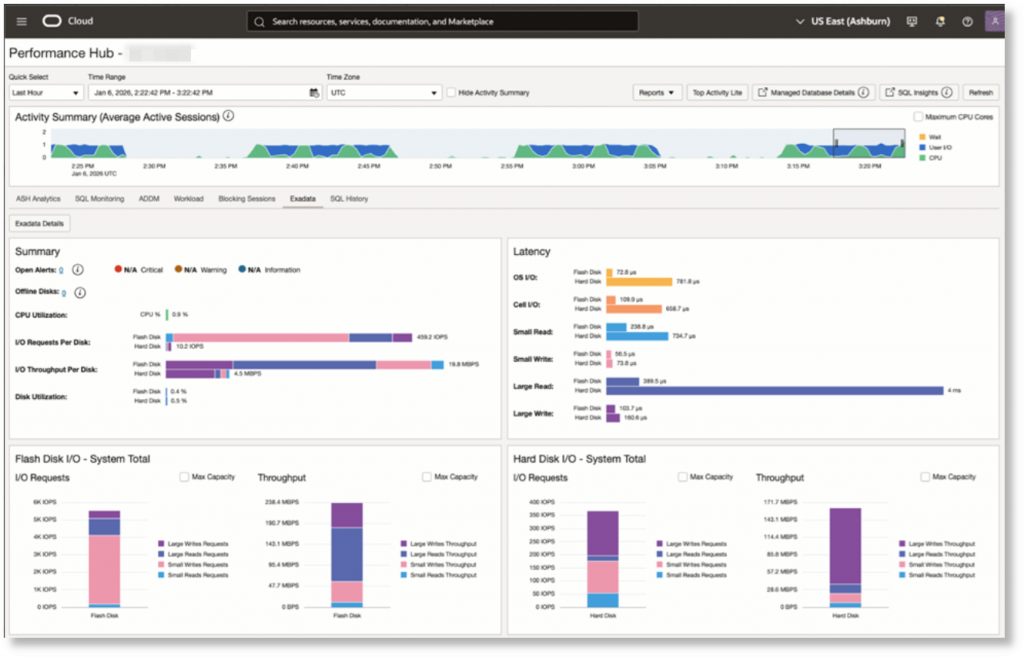
OCI Ops Insights: Proactive capacity and SQL Insights
While Database Management focuses on diagnostics and current performance, Ops Insights is an analytical engine designed for long-term optimization and strategic planning.
Architectural value: AutoML-driven forecasting
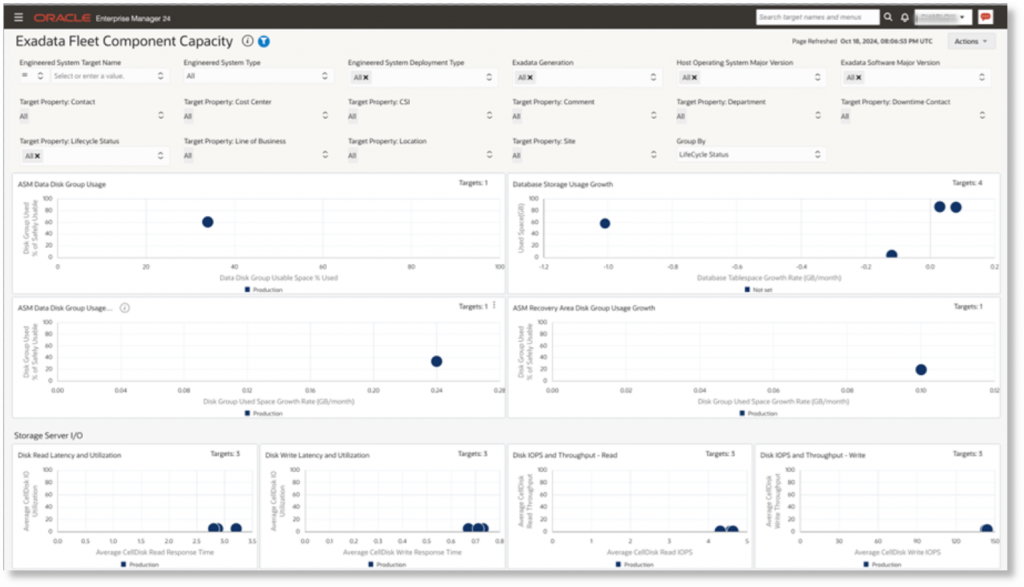
Ops Insights leverages AutoML to provide automated capacity planning. For architects, this is a critical capability for proactive scaling. For high-end platforms such as Exadata Cloud and Autonomous Database on Dedicated Infrastructure, Ops Insights can forecast compute, storage, and workload growth. This allows organizations to anticipate capacity shortfalls and performance risks before they occur, supporting data-driven infrastructure planning and cost optimization.
DBA value: SQL Insights
SQL Insights provides comprehensive SQL performance monitoring at both the fleet and individual database levels. By utilizing historical usage trends and predictive analytics, it highlights anomalies and trends of SQL degradation. This enables DBAs to intervene proactively before declining query performance impacts the user experience.
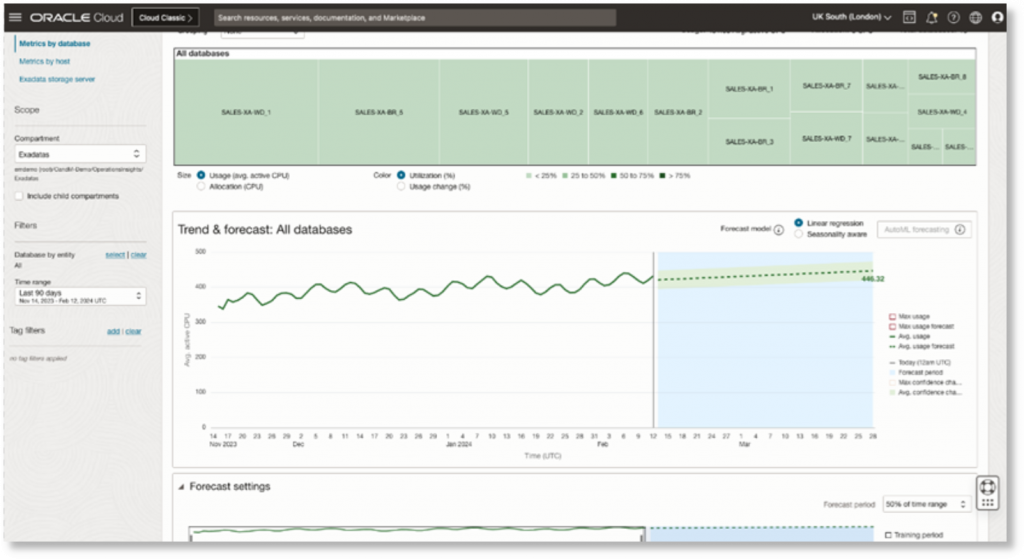
Enterprise Manager: Multi-cloud flexibility
For many organizations, Oracle Enterprise Manager (EM) represents a significant historical investment in skills and custom workflows.
Architectural value: Deployment flexibility
EM offers the unique advantage of flexible deployment options. It can be hosted on-premises, in AWS (running on EC2), or within OCI. This flexibility allows architects to select a deployment model that aligns with their specific compliance requirements and infrastructure strategies. It ensures a smooth transition to multi-cloud operations by maintaining a single pane of glass across the entire hybrid estate.
DBA value: Lifecycle management
EM provides a comprehensive set of capabilities for deep performance diagnostics and lifecycle management. It enables DBAs to leverage their existing expertise to manage Oracle Database@AWS with the same level of rigor they apply to on-premises systems, covering everything from patching to advanced performance tuning.
Enterprise Manager vs. OCI Database Management & Ops Insights: Feature comparison
| Feature category | Capability | Oracle Enterprise Manager | OCI Database Management & Ops Insights |
| Monitoring | Fleet view monitoring | No | Yes |
| Real-time monitoring | Yes | Yes | |
| Metric threshold alarms | Yes | Yes | |
| Alert based corrective actions | Yes | Yes, via Oracle Functions | |
| ML log-based analysis | Yes, via Cloud Extension | Yes | |
| Performance management | Performance Hub & Top Activity Lite | Yes | Yes |
| AWR Explorer | Yes | Yes | |
| ADDM Spotlght | Yes | Yes | |
| SQL Tuning Advisor, SQL Tuning Sets, SQL plan management | Yes | Yes | |
| SQL Insights | Yes, via Cloud Extension | Yes | |
| Custom dashboard framework | Yes | Yes | |
| Deployment and lifecycle management | Provision/upgrade a fleet of databases | Yes | Yes, via the native database console |
| Patch a fleet of databases | Yes | Yes, via the native database console | |
| Clone databases | Yes | Yes, via the native database console | |
| Consolidate and migrate databases | Yes | Yes, via Golden Gate and Data Migration Service | |
| High Availability | Monitoring | Yes | Yes |
| Configuration | Yes | Yes, via the native database console | |
| Security and compliance | User monitoring and privilege analysis | Yes | Yes |
| Security configuration management | Yes | Yes, via OCI Data Safe | |
| DBSAT support | Yes | Yes, via OCI Data Safe | |
| Health checks for databases and Exadata | Yes | Yes, via OCI Data Safe | |
| Regulatory/industry standards assessment | Yes | Yes, via OCI Data Safe | |
| Capacity planning | Exadata Insights | Yes, via Exadata Warehouse | Yes |
| Database resource capacity forecasting | Yes, via Cloud Extension | Yes | |
| Host resource capacity forecasting | Yes, via Cloud Extension | Yes |
Summary: Strategic value of unified observability
The availability of Oracle Database@AWS enables organizations to run their most demanding workloads within the AWS ecosystem, but the success of this strategy depends on technical visibility. A holistic approach that combines the infrastructure-centric monitoring of AWS-native features with the specialized diagnostic depth of OCI Database Management and Ops Insights is essential for operational excellence.
By adopting this unified observability model, technical teams can replace reactive troubleshooting with data-driven optimization. This strategy maximizes DBA productivity, simplifies multi-cloud operations, and ensures that the database environment is architected for long-term performance and reliability. Embracing this comprehensive toolset is a critical step in a successful enterprise cloud strategy.