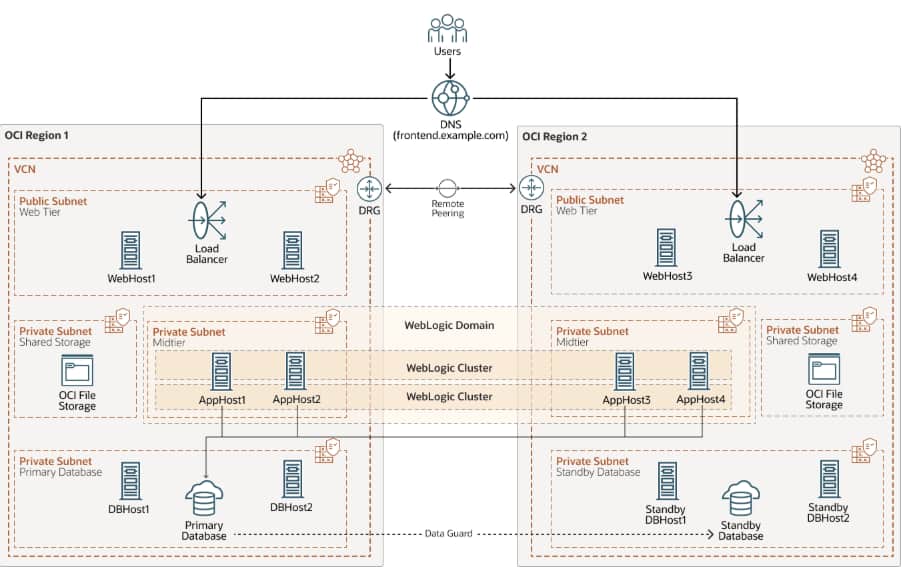

Oracle has released a new comprehensive guide detailing the deployment of Oracle Fusion Middleware stretched clusters. The playbook, “Use Oracle Fusion Middleware stretched clusters for maximum availability”, introduces an active-active configuration for the middleware tier, utilizing stretched clusters to enhance availability and distribute workloads effectively. For the database tier, the solution integrates Oracle Data Guard to ensure failure protection.
Document highlights:
- Architecture Overview: The guide presents a topology where a single Oracle WebLogic Server domain spans two locations, forming a stretched cluster. The database tier uses an active-passive architecture with Oracle Data Guard. All middle-tier servers are configured to connect to the database currently acting as primary, regardless of its location. Other key components include shared storage local to each site, JDBC persistent stores, and dedicated load balancers in each location. These load balancers direct traffic exclusively to web servers that are local to them. Clients connect via a consistent address, with a global load-balancing solution that routes the requests to each location based on predefined criteria.
- Implementation Guidance: The playbook offers instructions for setting up the recommended topology, including configuration steps and guidance on performance and failover implications. In particular, the playbook focuses on how to implement this model across Oracle Cloud Infrastructure (OCI) locations (regions or ADs). The setup leverages OCI features such as traffic management, health checks, load balancers, DNS private views, and dynamic routing gateways to support the configuration.
- Performance Considerations: The document emphasizes the importance of low network latency between tiers for this model. The round-trip time (RTT) between the midtier servers and the database should be below 10 milliseconds to maintain acceptable performance and consistency.
The document presents the results of different performance tests conducted on a stretched cluster, using an Oracle SOA Suite 14.1.2 system that follows the Enterprise Deployment Guide best practices. This is a significant example because it includes many features, such as standard Jakarta components, HTTP session replication, database metadata persistence, a Coherence cluster, and both Java Message Service (JMS) and Java transaction API (JTA) persistent stores, among other relevant considerations for stretched clusters. As a result, the described topology and recommendations can also be applied to other Oracle Fusion Middleware environments and components.
This document is intended for organizations aiming to implement resilient and efficient Oracle Fusion Middleware deployments across nearby sites, providing detailed insights into architecture, performance optimization, and failover strategies.