

In enterprise environments, restarts of critical components are unavoidable. They can result from unexpected failures and can also be a necessary part of maintenance and patching.
When restarts happen, what matters is how quickly and smoothly services recover. How much disruption do applications and customers see? How fast do teams return to full productivity?
That is where Oracle AI Database makes a decisive difference. It reduces the time between a database restart and full application usability. That means faster recovery, and in many cases, little to no noticeable impact for users.
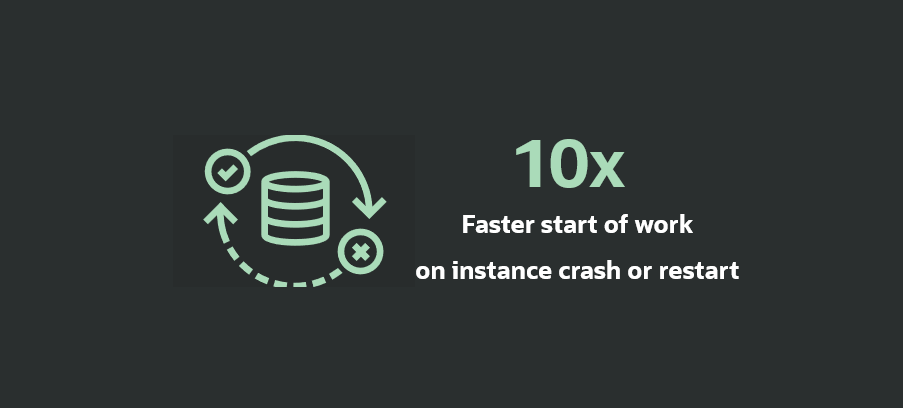
Bring OLTP workload back online up to 10X faster
Oracle Real Application Clusters (RAC) Fast Restart Recovery shortens the time from an instance crash or restart to a fully productive database. OLTP applications that were running on the affected instance can resume work up to 10X faster in Oracle AI Database 26ai compared to Oracle Database 19c. As a result, end users often see little to no disruption.
During recovery, the workload continues to run across the remaining database instances in the cluster. This keeps the Oracle RAC environment balanced and helps deliver predictable recovery times. As a result, customers can continue meeting SLAs during planned maintenance or unexpected failures.
Facilitating features such as a predefined recovery instance – called Buddy Instance – and parallel processing of the dirty buffer list, Oracle AI Database 26ai can significantly accelerate service availability, the outcome businesses care about most.
Open Pluggable Databases up to 2X faster after restart
Pluggable Databases (PDBs) are the foundation for consolidation. Running many workloads across a large number of PDBs, even small delays during restarts, failovers, or planned maintenance add up quickly.
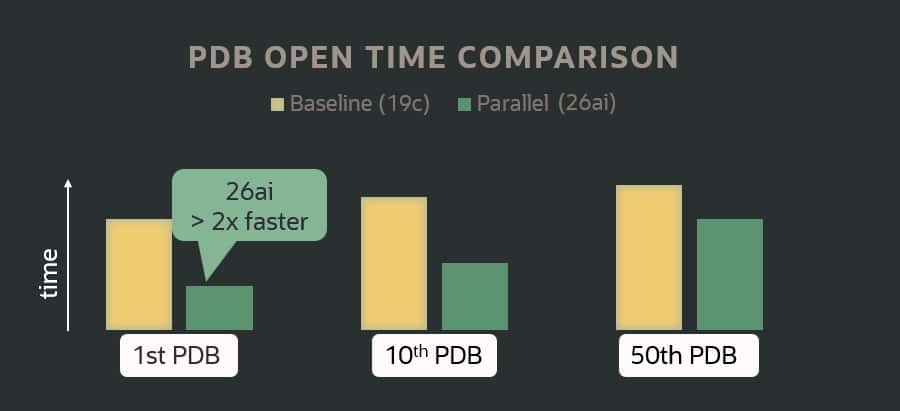
Oracle AI Database 26ai with RAC improves multitenant recovery by opening PDBs up to 2X faster compared to Oracle Database 19c. It achieves this by parallelizing work that previously ran sequentially, including Distributed Lock Manager (DLM) operations during PDB open.
As a result, PDBs become available sooner after maintenance or failover. Applications see less downtime. Operational bottlenecks are reduced, and the impact on other tenants in a shared environment is minimized.
Reduce disruption with Application Continuity
Even with faster restarts and faster PDBs open, the most effective way to reduce disruption is to prevent applications from experiencing it in the first place.
Application Continuity reduces disruption by automatically replaying interrupted transactions after an outage. This helps planned maintenance and unplanned outages occur with no visible application impact.
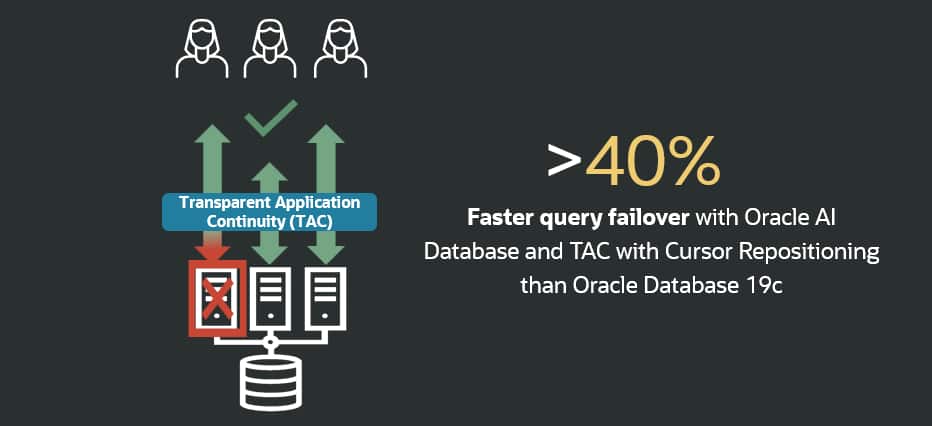
Oracle AI Database 26ai with Transparent Application Continuity with Cursor Repositioning delivers more than 40% faster query failover than Oracle Database 19c. It avoids regenerating and replaying the query on the failover instance only to discard rows already sent to the client. Instead, it regenerates the result set, repositions the cursor to the last row delivered, and resumes processing from the next row.
Conclusion
Taken together, these innovations accelerate recovery and minimize application impact in Oracle AI Database 26ai.
- Fast Restart Recovery brings OLTP back to productivity sooner.
- Faster PDB Open improves multitenant recovery, helping cut multitenant downtime in half.
- Overall faster service recovery helps clusters return to a steady state more quickly.
- Application Continuity reduces disruption further by automatically replaying interrupted sessions.
As a result, many planned maintenance events and most unplanned outages have no visible application impact. This enables more resilient e-commerce operations, stronger availability for financial services workloads, and higher efficiency in consolidated multitenant deployments.
Go to Configuring Continuous Availability for Applications for more information.