
For organizations that run critical Oracle environments, backup is not the strategy, but recovery is.
That distinction is becoming more important by the day. In a world of ransomware, credential compromise, insider risk, and AI-accelerated cyberattacks, the real test is no longer whether data was backed up but the real test is whether the business can recover fast, recover cleanly, and recover without data loss.
Beware..ransomware will not knock. It will sneak in.
That is exactly why generic backup platforms fall short for high-scale Oracle recovery.
Generic Backup Coverage vs. Oracle Recovery Architecture
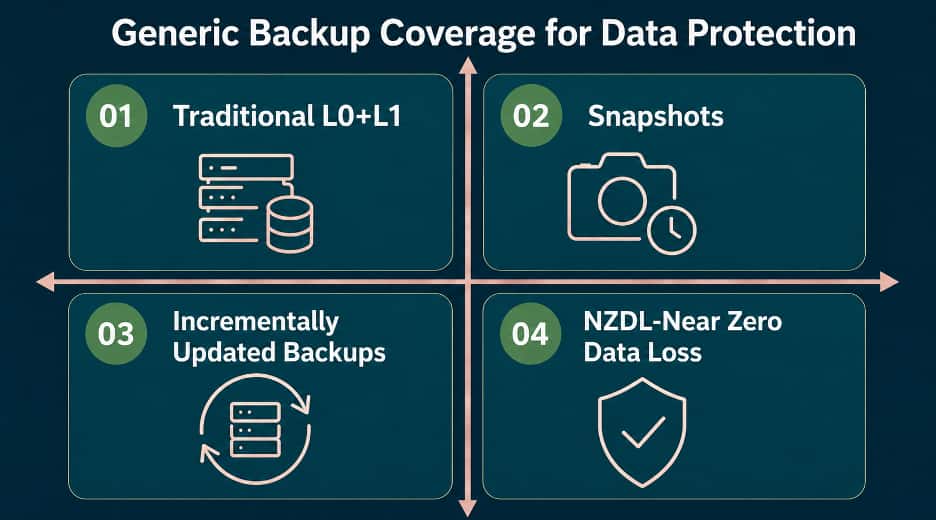
Most enterprise backup platforms are designed for generic coverage across workloads, environments, and data types. That model can provide basic data protection, but it is not sufficient for Oracle recovery at scale.
This gap is increasingly visible in non-purpose-built Oracle backup designs.
Many solutions still rely on storage snapshots as a primary backup mechanism. While snapshots can create rapid point copies, they do not inherently provide the continuous recovery architecture, validation depth, or Oracle-aware recovery workflow required for business-critical environments.
Others depend on RMAN incrementally updated image copy workflows to create up to date full backups, positioning this as ‘incremental forever’. Although functional, this is a comparatively primitive backup construct that extends traditional incremental-merge concepts without any new recovery capabilities. These solutions fall short in delivering a true recovery architecture designed for modern cyber resilience and large-scale Oracle protection.
Some implementations also attempt to approximate real-time redo protection by introducing a standby database that writes redo logs to an NFS-hosted share, as a way to capture redo activity generated by the primary database. This approach introduces additional failure domains across network, storage, standby, and redo transport layers.
The result is a more complex and brittle design that can compromise RPO, increase operational risk, and make implementation and support significantly harder.
Recovery expectations have changed. Periodic backups and restore tests are no longer sufficient for Oracle environments facing ransomware, AI-driven attacks, and operational failures. They require a recovery architecture that continuously validates recoverability, limits data loss exposure, preserves backup integrity, and enables predictable recovery at scale.
Why ZDLRA Is Different
Oracle Zero Data Loss Recovery Appliance, or ZDLRA, is not a generic backup platform. It is engineered specifically for Oracle Database protection and recovery, which ultimately matters most, not monitoring backup jobs day in and day out.
ZDLRA minimizes data-loss exposure, continuously validates recoverability, and secures recovery points with Oracle-aware controls, offering a strategic cyber-resilience layer, not just backup infrastructure.
That distinction matters because most competing solutions remain generic by design. They protect Oracle using interval-based backups, snapshots, proxy media servers, or image copy-based workflows, but lack deep integration with Oracle recovery semantics such as redo, archive log dependency, transactional consistency, and deterministic point-in-time recovery. In a ransomware event, those gaps become operational risks.
Oracle recovery requires validated, current, Oracle-consistent recovery points that can be restored with predictable outcomes under attack conditions. This is the singular mission of and Oracle-engineered design behind ZDLRA.
Exadata + ZDLRA: Integrated Recovery Architecture
The architectural advantage becomes even stronger with Exadata.Exadata with ZDLRA delivers a tightly integrated Oracle recovery architecture validated and performance-tested as a single end-to-end design. Backup, redo transport, restore throughput, and recovery execution are aligned to Oracle database behavior rather than bridged across heterogeneous infrastructure layers. With proven deployment patterns, including dedicated 100Gb backup and restore network paths through top-of-rack switches, it is optimized for high-throughput protection and predictable large-scale Oracle recovery in ways generic platforms are difficult to replicate.
Recovery Confidence Is the Competitive Difference
In architecture reviews, recovery is discussed in terms of RPO, RTO, validation, and scale.
That is where generic platforms often become exposed. They are optimized for coverage breadth. Critical Oracle recovery requires precision.
This is where unique and proven ZDLRA features stand out.
- Real-time recovery protection
- ZDLRA captures Oracle redo in real time, protecting changes as they are generated instead of waiting for the next scheduled backup or log collection cycle. This enables near-zero RPO, while non-ZDLRA platforms typically leave exposure between backup or snapshot intervals.
- Continuous Validation
- ZDLRA continuously validates backups and redo for physical correctness, corruption exposure, and recoverability as part of the protection workflow. Generic platforms may verify job success or object checksums, but ZDLRA performs Oracle-aware validation before recovery is needed.
- Incremental-forever backup strategy
- ZDLRA uses RMAN-integrated incremental-forever backups and Virtual Full Backup technology, ingesting only changed blocks after the initial backup. Unlike generic platforms that rely on periodic fulls, synthetic fulls, or agent-side dedupe, ZDLRA reduces production I/O, backup windows, network load, storage consumption, and restore-path complexity.
- Space-efficient encrypted backups
- ZDLRA combines Oracle-aware incremental-forever, compression, and encryption while preserving RMAN-native recovery semantics. These innovations greatly minimize overall storage costs while preserving database encryption from production to backup.
With Oracle Transparent Data Encryption (TDE) databases, the gold standard for securing production data, ZDLRA space-efficient backups become even more powerful. Compared with generic dedupe appliances, snapshots, or object-store policies which cannot compress encrypted data, ZDLRA keeps TDE database backups compressed and encrypted, with built-in RMAN catalog integration for seamless Oracle restore operations.
In the age of ransomware and AI-driven attacks, simply checking off the box on completed backup jobs is no longer the benchmark. It is now on complete recovery assurance with an increasingly critical eye toward return on investment.
Summary
For mission-critical Oracle environments, general purpose backup platforms often compensate with fragmented architectures built on full backups, snapshot dependency chains, synthetic reconstruction, and bolt-on cyber-recovery controls. That introduces more failure domains, more infrastructure/operational overhead, and less deterministic Oracle recovery under scale, corruption, or attack. ZDLRA is engineered to eliminate that complexity rather than manage around it.
ZDLRA brings together the core capabilities required for modern Oracle recovery at scale:
- Real-time protection to eliminate data loss
- Continuous validation to help ensure recovery readiness and data integrity
- Space-efficient encrypted backups that balance storage efficiency with security
When combined with Exadata, ZDLRA forms a fully validated and benchmarked architecture, delivering high availability, performance, and resilience through an engineered, end-to-end Oracle solution. And with the latest RA26 generation, usable capacity increases to nearly 2 PB, extending enterprise scale, without changing the core recovery model. As demonstrated over the last decade, ZDLRA continues to align with growing enterprise database environments, longer retention requirements, and ever-increasing cyber-resilience demands.
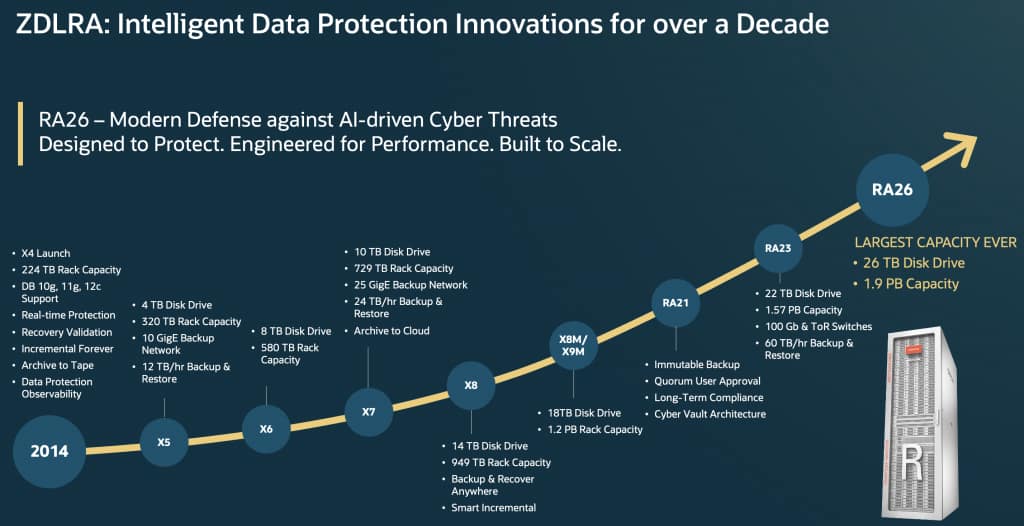
We look forward to what the next decade will bring!
For more information, check out Zero Data Loss Recovery Appliance product central, Zero Data Loss Recovery Appliance Features and the RA26 DataSheet.