
Oracle Update Advisor is already part of the Oracle Database software maintenance story. Many customers have encountered Oracle Update Advisor through established Oracle tooling such as Oracle Fleet Patching and Provisioning, Database Configuration Assistant, dbcactl, and AutoUpgrade Patching.
Oracle FPP documentation:
https://docs.oracle.com/en/database/oracle/oracle-database/26/fppad/about-oracle-update-advisor.html
Oracle Database patch maintenance and DBCA documentation:
https://docs.oracle.com/en/database/oracle/oracle-database/26/dbptc/index.html
AutoUpgrade Patching documentation:
https://docs.oracle.com/en/database/oracle/oracle-database/26/upgrd/autoupgrade-patching.html
Those tools remain important. Oracle FPP, DBCA, and AutoUpgrade help customers simplify software maintenance, evaluate software health, work with recommended patch levels, and streamline patching workflows.
But now there is a new opportunity: Oracle Update Advisor REST APIs.
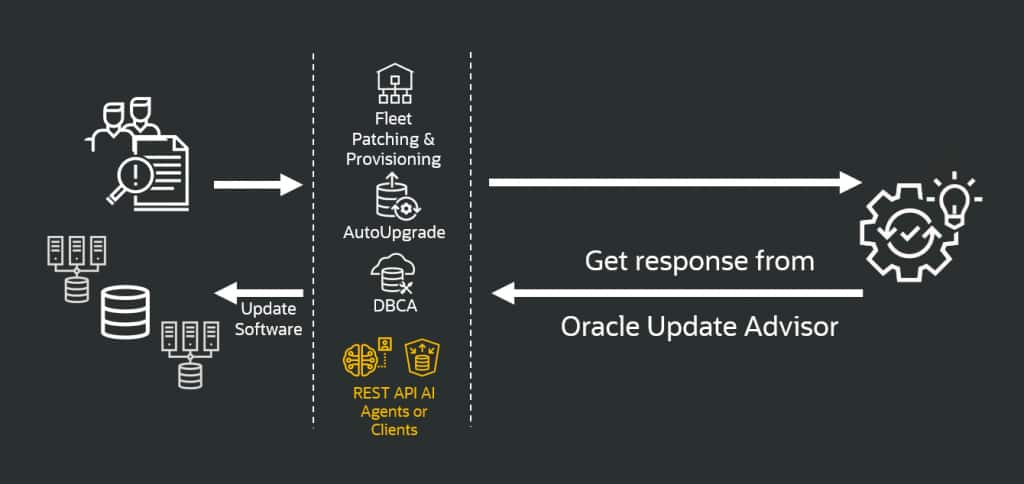
That means you can create your own client or agent. You can build your own workflow. You can connect Oracle Update Advisor directly into the way your team plans, checks, reports, and automates patching.
And with AI, this is much easier than you might think.
So here is the challenge:
Build your own Oracle Update Advisor client or agent using AI.
Make it a command-line tool. Make it a small web app. Make it a CI/CD integration. Or make it an agent that helps monitor your Oracle AI Database patching lifecycle over time.
A useful first version might support:
- registering with Oracle Update Advisor
- submitting a software health request
- requesting recommendations
- polling asynchronous requests
- reading JSON request files
- displaying useful results for DBAs and platform teams
A more advanced version could become part of an ongoing maintenance workflow. An AI agent could run scheduled checks, detect when software falls behind policy, request recommendations when health status is not green, summarize results, watch for credential lifecycle messages, and prepare reports or tickets for review.
The important point is that an agent should assist the patching lifecycle, not blindly take over operational decisions. Keep human review and approval in the loop for anything that changes infrastructure or affects availability. Used well, an agent can help teams stay informed, reduce repetitive work, and make better maintenance decisions faster.
I used OpenAI Codex as my current tool of choice to create clients and agents against the Oracle Update Advisor REST APIs. Codex works well for this kind of project because it can read documentation, inspect files, generate code, revise a working client, and help test the result in a tight development loop.
But Codex is not required.
Use your AI tool of choice. Whether you are a seasoned AI professional, a DBA trying LLMs for the first time, or a developer looking for a practical automation project, the challenge is the same: take the Oracle Update Advisor API guide and turn it into something useful.
Try prompts like:
>> Create a Python command-line client for the Oracle Update Advisor REST API.
>> Implement registration, signed requests, health checks, recommendations, and async polling.
>> Create an agent that periodically checks Oracle Update Advisor health status and summarizes recommendations for a DBA team.
>> Generate sample JSON payloads and a README for this client.
The Oracle Update Advisor REST API workflow is approachable:
- Register your client.
- Submit a software health request.
- Review the returned health status.
- Request recommendations when needed.
- Poll asynchronous requests when required.
- Feed the result into your own patch planning workflow.
The current API reference is available in My Oracle Support as:
Oracle Update Advisor REST API Documentation
The Oracle Update Advisor REST API reference is available in the public Oracle AI Database documentation:
Oracle Update Advisor API Reference and Integration Guide
This is a fun project, but it also produces something valuable. You learn the API. You learn how Oracle Update Advisor fits into your patching process. And you end up with a client or agent tailored to your own environment.
So here is the challenge again:
Pick an AI tool. Pick a language. Build your own Oracle Update Advisor client or agent.
You may be surprised how quickly you can go from documentation to a working tool, and how useful that tool can become in your Oracle AI Database patching lifecycle.