
Networks get faster. Workloads keep growing.
As a result, bottlenecks that were historically sitting in the network layer have moved, creating software and architectural opportunities for improvement that have been unnecessary for years.
Over the last few release update cycles, Oracle Data Guard implemented many such improvements. Our focus has been simple: finding existing limits and removing them.
The outcome is outstanding. Across our benchmarks on Exadata on-premises and on Oracle Cloud Infrastructure, we see approximately 2× to 9× higher redo transport throughput, depending on configuration. We expect our customers to see similar benefits once they run recent Exadata System Software and Oracle AI Database 26ai Release Update.
What You Get: Measurable Gains Across Environments
These improvements are consistent, but their magnitude depends on where and how you run.
On Exadata on-premises without network encryption, sustained redo transport rates roughly doubled. Systems that previously operated around ~850 MB/s now reach ~1.6 GB/s.
In the cloud, where network encryption is not negotiable, the gains are more pronounced: Cross-AD and cross-region deployments see approximately 4.5× to 9× throughput improvements.
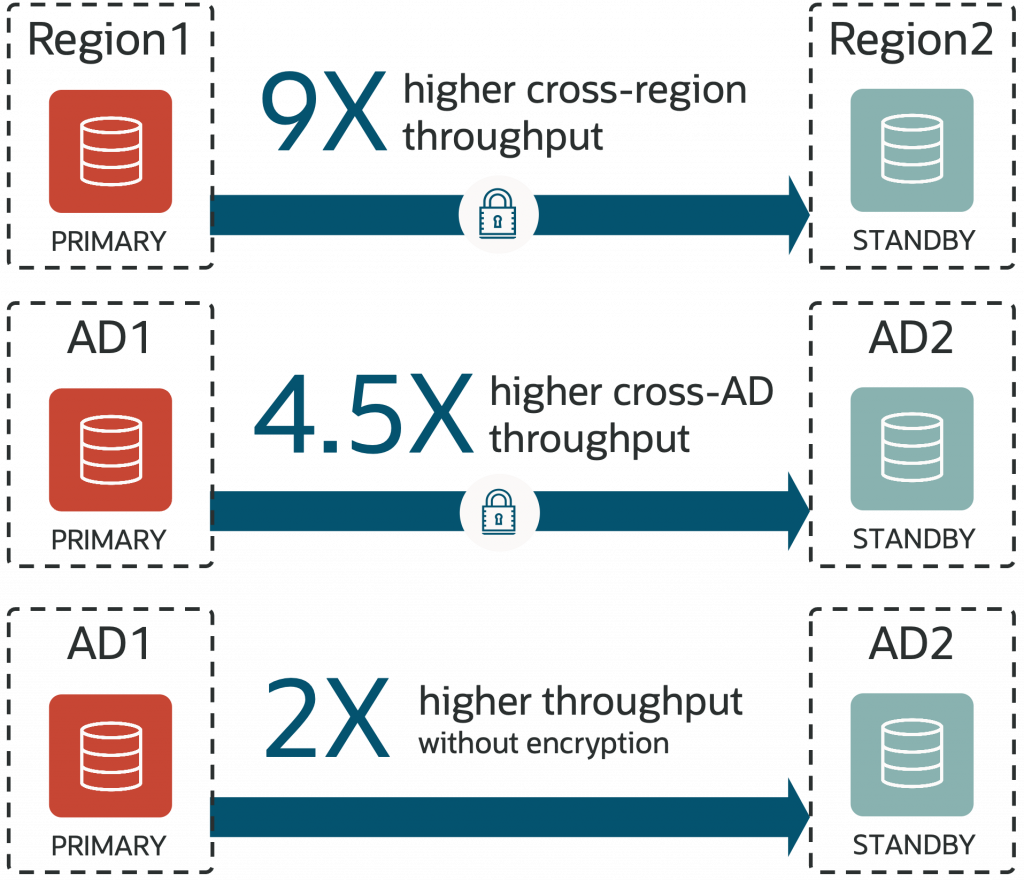
The encryption type plays a key role: TLS-based transport delivers substantially higher throughput than Native Network Encryption (NNE).
Finally, ASYNC transport scales more effectively. With multiple connections, redo shipping can match the characteristics of the underlying network—most notably per-connection bandwidth limits.
Why It Matters
You get more headroom to handle growing redo rates without redesigning your architecture.
You see more consistent low transport lag, even across longer distances.
More importantly, more standby databases meet protection goals. Configurations that were previously borderline now operate comfortably within target RPOs.
How We Got There
The gains come from a set of complementary improvements, each targeting a different part of the redo transport path.
TLS-based transport has been optimized and is now the preferred path
It benefits from OpenSSL 3.5, and now leverages vectored I/O for the TCPS protocol, which reduces buffer copying and minimizes kernel-space transitions.
The result: encryption keeps pace with higher throughput instead of competing with it.
Note: TLS Vectored I/O is available with Oracle AI Database 26ai and 19.30 Release Update (and later). OpenSSL 3.5 is GA only with Oracle AI Database 26ai at the moment.
ASYNC redo transport now uses parallel connections
This allows Data Guard to utilize available network bandwidth more effectively, especially in cross-region deployments.
Instead of relying on a single connection that saturates the per-connection bandwidth, transport scales with the network.
Note: ASYNC redo transport parallel connections are an Oracle AI Database 26ai-only feature, enabled by default on OCI.
Standby redo logs fully leverage Exadata flash cache
Before this improvement, the standby redo logs were bypassing the flash cache, making the I/O subsystem a bottleneck under heavy redo generation. Now it keeps up with the transport layer. This ensures the Exadata standby system can absorb higher redo rates consistently.
Note: This improvement is available on Exadata System Software 25.1.6 (and later).
Bringing It Together
Each of these improvements addresses a different part of the path—encryption, network usage, storage, and internal processing.
Together, they reshape the overall throughput efficiency.
A New Operating Envelope for Data Guard
Redo transport throughput now better aligns with the fastest networks.
The improvements are largely transparent. No major changes are required to benefit from them, except for following our Maximum Availability Architecture best practices.
What changes is what you can expect: higher redo rates, longer distances, and tighter protection targets.