
For decades, process automation ran on a single execution model and a simple premise: if you could enumerate the logic, you could automate the work. Deterministic flows captured everything that could be written down as steps and rules. Case models stretched the boundary by enumerating the activities that might happen and leaving a person to decide, which ones actually did. Everything beyond that stayed with people — the exceptions, the interpretation, the ambiguity and in our experience, that’s where the cost and the delay actually live.
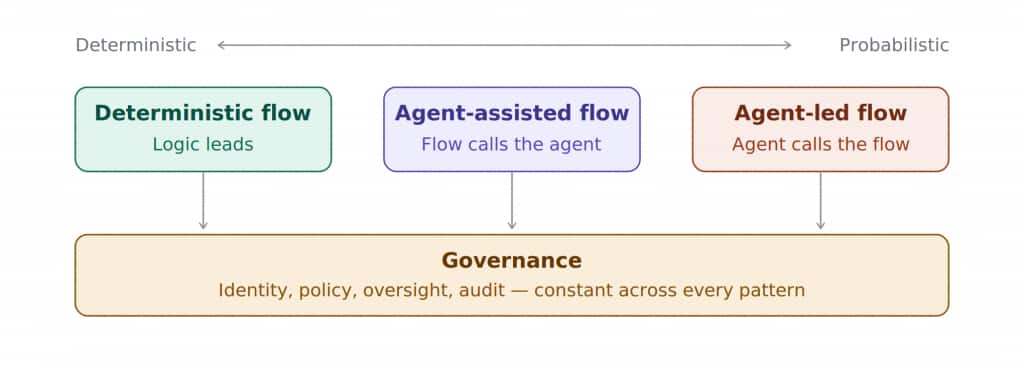
Agents move that boundary. Work that always needed human judgment — reading an ambiguous supplier email, untangling a mismatched invoice, deciding how to settle a dispute — can now be automated, within bounds you set. For the first time, the frontier is advancing into judgment itself. That means process automation is evolving from one execution model to three: deterministic flows where the work is enumerable, agent-assisted flows where judgment appears at known points, and agent-led flows where the path can’t be known in advance. The design decision of the next decade is which execution model each piece of work deserves. Put simply: you shouldn’t design your next process the way you designed your last one — and what follows is how to do it instead.
So how do you apply this in practice?
Every process you automate now has a choice of execution model, and there are three. The deterministic flow is the kind you’ve always built: you define the logic, the engine executes it, and the behavior is predictable and repeatable — testable before it runs, traceable after, and typically far cheaper to execute than model inference. The agent-assisted flow keeps that deterministic backbone but adds judgment at specific steps: where a step needs interpretation — an ambiguous document, an unexplained mismatch — the flow hands it to an agent, takes back a structured result, and carries on. This is where many real processes live: predictable end to end, with an agent handling the moments that rules can’t. The agent-led flow goes further: you give an agent a goal, context, and tools, and it reasons its way to an outcome, deciding each next step itself. It handles ambiguity that no predefined flow can — but it doesn’t guarantee the same path twice. That’s not a defect; it’s simply the nature of agents.
Whichever model a process uses — and most organizations will end up using all three — one layer sits across every one of them: governance. Identity and permissions, policy, human oversight, observability, and audit don’t change as execution does. They’re what make these automations safe to trust, and safe to run in production.
The patterns that follow aren’t just for new builds. They’re also the lens for the processes you already run: every flow you have today maps onto this architecture — most into Integration, Decisions, and HITL, and some, now, onto agent-led execution. Modernizing doesn’t mean starting over, either. Your existing process models hold years of business knowledge — the systems involved, the rules that matter, the points where people decide, the exceptions the business has learned to handle. The goal is to carry that knowledge into a simpler architecture: easier to operate, easier to evolve, and ready for agents where they add value.
Three patterns for building on Oracle Integration
The three patterns share the same controls — execution, policy, accountability, and audit. What changes from one to the next is autonomy: how much of the flow you hand to an agent. That’s a decision you’ll make per process.
Pattern 1 — Deterministic flow
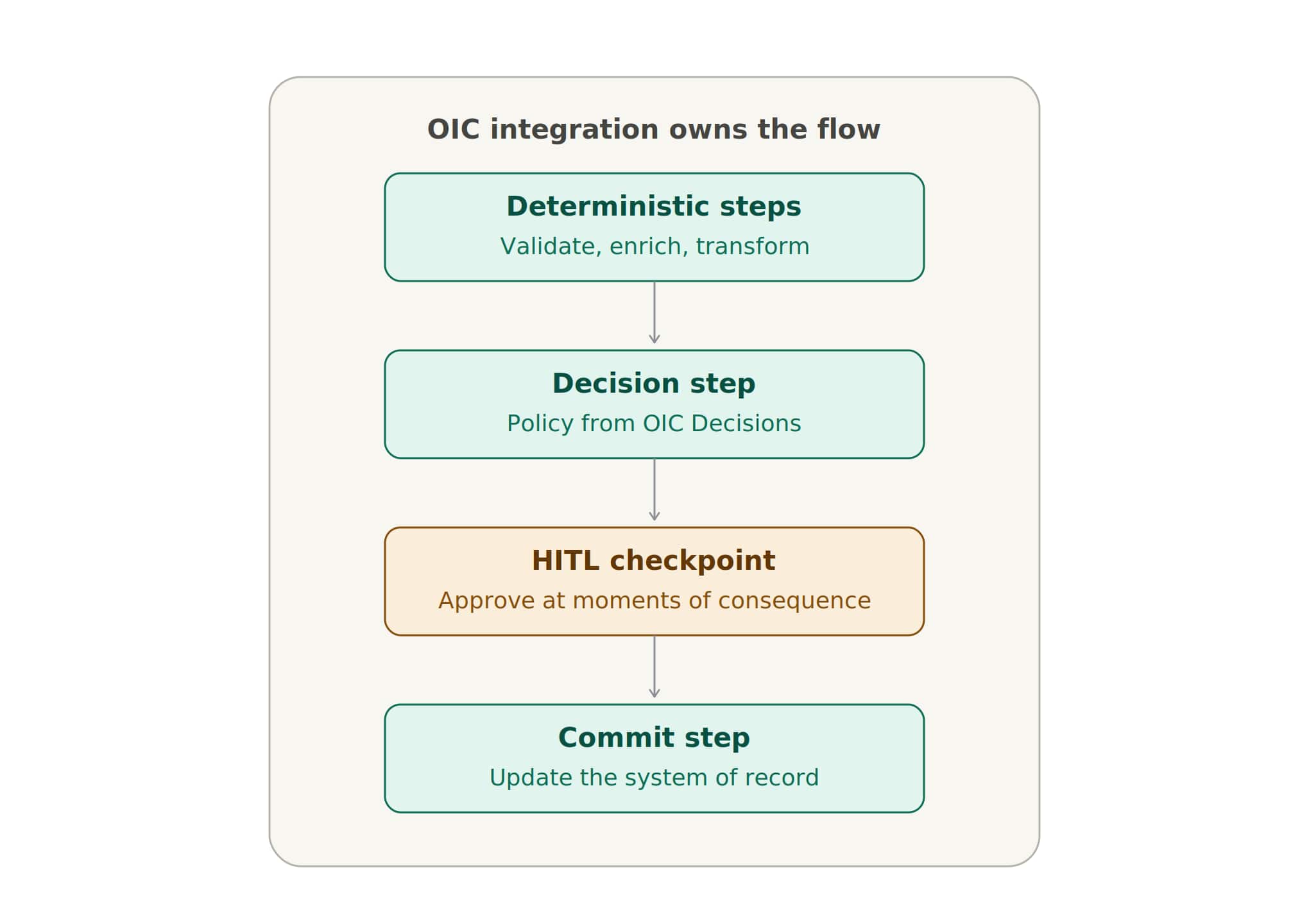
Anything you can enumerate stays deterministic. And deterministic work belongs in an OIC Integration, not a process diagram. Validation, enrichment, matching, transformation, system-of-record updates, routing, orchestration — all of it lives naturally in the integration itself. Add Decisions where business policy needs to stay explicit and independently managed. Add HITL where a person needs to decide. A separate BPMN process should be the exception, not the starting point. The design principle is simple: start with the work, not the workflow diagram, and use the simplest execution model that solves each part of the problem. Think of order-to-cash: a CPQ quote becomes a Fusion ERP order, becomes a fulfillment event, becomes an invoice. Every step is enumerable, and there’s no reason for an agent anywhere in the happy path.
Most steps in a deterministic flow need no human at all — that’s the point of automating them. But some flows reach moments of consequence, where an action carries real weight and a person should own the outcome before it proceeds. In OIC these are modeled as first-class HITL checkpoints inside the flow, and they take two forms. The first is the approval gate: when the process reaches such a moment — an order or refund above a threshold, a supplier activation — it pauses, presents the context to a person, records the decision, and resumes. Where several sign-offs are needed, the integration still holds a single HITL activity; behind it sits a separately modeled approval flow with one or more steps — tiered when the approval escalates through levels, parallel when multiple parties decide at once. The second use for HITL here is exception handling: when an error occurs, the flow hands the work to a person along with everything needed to resolve it.
Where policy can bound the risk — thresholds, limits, rules — let automation proceed within those bounds, and reserve HITL for the moments where accountability must be human. Whether a person decides or policy does, the decision is on the record — and it needs to be: most consequential decisions have to be auditable, for the business and for regulators.
Pattern 2 — Agent-assisted flow
Many real processes are deterministic until, suddenly, they aren’t. The three-way match fails. The customer email fits no template. The document has a field nobody anticipated. In this pattern, the OIC Integration keeps the control flow and invokes an agent as a step. Take invoice exception handling: the flow runs its deterministic checks, hits an unmatched invoice, and calls an agent to interpret the discrepancy — reading the PO, the receipt, the supplier’s correspondence. The agent returns a structured proposal. Anything above tolerance routes through a HITL checkpoint. The flow posts the approved correction and carries on.
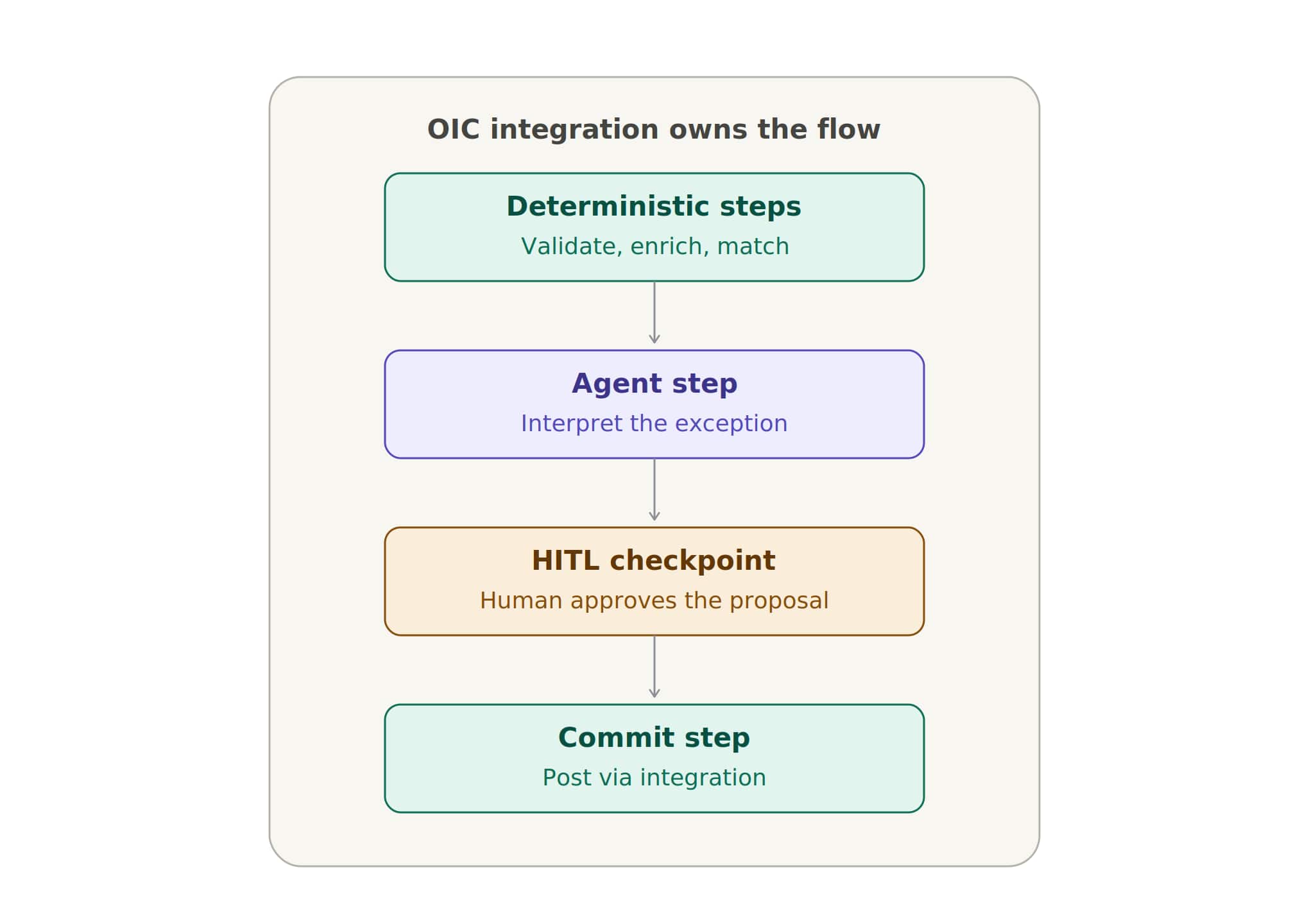
Wherever you eventually land on the spectrum, narrowly scoped agents embedded in deterministic workflows are the sensible place to start: the blast radius of an agent error is one step, not the whole process, and you automate the fuzzy middle without giving up control of the process itself.
Pattern 3 — Agent-led flow
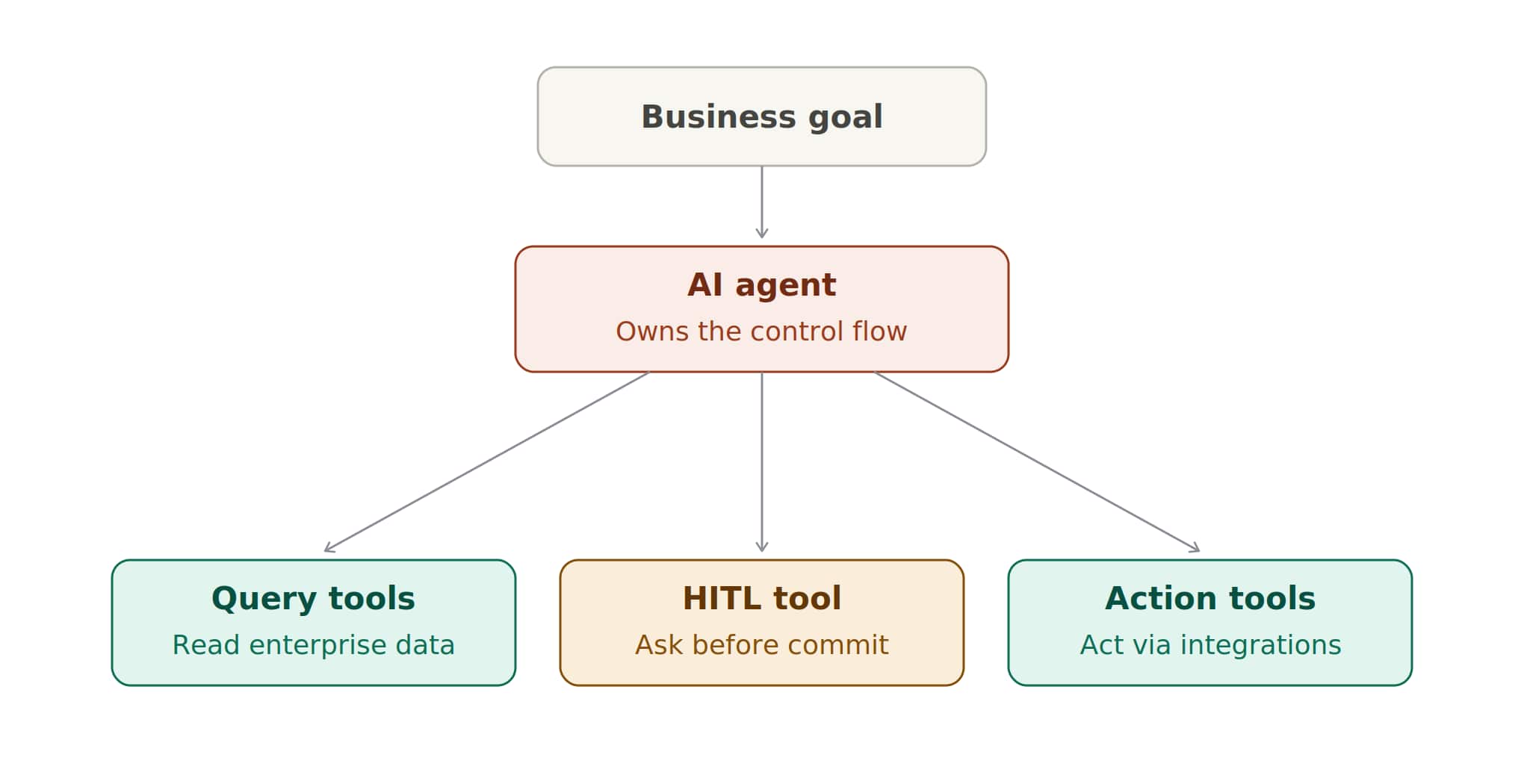
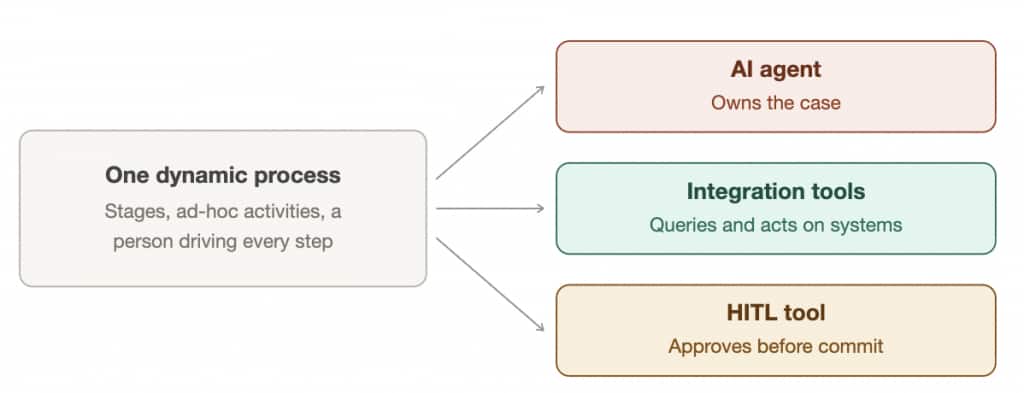
Some work resists enumeration entirely. “Resolve this customer’s billing dispute” has no flowchart. Automation platforms have long acknowledged this with case models and dynamic processes — collections of possible activities with no predetermined sequence. The model was honest about the work: a process engine executed the case model, but every next step waited on a human decision-maker. This is where control inverts: the agent owns the flow, and you expose OIC Integrations and HITL to it as tools. The agent investigates through query tools — order history, payments, contract terms. It acts only through action tools — create credit memo, adjust invoice — each one a governed OIC Integration with defined inputs, defined permissions, and a defined blast radius. And before any consequential action commits, it must call the HITL tool. A human reviews the proposal, with full context, and approves, modifies, or rejects.
Governing the tool layer
One practical question decides whether Pattern 3 scales: how does an agent discover and invoke tools in the first place? The answer emerging across the industry is the Model Context Protocol (MCP) — a common standard for agent-to-tool connectivity. It matters here for two reasons. The first is reach. An integration published as a tool through OIC’s MCP Server can be used by nearly any agent: one built in OIC, one from Fusion AI Agent Studio, the Database Agent Factory, or one running in a third-party framework. Build the tool once, govern it once, and serve every agent ecosystem you run.
The second reason is that in this architecture, the tool layer is the control surface. Everything an agent can do to your enterprise, it does through a tool — which means tool access is where governance concentrates. This is where an MCP Gateway earns its place: centralized enforcement on tool access — security and business policy, credential management, observability, and audit — applied once, across every agent framework, instead of re-implemented inside each one as adoption scales. Add agent compliance assessment on top — telemetry on what the agent saw, called, and did, evaluated against policy — and you have the kind of oversight, logging, and audit evidence that regulations such as the EU AI Act expect, built into the architecture rather than retrofitted after the pilot. Even the human checkpoint travels with this layer: HITL exposed over MCP means an agent requests approval as a long-running task, so the accountability moment is part of the protocol rather than an afterthought. You govern agents the way you’ve always governed the enterprise — at the point of access.
Where does your process belong?
Three patterns means a choice. For every process — and sometimes for a single step within it — the question is the one this article opened with: which execution model does this work deserve? These are the considerations we walk through with customers, roughly in the order we’d ask them.
| Consideration | Ask yourself | Design Guidance |
|---|---|---|
| Accountability | Who owns the outcome? | Add a HITL checkpoint wherever a named person must decide. Autonomy is a dial; accountability isn’t. |
| Error tolerance | What does a mistake cost, and how far does it spread? | Keep costly, hard-to-reverse steps in deterministic logic or behind a HITL gate. Contain any agent errors to a single step of high-risk processes. |
| Reproducibility | Must the same input give the same result? | Use deterministic execution for anything that needs to be reconciled or proven later. Use agents where variation is acceptable — or desirable, when each case deserves its own response — and validate their output. |
| Auditability | Will someone ask why the system did that? | Record everything. Rely on deterministic steps being traceable by design, and log every agent input, output, and tool call at the gateway. Treat non-deterministic as accountable, not unaccountable. |
| Context readiness | Can the agent reach the documents and history behind the decision? | Fix retrieval first — build a governed knowledge base — before placing an agent, because an agent without context will still answer. |
| Economics | Is inference worth it at this volume? | Spend inference where judgment creates value. |
| Time to production | What’s the fastest safe path? | Build enumerable logic as integrations. Prototype agents quickly, but build governance in from day one — that’s what gets them into production. |
| Volatility | How often does the logic change — and is it really logic? | Put stable logic in integrations, enumerable-but-changing policy in Decisions, and accumulated human judgment with agents. |
In practice the considerations reduce to four questions, asked for every process and every step within it:
- Can you enumerate the logic? Answer honestly — most teams believe they can, until the edge cases and variable context surface. If the true answer is yes, keep it deterministic
- Does judgment enter at a known point in a known flow? Then it’s an agent-assisted flow: keep the flow, and call an agent at that step
- Can the next step only be decided as the work unfolds? Then it’s an agent-led flow: the agent decides, with integrations, Decisions, and HITL as its tools.
- Is this a moment of consequence? Then add a HITL checkpoint, whichever pattern you’re in.
When two answers seem to fit, take the simpler one — the simplest construct that solves the problem is the one that lasts.
Modernizing process automation
If you’ve built on our process automation stack over the years, you’ll recognize three modeling disciplines: structured processes, decision models, and dynamic processes. They were the right abstractions for the technology available at the time. But we wouldn’t design most new automation the same way today — and that should also change how you think about the processes you already run. What changes is not the business intent captured in those models. What changes is where orchestration, policy, human work, and runtime judgment now belong: Integration handles deterministic execution, Decisions owns explicit business policy, HITL owns human work and accountability, and agents handle interpretation where the work can’t be fully enumerated. That separation makes processes simpler to model and manage.
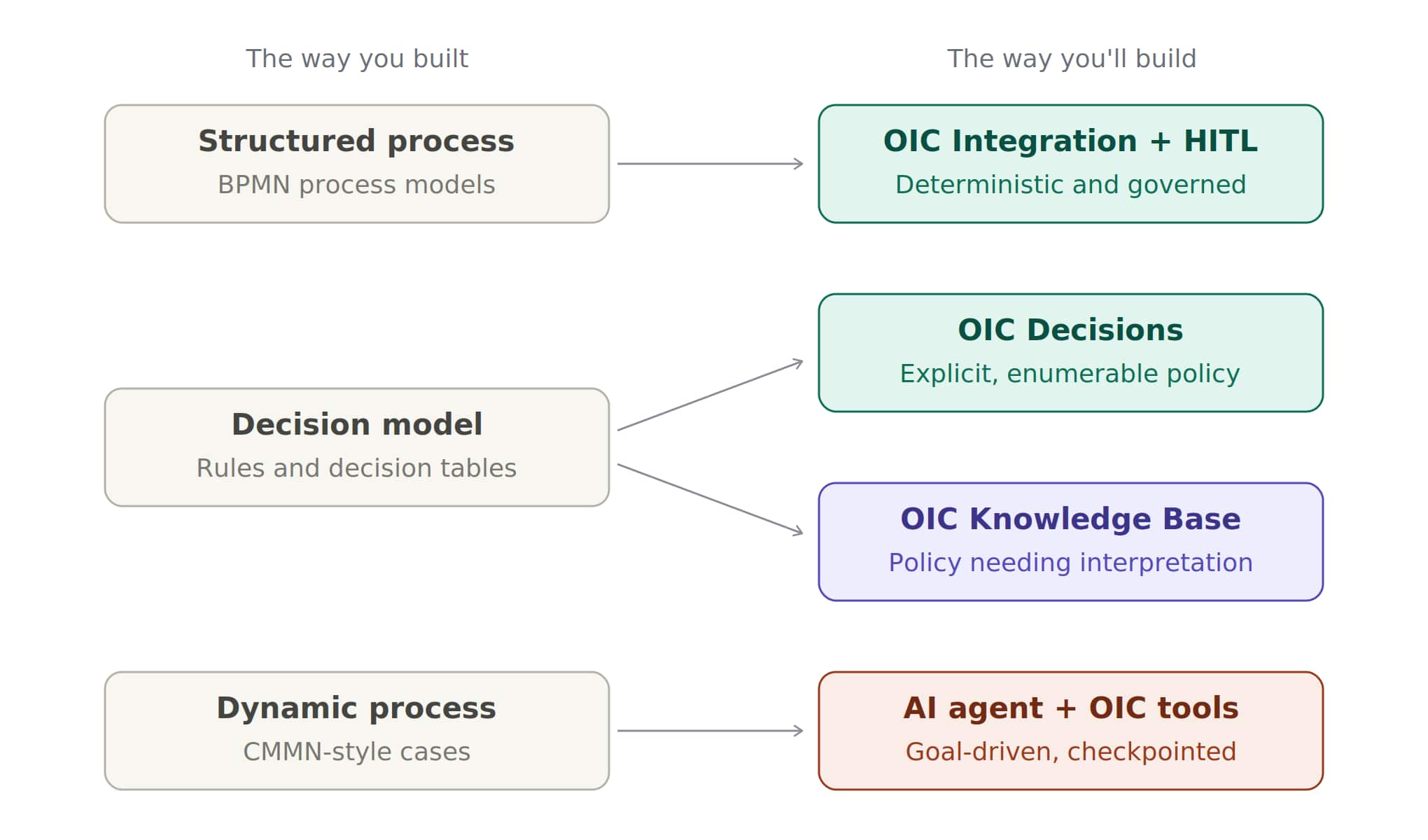
Start with structured processes, since that’s where most of your process footprint lives. A BPMN model carries three different kinds of work in one diagram: the control logic that decides what happens next, the automated actions that touch other systems, and the steps where a person gets involved. In the new architecture, each moves to its own home. Control logic — the routing, the switches, the sequencing — becomes the integration’s orchestration. Automated actions — service calls, data mappings, status updates, notifications — become the steps that orchestration invokes. Human steps become HITL checkpoints. The behavior stays the same; what changes is that each kind of work is now built, changed, and governed in the place designed for it.
The human steps gain the most from this separation. In the old diagrams, approval chains were drawn as sequences of user tasks and gateways, which is why reject loops, requests for more information, and resubmissions filled half the model. Now they’re modeled once, as an approval workflow: a single HITL activity in the integration, with one or more steps behind it — tiered when an approval escalates through levels, parallel when several people sign off at once. That also puts the right people in charge of the right things. The business defines who approves what, at which thresholds, and in what order, and changes it when the organization changes. Integration developers just reference the workflow from the flow. Neither side has to understand the other’s half.
Decision models separate along a similar line — this time between policy that can be written as rules and policy that can’t. Rules that are explicit and stable — thresholds, tiers, eligibility — move to OIC Decisions, where the business models and maintains them and every flow that needs them gets the same answer. Policy that people apply with judgment — the kind written in documents rather than tables — moves to the OIC Knowledge Base: upload the document, and agents read the actual policy through retrieval instead of relying on whatever their model remembers. Predictable policy gets modeled; interpreted policy gets grounded. Either way, none of it is improvised.
Dynamic processes change the most, because for them the separation runs deeper. A dynamic process was built for work that can’t be easily modeled: a set of possible activities with no fixed sequence, where a knowledge worker chooses what happens next. That design was right about the work — but look at what it actually separated. The engine ran the case model; a person supplied every decision. The model described what could happen, and a human decided what did. Agents complete the design. Give an agent the goal, the case context, and a set of governed tools, and it makes those runtime decisions itself — assess, choose the next activity, act, reassess — with HITL approving anything consequential. Pattern 3 is the dynamic process with the decision-maker finally built in. If you’ve invested in dynamic processes, you’ve already found the right work; that inventory is where agents go first.
In every case, the tools change and the craft doesn’t. The judgment your builders have developed over years — looking at a piece of work and knowing whether it’s a flow, a rule, or a case — is exactly the judgment this architecture asks for. It just has a better set of answers now.
Modernize by subtraction
The idea is simple: keep the business outcome, and get there with less process. In practice that happens in three stages. First, make the process equivalent — preserve its behavior by moving deterministic execution into Integration, explicit policy into Decisions, and human work into HITL, reusing the connections and mappings that already work. Component by component, the redistribution looks like this:
| What exists in the BPMN process | Where it naturally moves |
|---|---|
| Service calls, mappings, system updates | OIC Integration |
| Gateways and deterministic routing | OIC Integration |
| Explicit business rules | OIC Decisions |
| User tasks and approvals | OIC HITL |
| Large exception branch trees | Often one bounded agent step |
| Reusable business operations | Integration tools for agents |
| Dynamic or case navigation | Agent-led execution |
That first pass gives you an equivalent process in a simpler architecture, without asking the business to redesign anything. Then make it smarter. Find the constructs that created the most complexity — gateway forests, exception subprocesses, repeated human investigation — and ask whether they were true deterministic logic or attempts to model judgment that could never really be enumerated. Where judgment is the issue, an agent can collapse many modeled paths into one bounded step.
The economics work in your favor, because modernization is incremental and reuse-driven. You don’t need a portfolio-wide migration program. Start with processes already due for change, carrying a heavy maintenance burden, dominated by exception handling, or being extended with AI anyway — the places where investment is already required. And each process you modernize makes the next one easier: integrations become reusable business operations, Decisions become shared policy services, HITL workflows get referenced from multiple automations, and integrations exposed as governed tools serve both today’s processes and tomorrow’s agents. So the return on each modernization is bigger than the single process it improves.
Three familiar processes, built the new way
To make the mapping concrete, here’s how three common processes come together in this architecture.
Pattern 1 · Employee onboarding
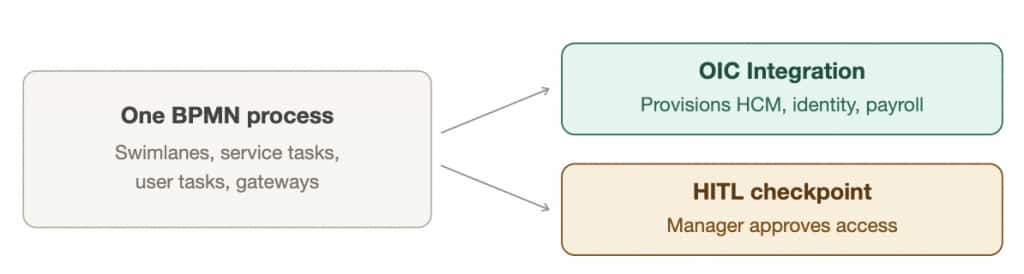
The way you built it: the classic swimlane model — HR, IT, and the manager each in a lane, service tasks provisioning systems, user tasks collecting approvals — deployed on a process engine that sits apart from the integration layer doing the actual work.
The way you’ll build it: one OIC integration orchestrates provisioning across HCM, identity, and payroll, with a single HITL checkpoint where the manager approves access before anything is granted. The business logic barely changes, and for an existing process the move is largely mechanical: the service interactions carry straight across, and two platforms become one.
Pattern 2 · Invoice processing
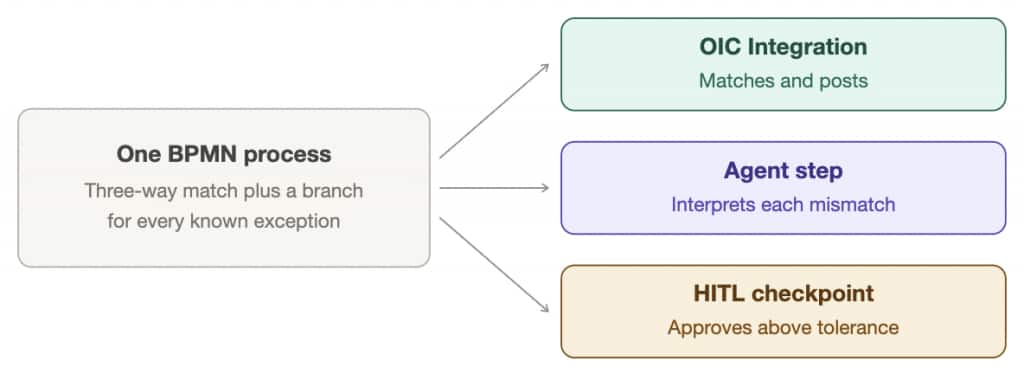
The way you built it: a deterministic three-way match that grew a branch for every discrepancy anyone had ever seen — dozens of exception paths, each with its own escalation, in a diagram that got harder to change with every release.
The way you’ll build it: the match stays deterministic in OIC. The exception branches — really attempts to enumerate human interpretation — collapse into one agent step that reads the PO, the receipt, and the supplier’s email, then proposes a resolution. HITL approves anything above tolerance, and the integration posts the correction. Fewer components, handling more cases.
Pattern 3 · Customer disputes
The way you built it: a dynamic process — stages, milestones, a palette of ad-hoc activities — with a person choosing every next step, because the model could describe the case but not decide it.
The way you’ll build it: an agent owns the case. It investigates through query tools (order history, payments, contract terms), acts through action tools (create credit memo, adjust invoice), and must call the HITL tool before anything financial commits. Every query, proposal, and approval is on the record — better governance than the manual version ever had.
Key takeaways
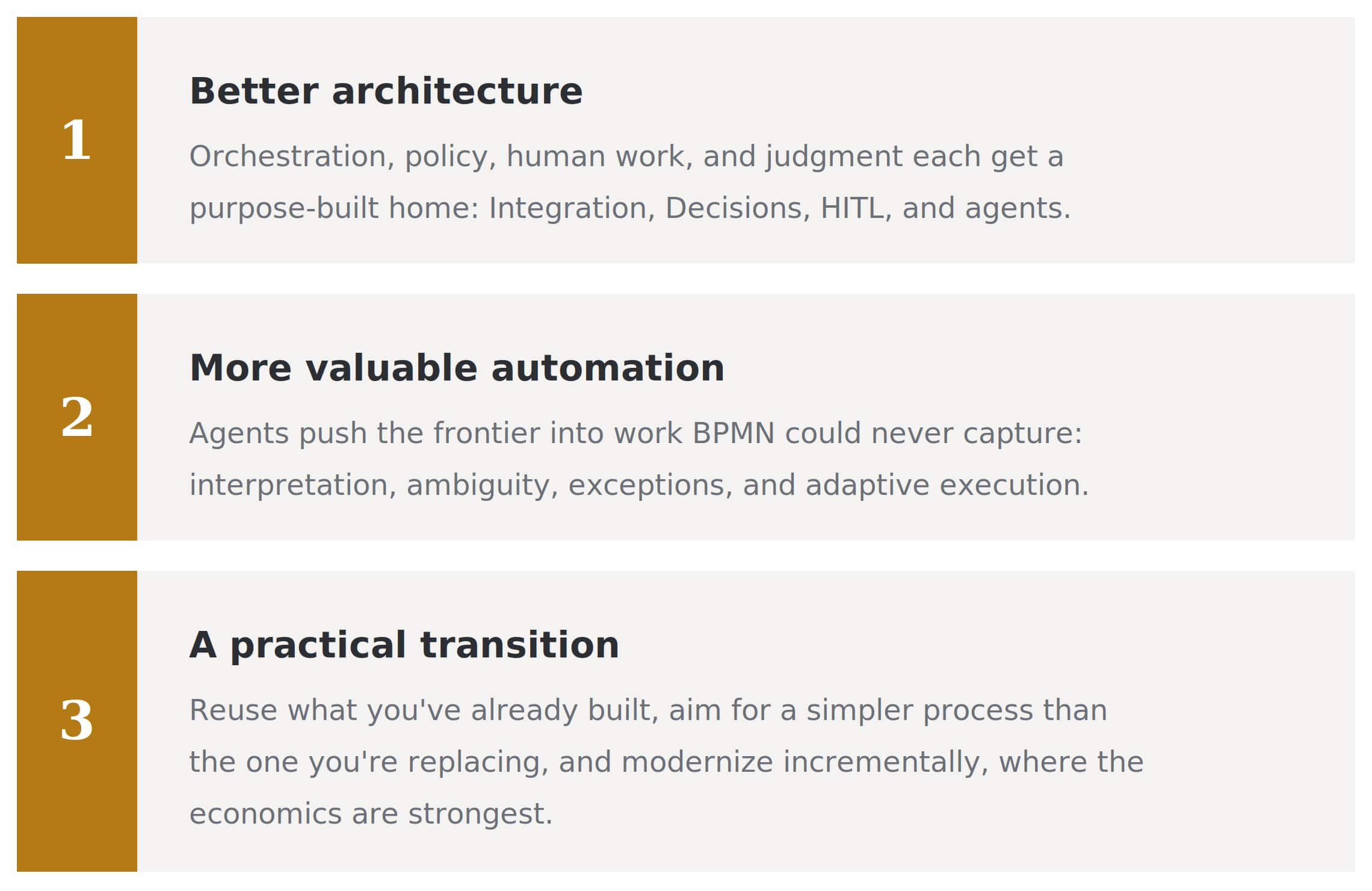
That’s the architecture we’d recommend for the next generation of process automation — and, increasingly, for the processes you already run. For new automation, make it your starting point. For existing automation, use it as a lens: the strongest modernization candidates are easy to recognize — processes dominated by service tasks, deterministic gateways, exception branches, or approval routing, especially the ones that change often or generate the most exception work. Modernization should earn its way into the backlog on business value, not platform mandate. And what you’ve already built is exactly what makes the transition practical: the systems are connected, the rules are discovered, the approval points are known. The future of process automation isn’t about replacing everything you’ve built. It’s about getting more value from what you already know, with less process required to express it.
For the next process on your backlog, don’t begin with a BPMN diagram. Begin with the work: what’s enumerable, where judgment enters, whether the path is knowable, and where accountability lives — then build the simplest architecture those answers require. Apply the same questions to the processes you run today, starting with a business opportunity rather than a migration target.