
Most organizations are past the question of whether AI belongs in their business. The harder question is how to move from scattered experiments to something that runs the work reliably, cost effectively, and at scale. Fusion AI is built for that transition. It puts AI directly where work happens, and it gives businesses a disciplined path to grow by identifying high-value work, proving the economics, and expanding deliberately.
Oracle customers have a head start here. Because Fusion AI operates inside the applications, data, workflows, permissions, and business context you already use, you’re not standing up a separate AI stack and then trying to bolt your security and governance onto it after the fact. The context is already there. That’s the difference between experimenting with AI and operating with it, and it’s what makes the playbook below achievable in quarters, not years.
Start with the business outcome
Agentic AI changes what’s possible because it completes work instead of just answering questions or drafting text. That’s a genuine shift, and it changes the first question you should ask. The old question was “Where can we add a copilot?” The better one is “Which outcomes do we want the system to deliver?” Starting from the outcomes keeps you focused on business value rather than on the novelty of the technology.
It also helps to understand the economics before you begin, because they’re refreshingly simple. Fusion AI is priced around trusted execution of enterprise work, not AI components. You pay for outcomes the platform delivers, described in outcome terms rather than for tokens, model calls, or intermediate steps. We’ll come back to exactly how that works, but hold onto the principle: you’re buying completed work, and you can budget for it.
Why Fusion AI
Plenty of tools promise to help your people work faster. Fusion AI is built to do the work—and to do it inside the guardrails your business already runs on. A few things set Fusion AI apart.
It gets work done, not just suggested
The distinction between an assistant and an agent is the distinction between advice and outcomes. Fusion AI is built to own tasks end-to-end so it can boost organizational productivity and ROI. Used well, it makes your employees faster and lets them focus on the judgment calls that differentiate your business.
It’s built in, not bolted on
Because the AI lives inside Fusion Apps, it inherits what those applications already know and enforce. It runs on OCI. It respects native Fusion SaaS roles, permissions, and security. And it draws on the data context already present in your Fusion Apps and connected external sources, so its outputs are grounded in your business rather than in generic assumptions. Hundreds of agents, agentic applications, and templates are available across virtually every functional and industry domain, so most customers start by adapting something proven rather than building from a blank page.
Its pricing is transparent
The unit of value for Fusion AI is deliberately simple: an AI Unit is worth one cent. SaaS customers receive a monthly allocation and can purchase more AI Units as they need them. What matters is what gets counted. AI Units are deducted only for AI actions delivered and completed, not for intermediate steps like API calls. That outcome-based design makes it easier to budget spend. Because consumption tracks the value delivered, you can plan against ROI targets instead of watching an open-ended meter. Customers who want maximum flexibility can stay usage-based; those who want maximum predictability can move to a subscription model. And they can shift between the two options as their program matures.
Prove value before you scale
The fastest way to lose momentum on an AI program is to scale something before you’ve shown it works. The discipline of finding valuable use cases, building on what exists, and rolling AI out in waves is what turns a promising pilot into a defensible business case.
Find the work worth doing
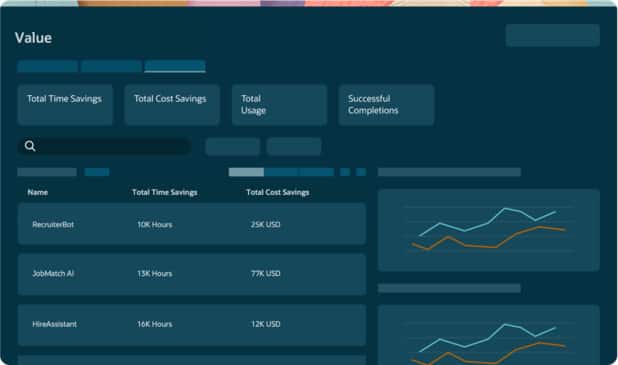
Start by identifying where you experience the most friction today and prioritize high-value use cases. Rank candidates by ROI target, expected volume, and the number of users who’d benefit. Anchor each one against the avoided cost of how the work is done today: the loaded cost of working a help-desk ticket or the hours your people lose hunting through screens. Where meaningful savings look possible, it’s worth building a short business case. Then, set an AI consumption-cost target up front for each use case. Measure and report actual costs and savings, both per use case and in aggregate. The goal is a portfolio you can defend with numbers.
Don’t start from scratch
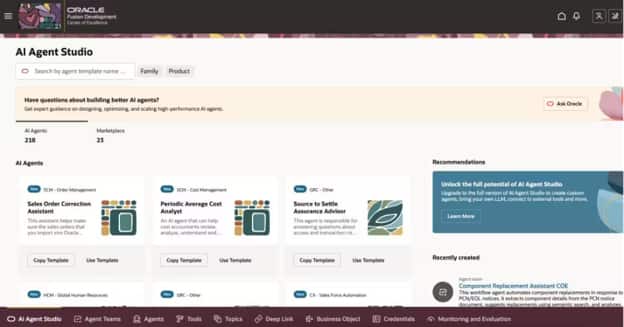
The hundreds of seeded agents in AI Agent Studio are a source of suggestions and best practices to get you started. Edit a seeded agent to fit your process or build your own agent, using no-code tools, pro-code tools, or a mix. Then, test each agent for results, performance, and efficiency before anyone depends on it. Building on proven patterns is faster, and it means your first production use case starts from a good baseline.
Roll out concentrically
Deploy in expanding waves rather than all at once. Start with a small group, then a medium one, then a large one, on the order of ten, fifty, and two hundred users. Pause between waves to measure quality, cost, and ROI, and to capture what worked and what needs to improve before you widen the circle. When possible, roll out a soft launch: leave the existing approach in place at first and retire it only as confidence builds. Each wave de-risks the next, and by the time you deploy broadly, you’re scaling something you’ve already validated three times over.
Govern for value
Good governance isn’t just about reducing spend. It’s about investing with confidence, because you can always see the outcome you’re getting for the money. Three practices, all supported by Fusion AI, make that real.
Budget and set alerts
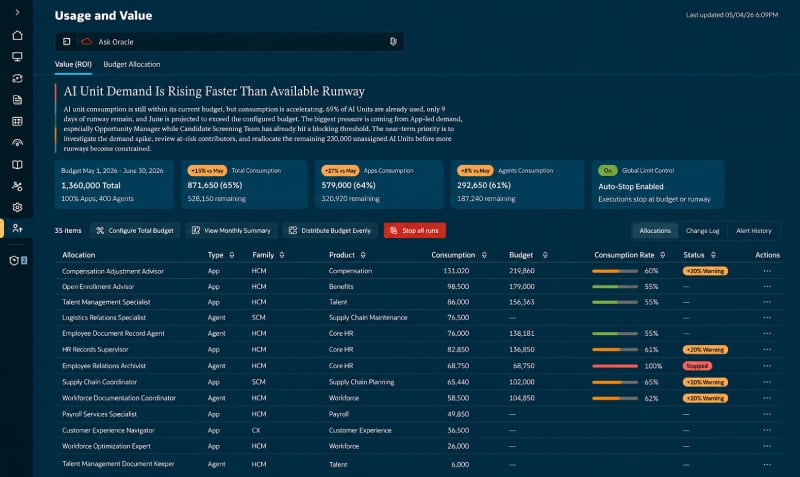
Set a budget (per agent or per team) and configure alerts at the thresholds that matter to you. These budget limits act like guardrails: you always know where you stand and aren’t surprised as you approach the limit.
Measure value, not just usage
Usage numbers alone can mislead. Use AI Agent Studio to review results, costs, and ROI on a regular cadence. Then ask questions that connect usage, costs, and results: Which agents get the most usage? And which deliver the most value, measured in outcomes completed, exceptions avoided, and cycle time reduced?
Compare your AI Unit drawdown against projections. If consumption is running ahead of plan, are benefits ahead too? If yes, which additional use cases would you accelerate to capture more of that upside? Then adjust your projections for the periods ahead. You’re building a habit of reading consumption and value together as a single picture.
Tune and improve
Agents get leaner with attention, and the platform surfaces the telemetry to guide it. Watch usage patterns to see what’s working and what’s dragging. Start from the user’s experience: Are people getting the outcome they need, and could the workflow be simpler? From there, refine agents to respond concisely and at the right level of detail, prune API calls down to relevant inputs, and have agents guide users with examples of what they can do and how to ask. Sometimes the right move is to split a worker agent for sharper focus or combine several to reduce handoffs. These are optional levers; what matters is that the visibility to pull them is built in.
Scale the impact
The real payoff comes when you stop thinking in terms of individual agents and start thinking in terms of AI-enabled operations. That happens in three steps.
The first is connecting related work. Individual agents are useful, but agent teams and agentic applications are transformative. As they work towards an outcome, they eliminate the handoffs where time and information are lost.
The second is reimagining the end-to-end process rather than automating the current one. The temptation is to speed up the steps you already have. The larger opportunity is to redefine the process’ purpose and to bring deep reasoning and pro-code to bear on problems that a simple agent couldn’t touch.
The third is institutionalizing what works so wins aren’t just one-offs. That means creating reusable agent patterns and templates, establishing a lightweight governance model, sharing successful use cases across functions, and building an internal community of AI practitioners. It also means reinvesting the savings and new capacity you’ve demonstrated into the next wave of opportunities, so the program funds its own momentum.
Get started this month
None of this requires a transformation office or a year of planning. It requires picking one thing and running it through the loop. This month:
- Identify three high-friction workflows.
- Select one that’s measurable and highly suitable for AI automation.
- Establish today’s baseline so you can prove the delta.
- Explore Fusion AI capabilities or templates and select one suited to your workflow.
- Build or customize using pro-code or no-code tools, if needed.
- Pilot with a limited group.
- Measure both outcome and consumption.
- Decide whether to improve, expand, or stop.
The last step matters as much as the first. A disciplined program is one that knows when to double down and when to step back. The economics of Fusion AI are designed so you can always tell the difference.
Related posts you might like
- 4 guides to get smart about agents in Fusion Apps
- Your complete guide to updates and feature adoption
- New Fusion Agentic Applications—details and demos

If you’re an Oracle customer and want to get new stories from The Fusion Insider by email, sign up for Oracle Cloud Customer Connect. If you’re an Oracle partner and want to learn more, visit the Oracle Partner Community.