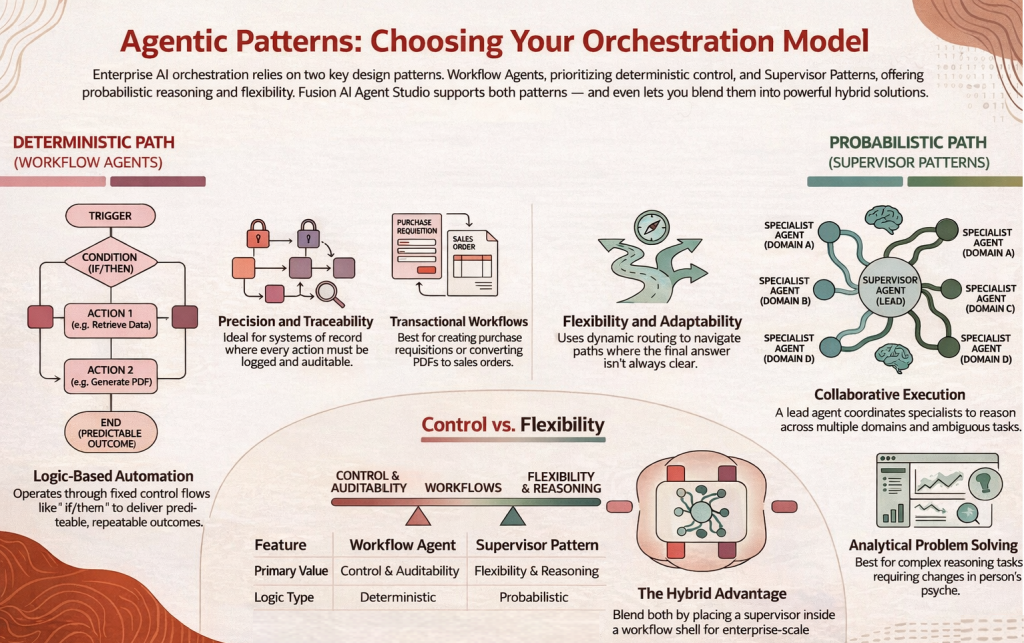
Deterministic vs. Probabilistic Agentic Patterns.
Introduction
As enterprises accelerate their journey toward AI-powered automation, choosing the right approach for orchestrating intelligent behaviors becomes critical. Oracle Fusion AI Agent Studio offers two powerful patterns – deterministic (Workflow Agents) and probabilistic (Supervisor + Agents) – tailored to address diverse real-world business needs. Understanding these patterns is the key to building reliable, flexible, and auditable AI solutions.
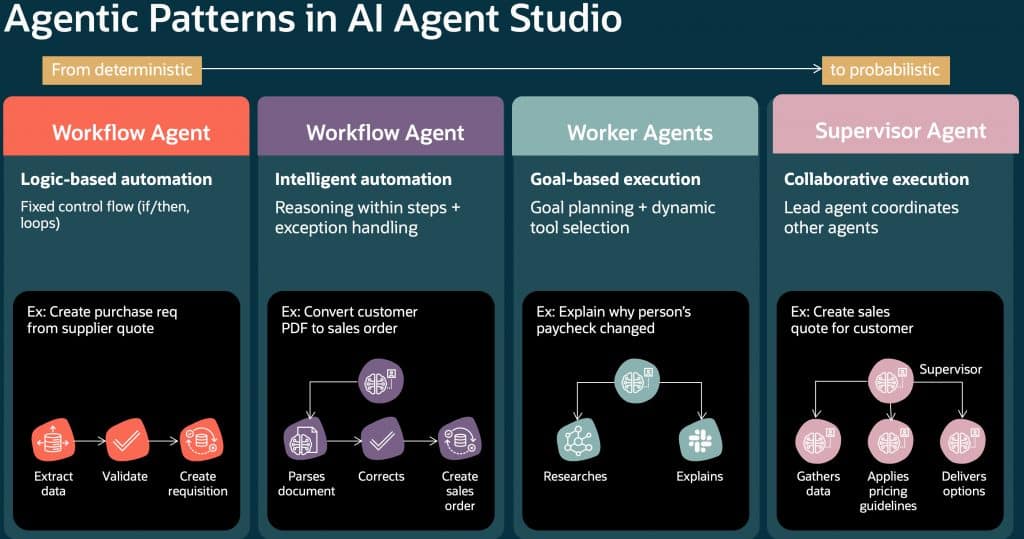
Deterministic Workflow Agents: Structured Precision
Meet your “structured teammate.” Workflow Agents operate through a predictable sequence of explicit steps – retrieving data, validating it, applying guardrails, and generating responses. The logic here is preset; every action is logged and auditable, making it perfect for scenarios where compliance, control, and repeatable processes are paramount.
Key Characteristics:
– Accuracy and consistency are guaranteed
– Actions are predictable, repeatable, and fully auditable
– Best suited for systems of record like Finance, HR, and Service
– Compliance and governance always come first
– Ideal for tasks where every step must be transparent
Probabilistic Supervisor + Agents: Dynamic Flexibility
Now, imagine a “team lead.” The Supervisor listens, reasons, and routes requests dynamically – deciding which specialist agent should respond, or if multiple agents should collaborate. This approach excels in handling ambiguity, complex conversations, and tasks where paths to the solution are not always straightforward.
Key Characteristics:
– Flexibility and adaptability to changing context
– Dynamic, multi-domain reasoning
– Supports exploratory, creative, and analytical problem-solving
– Enables fast experimentation and organizational agility
– Perfect for scenarios demanding natural, complex conversations
Side-by-Side: When to Use Which Pattern?
The following table compares the Workflow Agent pattern and the Supervisor + Agents pattern based on the provided sources:
| Feature | Workflow Agents | Supervisor + Agents |
| Primary Focus | Control and auditability; prioritizing precision and traceability. | Flexibility and adaptability; prioritizing creative reasoning and agility. |
| Logic Type | Primarily deterministic (logic-based) using fixed control flows like if/then loops. | Primarily probabilistic (goal-based) using collaborative execution. |
| Structure | A structured sequence of explicit steps (e.g., retrieval → validation → guardrail check). | A hierarchical team where a lead agent coordinates specialists dynamically. |
| Best Used For | Predictable, repeatable tasks where compliance and accuracy are critical. | Ambiguous or exploratory tasks where the path to an answer isn’t always clear. |
| Key Capability | Ensuring consistent outcomes and logging every action for systems of record. | Reasoning across multiple domains and handling natural, complex conversations. |
| Outcome | Delivers structure. | Delivers flexibility. |
Hybrid Approach: The Best of Both Worlds
Complex enterprise needs rarely fit neatly into one pattern. That’s why Oracle Fusion AI enables a hybrid approach – embedding agents or agent teams within deterministic workflows. This means adaptive decision-making can thrive within a controlled, auditable environment, offering maximum power and flexibility.
Conclusion
Choosing between deterministic and probabilistic agentic patterns – and knowing when to combine them, empowers your organization to unlock the full spectrum of AI capabilities. Whether you need a “structured teammate” for compliance or a “team lead” for creative problem-solving, Oracle Fusion AI Agent Studio has you covered. Let structure and flexibility work hand-in-hand to transform your business!