
The next generation of enterprise orchestration — where deterministic control meets autonomous intelligence inside Oracle Fusion Applications.
Enterprise workflows have always been the backbone of how organizations get things done — procure-to-pay, hire-to-retire, order-to-cash. But the traditional approach of hard-coding every path, every exception, and every decision is starting to show its limits. Enter Workflow Agents.
The Problem with Traditional Workflows
If you’ve spent any time in the Oracle Fusion ecosystem, you know the drill. Business processes get codified into workflows with rigid, predefined steps. They work beautifully — until they don’t. A supplier sends a quote in an unexpected format. A court order arrives requiring a payroll update. An FDA recall notice means inventory needs to be quarantined across multiple facilities. Every one of these scenarios traditionally required someone to anticipate the exception, code the logic, and maintain it forever.
The real world doesn’t follow happy paths. Documents arrive in varying formats, data is incomplete, edge cases multiply, and the people who understand the business rules are often too busy to spell them all out for a developer. Traditional workflows execute predefined steps in a fixed sequence, require pre-coded routing logic, and halt whenever something unexpected happens — waiting for a human to come to the rescue.
What Are Workflow Agents?
Workflow Agents are a new type of agentic AI agent in Oracle’s AI Agent Studio, designed to execute end-to-end business workflows by combining two things that have historically been at odds: deterministic control flow (the governance and predictability enterprises demand) with autonomous intelligence (the reasoning, memory, and coordination that AI makes possible).
Think of a Workflow Agent as a process that can think. It follows a structured path — it’s not a free-roaming chatbot — but at key decision points within that path, it can reason over context, interpret intent, classify information, extract entities from documents, and even call on other specialist agents for help. When it encounters something it can’t handle or a high-stakes decision that requires a human, it knows to pause and ask.
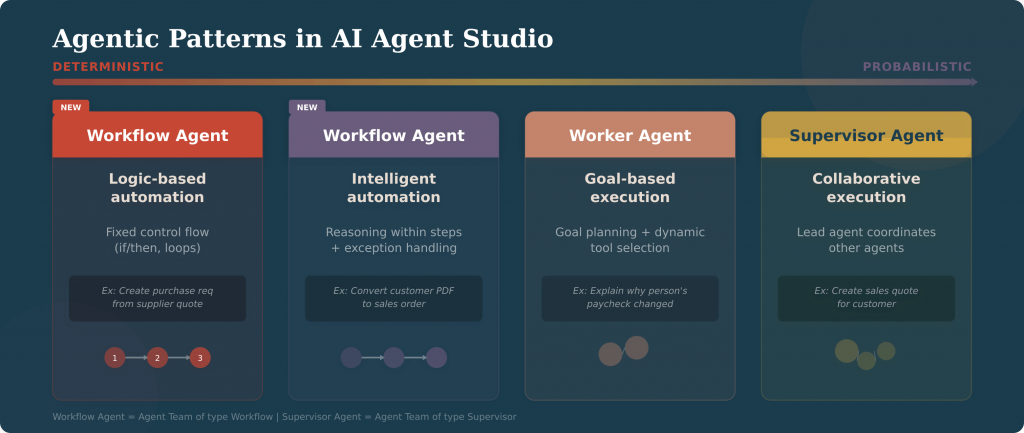
Figure 1 — The four agentic patterns in AI Agent Studio, ranging from deterministic to probabilistic.
Workflow Agents sit on the deterministic end of the agentic spectrum, but they’re far from dumb pipelines. They bring agentic behaviors like dynamic path selection, multi-turn reasoning across steps, parallel branching, multi-agent collaboration, and self-correction when inputs are missing or fail validation. They allow workflows to understand goals, interpret user intent, and adapt as reality changes — expanding automation to workstreams that previously required human judgment and domain reasoning.
Why This Matters Now
The promise of agentic AI is tantalizing, but enterprises can’t afford to hand the keys to a non-deterministic system and hope for the best. Compliance, auditability, SLAs, and repeatable outcomes aren’t nice-to-haves — they’re table stakes. What makes Workflow Agents special is that they don’t ask you to choose between intelligence and control. You get both.
A traditional workflow says: “Run step A, then step B, then step C, and if this field equals X, go to step D.” A Workflow Agent says: “Run step A, then use an LLM to interpret this unstructured document and extract the relevant entities, validate them against policy using a RAG lookup, and if confidence is high enough proceed autonomously — otherwise loop in a human reviewer.” Same structure. Dramatically more capability.
| KEY INSIGHT Workflow Agents allow workflows to understand goals, interpret user intent, and adapt as reality changes — expanding automation to workstreams that previously required human judgment and domain reasoning. |
Traditional Workflows vs. Workflow Agents
It’s worth seeing the contrast side by side. The shift isn’t about throwing out everything you know about process orchestration — it’s about augmenting it with intelligence at the right moments.
| Dimension | Traditional Workflow | Workflow Agent |
| Execution | Predefined steps, fixed sequence | Outcome-based with contextual reasoning |
| Routing | Pre-coded, static logic | Dynamic, using evidence + context |
| Orchestration | Linear conditional flow | Tools, subflows, agents, parallel branches |
| Exceptions | Coded upfront (brittle) | Repair loops, refinement, self-correction |
| Human role | Drive next steps manually | Consulted only when needed |
The Building Blocks
Under the hood, Workflow Agents are assembled from five categories of nodes, each playing a specific role in the orchestration. If you’ve built BPM processes or BPEL flows in the past, the structure will feel familiar — but the capabilities within each node are a generation ahead.
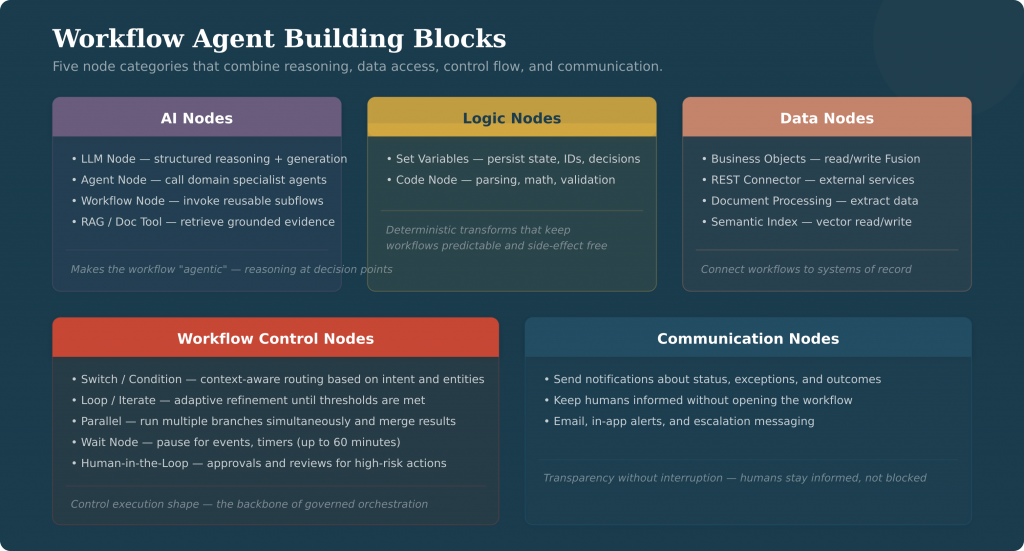
Figure 2 — The five categories of nodes that compose a Workflow Agent.
The magic is in how these categories work together. AI Nodes bring the reasoning. Logic Nodes keep things deterministic and side-effect free. Data Nodes connect you to Fusion business objects and external systems. Workflow Control Nodes shape the execution — routing, looping, running things in parallel, waiting for events, and bringing humans in at the right moments. And Communication Nodes keep everyone informed without forcing them to open the workflow itself.
Design Patterns That Power Real Work
Workflow Agents aren’t just a bag of nodes — they’re composed using battle-tested design patterns that map to how real enterprise processes actually operate. Oracle’s AI Agent Studio supports several core patterns that can be combined to handle remarkably complex scenarios.
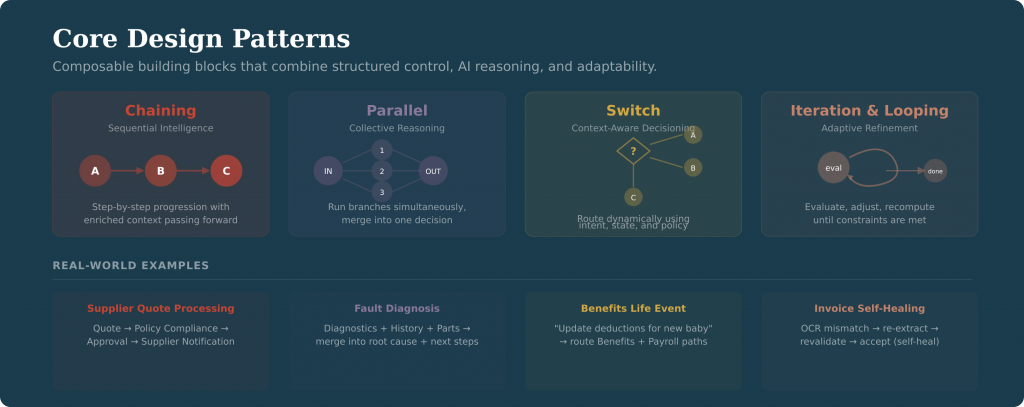
Figure 3 — Four composable design patterns that handle the majority of enterprise workflow scenarios.
Chaining is the workhorse — a step-by-step progression where each stage reasons over evolving context and passes enriched state forward. Think of a supplier quote arriving, being checked against policy, routed for approval, and resulting in a notification — all flowing naturally through a chain.
Parallel execution lets you run multiple branches simultaneously and merge signals into one decision. Need to check risk, compliance, order history, and inventory availability before approving a large order? Run them all at once and converge the results.
Switch patterns dynamically route to the right subflow using intent, entities, profile, state, and policy — without brittle rule trees. And Iteration / Looping patterns let the agent evaluate, adjust, and recompute until constraints or thresholds are satisfied, which is perfect for scheduling, optimization, and self-healing scenarios like OCR extraction mismatches.
Workflow Agents vs. Hierarchical Agents: Knowing When to Use What
AI Agent Studio offers another powerful pattern: Hierarchical (Supervisor) Agents, where a lead agent dynamically decomposes goals and delegates to specialist workers. The question isn’t “which is better?” — it’s “which fits the job?”
Workflow Agents are optimized for predictability, auditability, and SLA stability. They’re your best choice for structured processes where rules and policies are known and outcomes must repeat. Their execution model is policy-bound orchestration with contextual reasoning — and their primary goal is consistent, compliant outcomes at scale.
Hierarchical Agents, on the other hand, excel at discovery, planning, and synthesis under uncertainty. If you have an ambiguous problem with many possible paths and evolving goals — like creating a bespoke sales quote by researching a customer’s history, applying pricing guidelines, and delivering options — the Supervisor pattern gives the LLM more freedom to plan and reason dynamically.
In practice, many real-world implementations combine both: a Workflow Agent handles the structured backbone of a process, and at specific steps it delegates to a specialist Worker or Supervisor Agent for tasks that require more open-ended reasoning.
How to Start Designing a Workflow Agent
Oracle recommends a six-step design approach that balances ambition with pragmatism. First, define the job to be done — what’s the end-to-end outcome? Then, set execution boundaries — what must the agent never do autonomously? Third, choose your orchestration patterns — chaining, parallel, switch, iteration, or a combination. Fourth, design for real-world exceptions — because they will happen. Fifth, plan for async and long-running work — enterprise processes don’t finish in milliseconds. And finally, instrument and test end-to-end, adding evaluations to measure quality over time.
Looking Ahead
Workflow Agents represent a genuine inflection point in how enterprise processes are built and run. They don’t replace your existing understanding of workflows — they supercharge it. The structured governance that enterprises require is still there, but now it’s paired with the ability to reason, interpret, self-correct, and collaborate with other agents.
If you’re building on Oracle Fusion Applications, Workflow Agents are worth learning deeply. They’re not a speculative future capability — they’re available now in AI Agent Studio, and the use cases are practical, grounded, and immediately impactful. Start with a well-understood process, identify the steps where human judgment is the bottleneck, and see what an agent with structure and intelligence can do.
The era of workflows that can think is here. And it’s built in — not bolted on.