


The fundamental paradigm shift from traditional applications to AI – native agentic experiences
Introduction
If you have been working with a traditional ERP for any length of time, you know the drill: log in, navigate through menus, search for the data you need, run a report, export to Excel, analyze, decide, act. The user does the heavy lifting. The application is a passive system of record.
That is about to change. Fundamentally.
Oracle’s Agentic Apps, built within the AI Agent Studio, represent a completely new category of enterprise application – one that does not just store your data or present your data, but understands it, prioritizes it, and proactively tells you what to do about it. These are not “apps with AI bolted on.” They are apps that are only possible because of AI.
| Key Insight Traditional apps retrieve data and present it. Agentic apps understand context, identify what matters, and proactively surface only the decisions that require human input. |
The Evolution of Enterprise Software
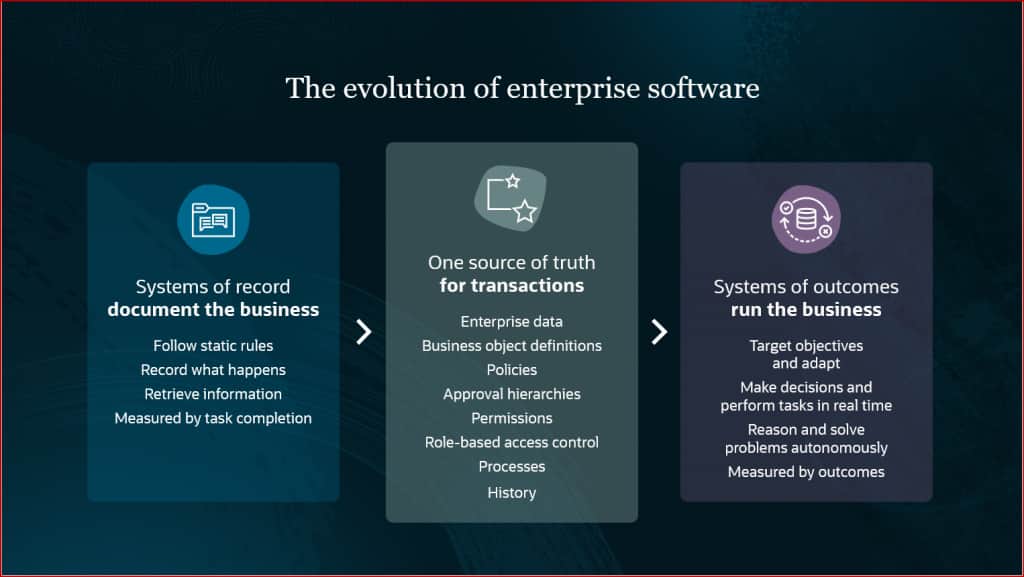
Enterprise software has progressed through three distinct eras, each building on the one before it. Understanding this evolution helps explain why agentic apps are not merely an incremental improvement – they are a generational leap.
Era 1: Systems of Record
The first generation of enterprise software was designed to document the business. These systems followed static rules, recorded transactions, and provided a reliable way to retrieve historical information. If you needed to know how many purchase orders were created last quarter, the system could tell you. But it could not tell you which ones required attention or what you should do about them. Success was measured by task completion – did the data get entered correctly?
Era 2: Single Source of Truth
The second generation evolved to transact for the business. Enterprise data, policies, permissions, RBAC controls, approval hierarchies, and business process definitions all lived in one integrated platform. Oracle Fusion Applications are the gold standard of this era – a unified suite where HCM, ERP, SCM, and CX share a common data model and security framework. This was transformational. But the application still waited for the user to act. It was reactive, not proactive.
Era 3: Systems of Outcomes
The third generation – where agentic apps live – is designed to run the business. These systems target objectives and adapt. They make decisions in real time. They reason and solve problems autonomously. And critically, they are measured by outcomes, not tasks. Instead of asking “Did the user complete the workflow?” the question becomes “Did the business achieve the result?”
This is the world agentic apps unlock. An HR manager does not need to run a report on employee attrition risk – the app proactively tells them which employees are at risk, why, and what actions to take. A procurement lead does not need to review every supplier contract – the app surfaces the three that need attention this week and drafts the communications to resolve them.
The Paradigm Shift
Let us be very clear about what agentic apps are and are not. They are not traditional applications with a chatbot pasted on top. They are not dashboards with an AI summarizer. They are an entirely new application architecture where agents handle the reasoning, data fetching, and UX binding. The UI is not hardcoded – it is dynamically composed from standardized Agent UX building blocks.
In a traditional application, APIs are wired directly into the UI. A developer writes code to call an endpoint, parse the response, and render it in a specific screen layout. In an agentic application, a specialized AI agent is responsible for deciding what data to fetch, how to analyze it, what insights to surface, and how to present them – all configured through prompts and a visual builder, not code.
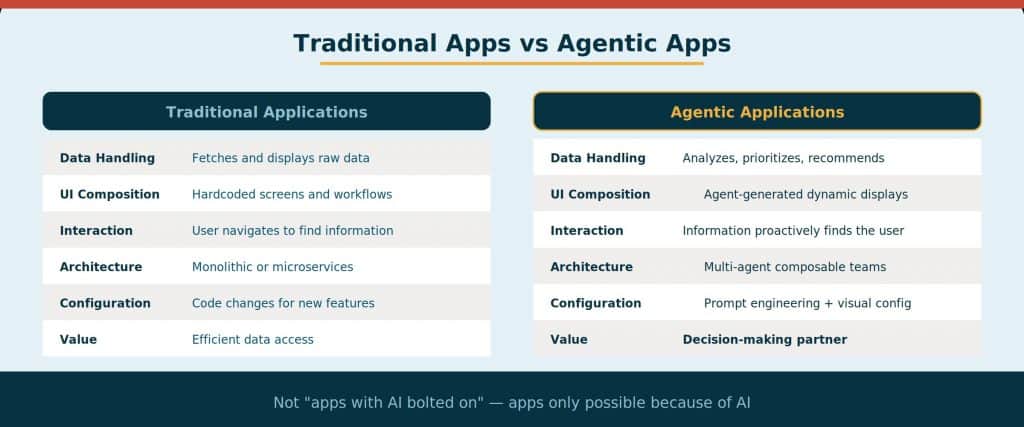
Traditional Apps vs. Agentic Apps: A Side – by – Side Comparison
The table below illustrates the fundamental differences across six key dimensions. This is not a minor feature upgrade – it is a rethinking of how enterprise applications are designed, built, and experienced.
| Dimension | Traditional App | Agentic App |
| Data Handling | Fetches and displays raw data | Analyzes, prioritizes, and recommends |
| UI Composition | Hardcoded screens and workflows | Agent – generated dynamic displays |
| User Interaction | User navigates to find information | Information proactively comes to the user |
| Architecture | Monolithic or microservices | Multi – agent composable teams |
| Configuration | Code changes for new features | Prompt engineering and visual configuration |
| Value Proposition | Efficient data access | Decision – making partner |
The last row is the most important. Traditional apps help you access data more efficiently. Agentic apps become your decision – making partner – they do not just show you what is happening; they tell you what it means and what to do about it.
Core Value: From Data to Decisions
If I had to distill the philosophy behind agentic apps into one line, it would be: From Data to Decisions – Agentic Apps Empower, Advise, and Act in Real Time. This isn’t just about surfacing insights – it’s about closing the loop between insight and execution.
Every agentic app is built around four core capabilities:
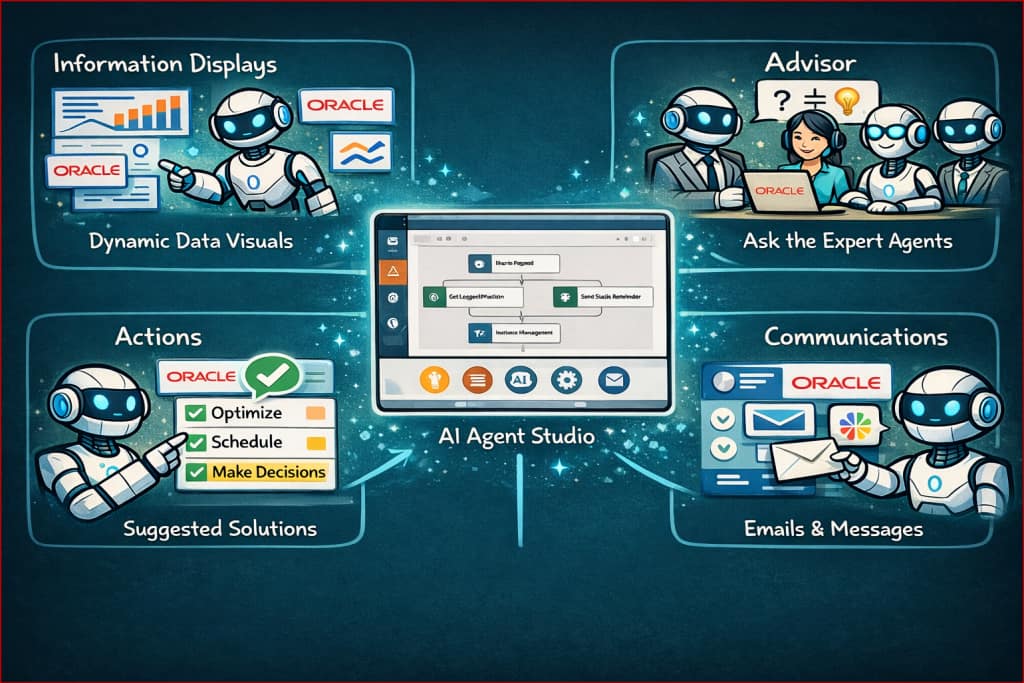
1. Information Display: Context That Comes to You
Agentic apps don’t just retrieve data – they generate context dynamically.
- Visualizations like charts, tables, cards, and forms are created automatically at startup or on demand
- Real – time widgets (charts, cards, message lists, change logs, multi – record views, Sankey diagrams, etc.) adapt based on your interaction
Instead of hunting for data, the system brings the right view to you, when you need it.
2. Advisor: Built – in Expertise, On Demand
Think of this as having a 24/7 expert panel embedded in your workflow.
- Ask questions in natural language
- Get responses from specialized agents (or coordinated agent teams)
- Receive insights grounded in business context, policy, and real – time signals
This moves decision – making from guesswork to guided intelligence.
3. Actions: From Insight to Execution
This is where things get real. Agentic apps don’t stop at recommendations – they drive action:
- Suggest next best steps (approve, adjust, escalate, optimize)
- Present structured decision points with clear context
- Execute actions directly within the system when invoked
The key shift: no swivel chair, no handoffs – just execution where the data lives.
4. Communication: Proactive and Embedded
Work doesn’t end with a decision – it requires follow – through.
Agentic apps help by:
- Drafting emails, updates, and messages
- Suggesting proactive follow – ups
- Keeping stakeholders aligned without manual effort
It’s not just automation – it’s continuous momentum.
Quick Glossary
New to agentic terminology? Here is a quick reference for terms introduced in this post:
| Term | Definition |
| Agentic App | An AI – native application where agents handle reasoning, data fetching, and UX composition – designed to be a decision – making partner, not a data retrieval tool. |
| AI Agent Studio | Oracle’s platform for building, configuring, and deploying agentic applications and their underlying agent teams. |
| Agent Team | A specialized group of AI agents built in AI Agent Studio that work together within an agentic app. |
| Summary View | The top – level entry point showing a high – level overview of what needs attention. |
| Section Focus View | An expanded view of one section with richer details and scoped Ask Oracle interaction. |
| Item Focus View | A deep dive into one specific object or record with full context and dedicated insights. |
| Ask Oracle | The conversational interface where users can ask questions and receive agent – powered answers. |
| Four Pillars | The four capabilities of every agentic app: Information Displays, Actions, Communications, and Ask Oracle Advisors. |
| Systems of Outcomes | The third era of enterprise software where applications target objectives, decide in real time, and are measured by business outcomes. |
New to Oracle Fusion AI Agents?
Explore AI Agent Studio Learning Path — blog series to help build from zero to production-grade AI agents, with deep dives on every agent pattern, node type, and tool integration.
Explore AI Agentic Apps Learning Path — blog series on everything you need to build Oracle Fusion AI Agentic Apps using AI Agent Studio.