
When an organization undergoes a corporate split—creating a NewCo from a RemainCo—it’s vital that employee data is transferred smoothly, securely, and in compliance with corporate governance standards. Oracle HCM Cloud offers several strategies and tools to support this process, each with its own benefits and challenges.
Key Terminology:
NewCo: The new entity being created as a result of the spinoff.
RemainCo: The original entity, which continues after NewCo is spun off.
Strategic Approaches
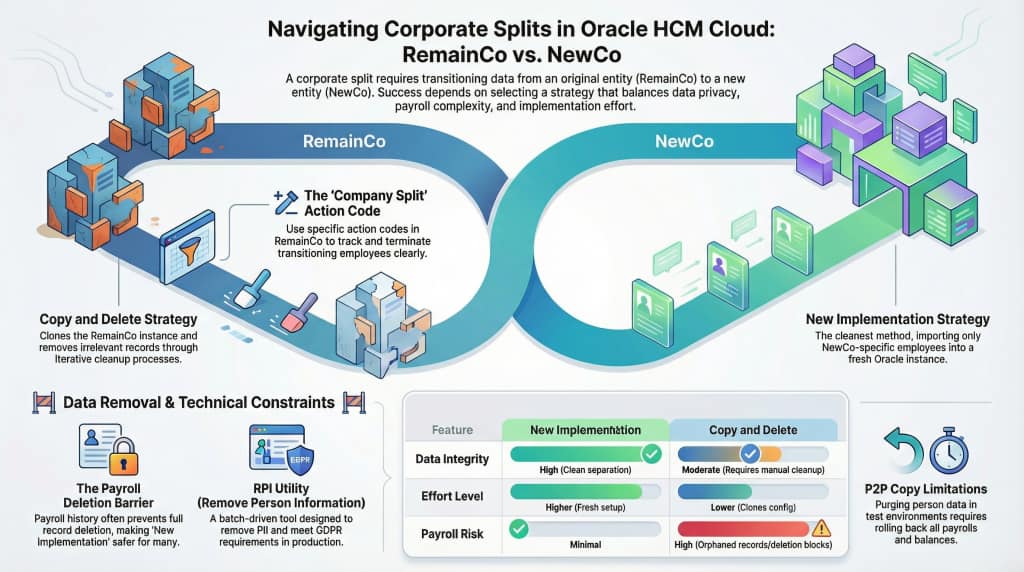
There are two main approaches for supporting a corporate split in Oracle HCM Cloud:
1. New Implementation
This is often the cleanest option. NewCo is set up as a brand new instance, following implementation best practices. Only those employees who are transitioning to NewCo are imported, ensuring separation from RemainCo’s data history. Once those employees are migrated to NewCo, they are terminated in RemainCo with a special action code (e.g. Company Split).
2. Copy and Delete
In this approach, a copy of RemainCo (including all current data) is used to create NewCo. After the instance is duplicated, records related to RemainCo employees are deleted, leaving behind only those relevant to NewCo. Additional cleanup is performed to further ensure data separation and compliance.
Data Management and Privacy Considerations
Oracle provides several techniques to help maintain data privacy and meet regulatory requirements:
Data Removal Methods
Oracle supports two primary data deletion utilities:
Remove Person Information (RPI):
– Developed to support GDPR requirements to completely remove PII
– Works in both Test and Production environments.
– Batch-driven via HDL using a list of person numbers.
– Can selectively remove business objects and can handle up to approximately 50,000 assignments per batch.
– Note: If the person had payroll processed, payroll records can become orphaned. In practice, removing those records can be complex.
Purge Person data in Test Environments:
See Purge Person data in Test Environments
– PL/SQL-based and can’t be used in production.
– Cannot delete records with payroll history unless all payrolls are rolled back, including balance loads.
Process Overview
A tried-and-true basic process using the Copy and Delete method is:
1. Request a P2P (Production to Production) to make a copy of RemainCo (NewCo).
2. In RemainCo, terminate the migrating employees, optionally using a custom “Company Split” action code for tracking.
3. Within the NewCo instance, carefully remove any records related to RemainCo employees. In practice this will take several trial runs to completely validate the process and the data removed.
4. Run any post-migration processes such as LDAP updates, rebuilding the manager hierarchy, reassigning roles, and search indexing.
Complexities Unique to Payroll
A crucial challenge when splitting entities is handling payroll data. Oracle HCM Cloud restricts deletion of employees with payroll history unless all payrolls and related balance loads are completely rolled back—a task that can be risky and complex. Therefore, organizations often favor a New Implementation approach to avoid complications with payroll data deletion.
Special Considerations
To successfully remove persons using RPI one must ensure that they are not part of a manager hierarchy and that they have undergone a payroll final close.
Conclusion
Spinning off a new entity from Oracle HCM Cloud requires careful attention to planning, data privacy, and technical limitations. Choose the strategy that best aligns with your organization’s risk tolerance, compliance needs, and operational goals. For detailed step-by-step instructions, always refer to Oracle’s official product documentation and seek guidance from your Oracle support team or systems integrator to ensure success.
Finally, before performing deletions or significant data changes, always consult Oracle documentation and your internal compliance team to ensure that your actions align with security, privacy, and business requirements.