

Are you running multiple applications, databases, or business workloads on the same infrastructure? That is where consolidation can create real value. It is also where isolation becomes essential. Shared infrastructure can improve utilization and simplify operations, but only when each workload keeps the separation it needs.
Oracle Exadata is a purpose-built platform ideal for database consolidation because it allows organizations to run more Oracle Database workloads on fewer systems while preserving the performance, availability, and operational control those workloads require. A single Exadata infrastructure may support workloads from different teams, business units, or tenants, but those workloads still require isolation from other workload’s compute, memory and network resources. While VM clusters isolate compute and memory resources, the shared private network remains a common infrastructure that requires additional isolation.
This is where Exadata Secure RDMA Fabric Isolation, or Secure Fabric, plays an important role. Secure Fabric enables strict network isolation for VM clusters on Exadata systems that use RDMA over Converged Ethernet. In this model, each tenant resides in a dedicated VM cluster. Database server VMs in different VM clusters cannot communicate with each other on the private RoCE fabric.
Multiple VM clusters can share Exadata storage server resources while cross-cluster network traffic on the private fabric is prevented. Storage remains shared where Exadata is designed to be shared. VM cluster communication remains isolated where enterprise workloads require separation.
Secure Fabric uses RoCE VLANs to separate VM cluster traffic, but the separation in Exadata is more precise than a simple VLAN boundary. It uses double VLAN tagging. One tag identifies the network partition, and the other identifies the membership level of the server in that partition.
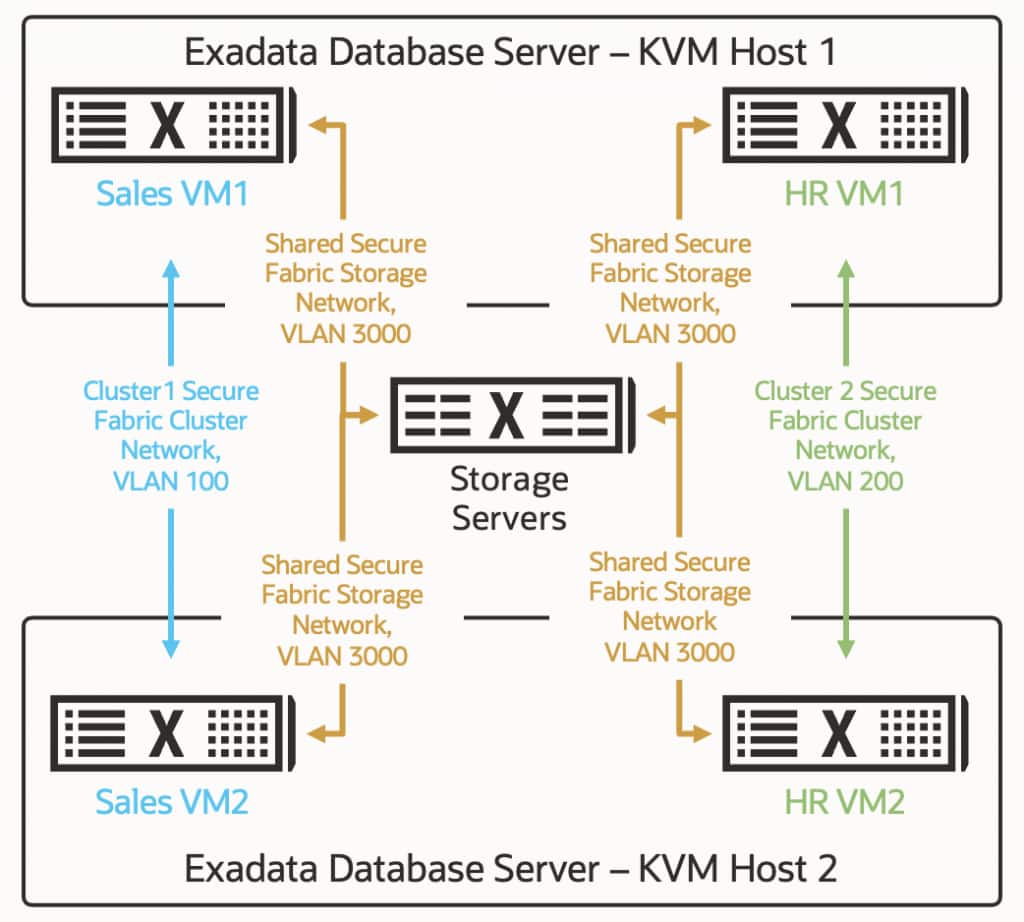
The diagram shows this model. The Sales VM cluster uses its own cluster VLAN shown in blue. Sales VM traffic stays inside that VLAN for intra cluster communication between Sales database server VMs.
The HR VM cluster uses the separate cluster VLAN highlighted in green. HR VM traffic stays inside its own VLAN for intra cluster communication and remains isolated from the Sales VM cluster.
Both Sales and HR also connect to the shared storage network VLAN shown in orange. The storage network VLAN allows database server VMs to communicate with the Exadata storage servers, but it does not allow Sales and HR VMs to communicate with each other. The blue and green cluster VLANs keep the VM clusters separated, while the orange storage VLAN allows both clusters to share Exadata storage safely.
For cluster communication, each VM cluster has its own cluster network partition, which is different from the storage network partition. The database server VMs in that cluster are full members of their cluster partition, so they can communicate with each other for RAC traffic. They cannot communicate with database server VMs in other cluster partitions.
In the storage network partition, the storage servers are full members, while the database server VMs are limited members. A database server VM can communicate with the storage servers, and the storage servers can communicate with the database server VMs they support. Limited members cannot communicate with other limited members, so one VM cluster cannot use the shared storage partition as a path to another VM cluster.
Secure Fabric gives Exadata customers a stronger trust model for consolidation. Applications continue to run in their dedicated VM clusters. Databases continue to use Exadata storage. The Exadata platform continues to deliver the performance, efficiency, and consolidation benefits needed for large Oracle Database estates. Secure Fabric extends the strict VM cluster isolation to the network, making consolidation easier to trust.
Secure Fabric is one of the unique capabilities that makes Exadata more practical and trustworthy as a consolidation platform. It helps customers safely share infrastructure, increasing efficiency, reducing costs, while preserving required isolation.