

The Exadata Product Management and Engineering teams are excited to announce the availability of Exadata System Software 26ai, release 26.2. It delivers a modern, highly secure software foundation for Exadata, helping customers address their evolving compliance and security requirements. At the same time, it continues to optimize the performance, availability, data protection, and operational control that customers expect from Exadata. The innovations in this release make Exadata an even stronger foundation for secure, high-performance enterprise applications and data.
What’s new in Exadata System Software 26ai, release 26.2
This post covers the release highlights and upgrade considerations most relevant to Exadata customers:
- Oracle Linux 9 with Java 25, FIPS 140-3, and post-quantum cryptographic algorithms
- Exadata Live Update for RoCE Switches
- Autonomous Kernel Updates
- Smart Flash Cache Advisor
- Minimum requirements and upgrade readiness
The announcement also covers ASM Mirror Resync Log, a related ASM capability that accelerates storage redundancy recovery after maintenance.
Modern security foundation for Exadata workloads
Oracle Linux 9 and Java 25
Exadata System Software 26.2 moves Exadata to Oracle Linux 9, delivering the latest security libraries and algorithms, and system-wide security policies.
Exadata System Software 26.2 also updates the system default Java to the Java 25 long-term support release. Java 25 provides standardized post-quantum algorithms through its security APIs, including ML-KEM for key encapsulation and ML-DSA for digital signatures. Java applications can use these algorithms when their cryptographic configuration, protocols, certificates, and endpoints support them.
Oracle Linux 9 and Java 25 strengthen Exadata’s security foundation, support current compliance requirements, and prepare the platform for post-quantum cryptography.
Cryptographic foundation for updated compliance
FIPS 140-3 defines security requirements for cryptographic modules and provides the basis for validating them. Exadata System Software 26.2 uses Oracle Linux 9 which provides FIPS 140-3 validated cryptographic modules that support platform functions and applications using TLS, SSH, certificate processing, key management, and related cryptographic services. These capabilities help regulated organizations protect sensitive information and support compliance, risk management, procurement, and audit activities.
Post-quantum cryptography readiness
Exadata System Software 26.2 gives customers a practical foundation for post-quantum cryptography (PQC), with updated Oracle Linux 9 cryptographic libraries, system-wide policies, and platform interfaces. Updated OpenSSL 3.5 libraries include implementations of NIST-standardized PQC algorithms. Supported TLS 1.3 configurations can also use hybrid key exchange. This combines classical and post-quantum cryptography and provides a practical migration path. Customers can adopt PQC incrementally by enabling it for supported services and applications, then validating compatibility across clients, servers, certificates, and protocols.
FIPS 140-3 and PQC address complementary aspects of cryptographic security. FIPS 140-3 validates specific cryptographic modules in defined configurations, while PQC addresses resilience against attacks from future quantum computers. This combination helps organizations address current compliance requirements while preparing their existing Exadata platform for future quantum threats.
Platform updates improve upgrade speed and modernize security
Smaller operating system images strengthen security
Exadata System Software 26.2 modernizes Exadata security with smaller, purpose-built operating-system images. Release 26.2 reduces the number of packages and software components in database and storage server images, helping reduce the attack surface and simplify lifecycle management. Database server images are now approximately 2X smaller, and storage server images are 10% smaller.
By delivering optimal operating system images curated and designed for Exadata and Oracle Database, the burden of securing and maintaining unused or unnecessary packages is removed. The smaller image also supports faster upgrade operations and complements a seamless major OS upgrade experience from Oracle Linux 8 to Oracle Linux 9 in Exadata Release 26.2.
Faster server upgrades
Exadata System Software 26.2 enables operating system upgrades on Exadata database servers without reimaging them and can make those upgrades up to 1.5X faster when compared to prior major operating system upgrades such as Oracle Linux 7 to Oracle Linux 8. Database server upgrades can run in a rolling manner, keeping customer databases online and shortening the maintenance window. Combined with smaller operating-system images, the no-reimage upgrade capability delivers a faster, more efficient experience while preserving the existing database server environment.
Exadata System Software 26.2 simplifies database server update packaging
Exadata System Software 26.2 delivers patchmgr in the database server update package, reducing update steps. Administrators can access both the update utility and release software from one package, making updates faster and easier to prepare.
Maintenance releases for Exadata System Software 25.2 and 26.1 continue to use a separate patchmgr download package.
When an ISO is used as the update repository, the --repo and --target_version options no longer need to be specified.
This integrated packaging aligns database server updates with storage server and switch updates, minimizing steps and creating a more consistent update experience across Exadata. See My Oracle Support Note KB153930 for details.
Continuous Linux kernel protection increases security
Exadata System Software 26.2 introduces Exadata Autonomous Kernel Update for automated, online Linux kernel security patching. Powered by Oracle Ksplice, it automatically downloads and applies eligible security fixes while database servers remain online, helping customers address critical kernel vulnerabilities without interrupting database workloads or requiring a database server reboot.
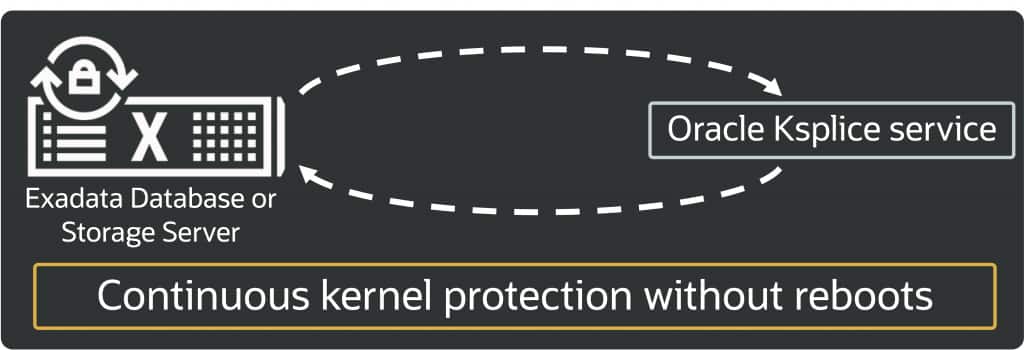
Exadata provides customers with several ways to keep their systems current. We recommend Exadata Live Update for Database Servers and conventional updates. Exadata Live Update supports online security and full updates for database servers, while conventional updates provide rolling updates for both database and storage servers. Customers who want to receive the latest available kernel Ksplice updates automatically can opt in to Autonomous Kernel Update, reducing the effort required to keep their systems current.
These options help customers keep Exadata kernel software current, strengthen security continuously, and preserve the availability required for mission-critical workloads.
Higher availability during maintenance
Exadata Live Update for RoCE Switches increases availability during maintenance
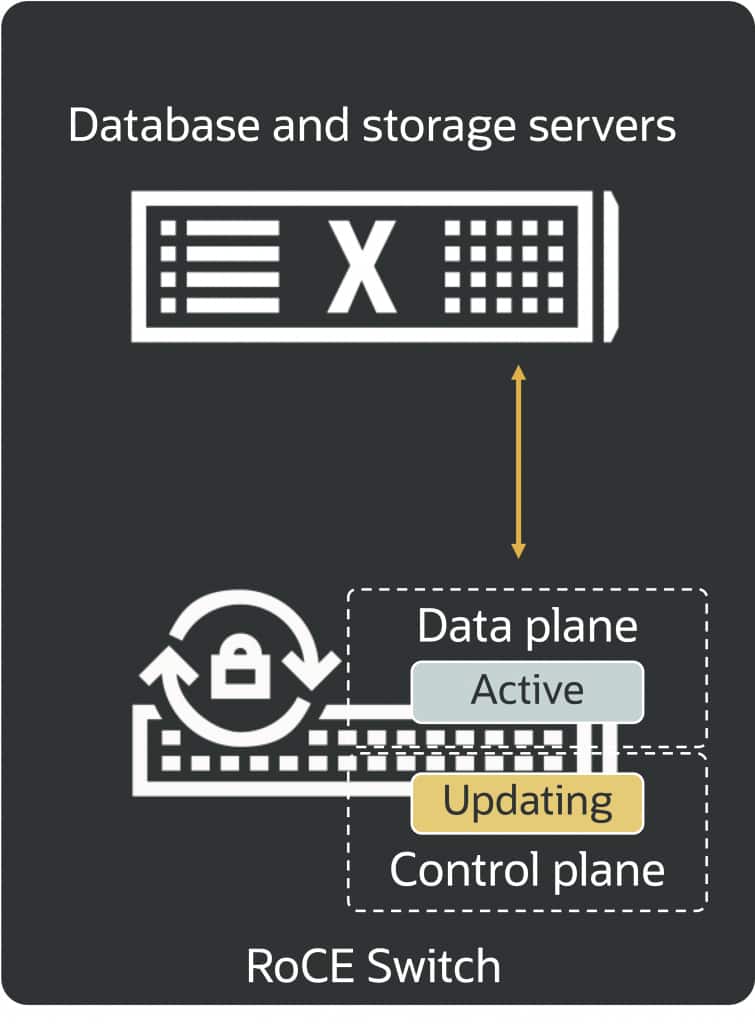
Exadata System Software 26.2 adds Exadata Live Update for RoCE Switches. Database and storage traffic continues to flow at full bandwidth delivering even better high availability during switch software maintenance. The data plane remains active while the control plane is updated, so switch maintenance does not interrupt RoCE traffic or database operations.
Exadata Live Update is automatically enabled and requires no user action to implement. It is immediately available on systems running supported Exadata System Software releases from the previous 12 months.
Together, these capabilities provide higher availability and full-bandwidth network performance during switch maintenance, helping customers maintain uninterrupted operation of their mission-critical Exadata environments.
Exadata Smart Flash Cache Advisor turns insight into sizing guidance
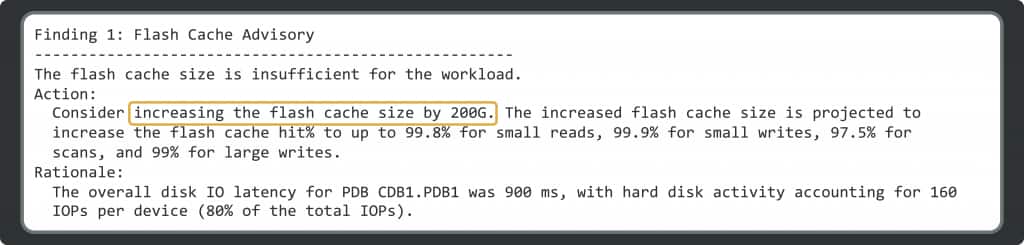
Available with Oracle AI Database 26ai Release Update 23.26.4, Exadata Smart Flash Cache Advisor turns real workload behavior into actionable guidance for sizing Exadata Smart Flash Cache. It models the impact of larger cache allocations and helps identify when additional Flash Cache could improve I/O efficiency.
Using Automatic Workload Repository (AWR) data, the advisor evaluates cache hits, misses, disk utilization, and I/O latency across different Flash Cache sizes. It then surfaces workload-specific recommendations for pluggable databases (PDBs) and container databases (CDBs), including whether to increase Flash Cache through an IORM plan, an Exascale resource profile, or additional storage servers. When I/O consumes significant database time and additional Flash Cache is projected to benefit the workload, the recommendation appears in the AWR report. The AWR recommendation identifies the suggested Flash Cache increase, expected cache hit rates, and projected benefits, giving customers a clear path from insight to action.
Customers can start by reviewing the AWR recommendation and selecting the sizing option that best fits their workload and operating model. It turns complex I/O analysis into a targeted Flash Cache sizing decision.
ASM Mirror Resync Log accelerates disk resynchronization after storage server maintenance
Available with Oracle AI Database and Grid Infrastructure Release Update 23.26.3, ASM Mirror Resync Log helps Exadata restore data redundancy faster after storage server maintenance. ASM traditionally resynchronizes an entire 4 MB allocation unit when changes occur. ASM Mirror Resync Log tracks exact changes, allowing ASM to resynchronize only the data that changed.
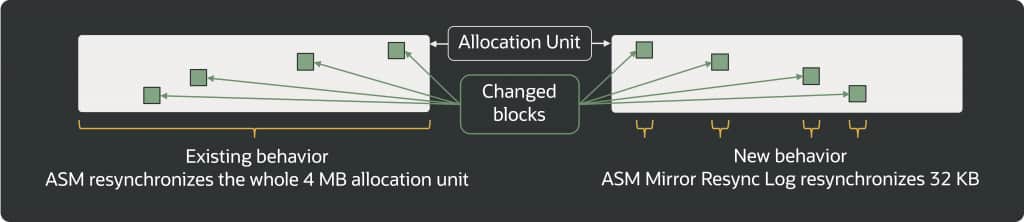
By moving only changed data, ASM Mirror Resync Log reduces data movement by up to 20X and restores redundancy up to 8X faster. This shortens the time required to restore redundancy and improves resynchronization efficiency.
Enabling ASM Mirror Resync Log is straightforward. Install or update Grid Infrastructure and Oracle AI Database 26ai to Release Update 23.26.3, set the database COMPATIBLE parameter to 23.0 or higher, restart the database, and update the compatible.asm and compatible.rdbms attributes to 23.26.3 for each ASM disk group.
This complementary database and ASM capability enhances storage resilience and I/O efficiency on Exadata.
Minimum requirements and upgrade readiness
The following minimum hardware configurations apply to Exadata System Software release 26.2.0:
- Oracle Exadata X8M-2 for two-socket systems
- Oracle Exadata X8M-8 for eight-socket systems
Existing systems must run at least one of the following Exadata System Software versions before updating to release 26.2.0:
- Exadata System Software 25.1.9, released in September 2025
- Exadata System Software 25.2.2, released in September 2025
- Exadata System Software 26.1.0, released in June 2026
For release details, supported configurations, prerequisites, and download instructions, see My Oracle Support Note KB153930 and the Exadata System Software documentation.
Pre-upgrade actions
Before upgrading to Exadata System Software 26.2, prepare supported KVM hosts, KVM guests, and bare-metal database servers as applicable:
Prepare custom software
- Identify the custom software and tools required after the upgrade. Oracle Linux 8 RPMs are not compatible with Oracle Linux 9.
- If required, use
patchmgr --force_remove_custom_rpmsto remove custom RPMs during the major operating system upgrade. - After the upgrade, install Oracle Linux 9-ready versions of the required custom software and tools.
Validate SSH keys
- Confirm that SSH keys meet the key-length requirement of 2048 bits.
Plan database servers for a conventional upgrade
- Plan the upgrade to Oracle Linux 9 as a conventional database server upgrade. Use Exadata Live Update only when the major Oracle Linux version remains unchanged, such as Oracle Linux 8 to Oracle Linux 8 or Oracle Linux 9 to Oracle Linux 9.
Plan for storage servers to be updated and restarted in a rolling manner.
Extending Exadata leadership for Oracle Database
Exadata System Software 26ai, release 26.2, advances Exadata as a modern, secure, high-performance platform for Oracle Database. Oracle Linux 9, Java 25, support for FIPS 140-3 validated cryptographic modules, and post-quantum cryptographic readiness strengthen protection against evolving threats and compliance demands. Purpose-built operating-system images reduce the attack surface and help accelerate upgrades, while Autonomous Kernel Update and integrated patchmgr packaging simplify ongoing maintenance.
Release 26.2 also helps customers keep mission-critical workloads available and running efficiently during change. Exadata Live Update for RoCE switches keeps network traffic flowing during switch maintenance, and no-reimage database server upgrades can reduce upgrade time by up to 1.5X. Complementary ASM and Oracle AI Database capabilities accelerate storage redundancy recovery and turn Smart Flash Cache analysis into actionable sizing guidance. Together, these improvements help customers modernize security, simplify operations, and sustain the performance, availability, and data protection that define Exadata.