
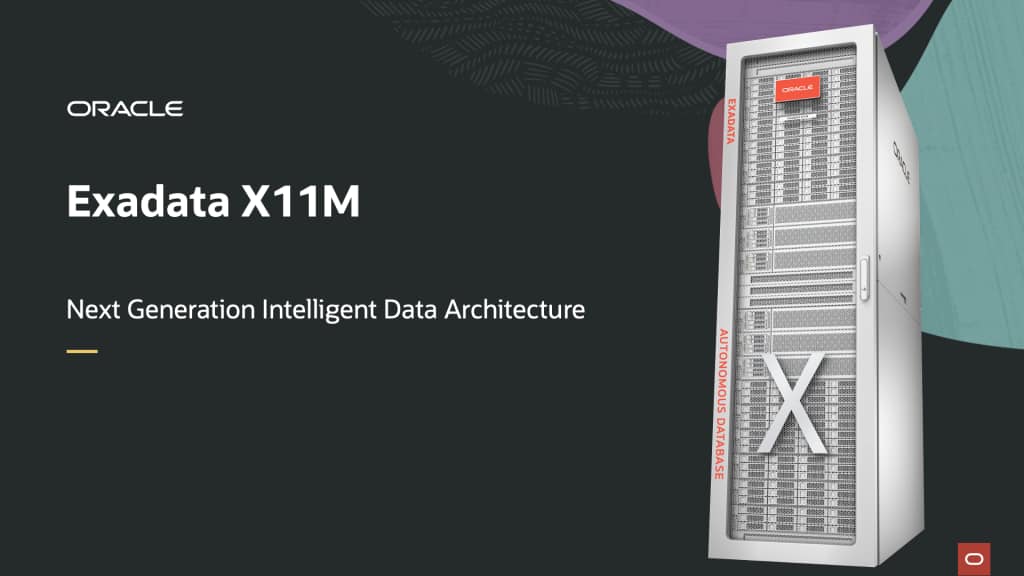
For years, the best database platforms have been the ones that deliver the most value for every dollar of infrastructure investment. That principle matters more today than ever before.
The economics of infrastructure have changed. Memory is expensive. Flash is expensive. Power is expensive. And simply throwing more compute at a database problem is no longer the smart or cost-effective answer it once seemed to be.
That is exactly where Exadata’s architecture is designed to differentiate itself.
Exadata has long focused on architectural optimization rather than relying solely on additional hardware resources. It has always been about doing things smarter. And in today’s environment, that architectural advantage translates directly into stronger value, lower total cost, and better long-term economics for running Oracle Database.
Smarter architecture beats brute force
A generic database server often relies on scaling up resources to compensate for inefficiency. More memory. More CPUs. More storage. That may work, but it is expensive and increasingly hard to justify.
Exadata’s next generation intelligent data architecture takes a different approach. It reduces the need for excess resources by making better use of the resources it already has. Instead of forcing customers to buy more of everything, Exadata uses intelligence across the stack to deliver extreme performance with fewer resources.
That difference matters even more now that infrastructure prices have risen and capacity planning mistakes become more expensive.
Smaller memory deployments perform better
One of the most important cost drivers in any database environment is memory. However, traditional systems face a conundrum. Large buffer caches are expensive, while reducing memory comes with a steep performance penalty.
Exadata changes that equation.
Exadata database instances retrieve data directly from storage server memory using Remote Direct Memory Access (RDMA). Because this data access is so much faster, the penalty for cache misses is significantly lower than it would be on a conventional platform. That means customers can often achieve excellent performance without paying for an oversized memory footprint, resulting in better economics and better resilience as infrastructure costs rise.
Flash-based analytics reduces need for database memory
Exadata also provides a highly cost-effective way to accelerate analytics. It can maintain columnar representations of operational data in the storage server flash cache and Exadata RDMA memory (XRMEM) to accelerate analytic processing while reducing reliance on large database-server memory footprints. This gives customers much of the performance benefit of in-memory analytics without all that expensive database server memory. Flash is not as fast as database memory, but it is far less costly, allowing each Exadata server to have terabytes of flash caching much larger data sets and ultimately providing a bigger performance benefit.
Just as important, the columnar data is accessible from any compute server. That is a major advantage over a design where analytic structures are locked into the memory of a single database server. Shared infrastructure means better utilization, better scale, and better return on investment.
Auto-tiered storage boosts price performance
Exadata’s storage architecture automatically places hot, warm, and cold data on the most appropriate storage medium.
Hard disk drives (HDDs) provide the persistence layer and the best capacity economics. Flash provides fast access and high IOPS for hot data. RDMA-enabled memory reduces latency for frequently accessed data.
Exadata automatically moves data between these tiers based on how it is used. That means customers do not have to pay premium pricing for every piece of data just to make sure access to the hottest data is fast enough. No complex tuning is needed either.
Because most application data is read many times, this database-aware auto-tiering model delivers performance that often exceeds flash-only approaches while preserving the economics of lower-cost capacity storage. That is a powerful advantage in a world where every layer of the stack has become more expensive.
Smart Scan reduces I/O and database licensing requirements
Exadata Smart Scan is another example of doing more with less.
Instead of sending huge amounts of data up to the database server and filtering it there, Exadata pushes processing down to the storage servers, which is where the data resides. That creates three important benefits.
- Data is filtered earlier, reducing data movement from storage to the database instance by up to 99%
- Processing happens in parallel across multiple storage servers, which improves throughput
- The work is performed on storage servers that do not require database licenses.
That combination of reduced I/O, parallelism, and offloaded processing directly improves cost efficiency. It is not just faster. It is smarter.
Storage Indexes eliminate unnecessary processing
Exadata Storage Indexes provide another example of efficiency through intelligence. They track ranges of data on storage devices and allow Exadata to skip reading large regions when that data cannot possibly match the request.
That means Exadata can avoid unnecessary I/O entirely. This reduces numerous disk reads, minimizes scanning, and improves resource efficiency.
A generic storage array cannot do this because it does not understand the data in the way Exadata does. Exadata is not just storage attached to a database. It is an integrated system designed to understand and accelerate Oracle Database workloads.
Scalability reduces upfront hardware purchases
Exadata is also cost-effective because it scales incrementally and in a completely online manner.
Customers can start small and expand as demand grows, adding compute and storage servers online. That means they only pay for what they need now, not what they might need years from now. This matters when the cost of memory, storage, and compute remains elevated and future pricing is uncertain. Buying forecasted peak capacity too early can lock customers into unnecessary expenses. Exadata lets them grow in step with the business.
Traditional architectures are not easy to scale, forcing disruptive migration to a larger machine once outgrown. That can mean downtime, added complexity, and the added cost of completely new hardware. Exadata avoids that trap by making scale-out part of the design.
Best-in-class high availability minimizes downtimes
Exadata is not only efficient. It is also highly available.
Its architecture is inherently redundant, with multiple database servers running Oracle Real Application Clusters and a platform designed for mission-critical workloads. That reduces the risk of downtime and helps protect the business from the hidden costs of outages, recovery, and operational disruption. Numerous features eliminate planned downtime such as rolling maintenance and optimized algorithms to rewarm caches after a server restart. Additional intelligent features detect and evict sick components before they can impact the performance of the system. Lastly, intelligent storage management with ASM and Exascale provide data redundancy ensuring data resiliency and durability.
When customers evaluate cost, they should look beyond purchase price alone. Availability, resilience, and operational simplicity all affect total cost of ownership. Exadata performs well in all three areas.
Security Built In, Not Bolted On
Security is another area where Exadata delivers value through intelligent design. Exadata is secure by default, with unnecessary Linux packages removed to reduce attack surfaces and configurations aligned with security best practices from day one. The platform enables SELinux and hardened security policies out of the box, and a standard Exadata deployment satisfies more than 90% of STIG-SCAP requirements, significantly reducing compliance effort.
Oracle also provides full-stack patching with live updates that allow critical security patches to be applied without system reboots, minimizing operational disruption while maintaining protection. In addition, Exadata includes the Advanced Intrusion Detection Environment (AIDE), which automatically establishes a trusted baseline of critical system files and directories and performs regular integrity checks to detect unauthorized changes. Together, these capabilities deliver value by reducing security and compliance costs, lowering operational overhead, and helping organizations maintain a strong security posture without requiring additional tools, expertise, or infrastructure.
Why this matters now
The old assumption was that performance problems could be solved by buying more hardware. Today, that approach is far less attractive. Memory and storage pricing make brute-force solutions expensive, and the broader infrastructure market continues to face pressure from rising demand and constrained supply.
That is why Exadata’s value proposition is stronger now than ever. Its design avoids waste, reduces dependence on expensive resources, and delivers performance through intelligence rather than brute force.
Exadata’s extreme performance not only supports the most intensive workloads, but also enables denser consolidation of other workloads, further improving overall efficiency. Exadata was already one of the most cost-effective ways to run Oracle Database. In today’s environment, it is even more compelling.
The bottom line
When customers look at the true cost of running Oracle Database, they need to account for memory efficiency, storage efficiency, licensing efficiency, scale, availability, and long-term flexibility. These efficiencies can translate into lower operational costs, simplified capacity planning, and the ability to scale performance without proportionally increasing infrastructure investments.
Exadata delivers on all those fronts.
Its architectural optimizations help deliver higher performance while improving resource efficiency. It is more efficient because it is purpose-built. And as infrastructure costs continue to rise, those advantages are not just technical strengths. They are economic advantages that maximize the value of a customer’s Oracle Database investments.