
From generative AI-powered conversations and enterprise knowledge retrieval to intelligent multi-agent orchestration and natural-language database access.
Introduction
Generative AI is transforming how organizations interact with information, applications, and business processes. What began as simple conversational interfaces is evolving into intelligent AI-powered assistants capable of understanding natural language, retrieving enterprise knowledge, analyzing documents, and interacting with multiple systems to fulfill complex requests.
For enterprises, the opportunity extends beyond building chatbots that answer questions. It is about creating intelligent conversational experiences that connect users with the data, AI capabilities, and business services they need.
Oracle Digital Assistant (ODA) helps developers build these experiences by providing a conversational interface that can integrate with Oracle Cloud Infrastructure (OCI) AI services, enterprise data sources, and business APIs.
By combining ODA with OCI Generative AI, Generative AI Agents, Document Understanding, Speech, Autonomous Database Select AI, and OCI Generative AI Tools, developers can build sophisticated AI-powered applications without requiring users to navigate multiple systems or understand the underlying technical architecture.
In this blog, we explore four integration patterns demonstrated through Oracle LiveLabs workshops:
- Generative AI-powered conversations and document analysis
- Retrieval-Augmented Generation (RAG) for enterprise knowledge
- Multi-agent orchestration across enterprise knowledge and APIs
- Intelligent multi-tool workflows with natural-language database access
Each workshop provides a hands-on opportunity to deploy and explore these capabilities in an OCI tenancy.
1. Bring Generative AI into Conversations with Oracle Digital Assistant
Large language models (LLMs) have introduced powerful new capabilities for understanding and generating natural language. By integrating these models with Oracle Digital Assistant, developers can create conversational applications that go beyond predefined responses and traditional intent-based interactions.
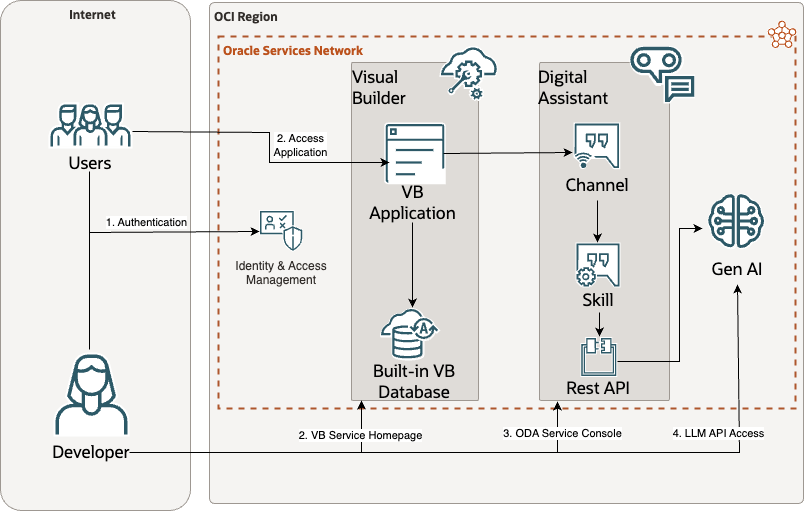
The Oracle LiveLabs workshop Deploy ATOM (AI Powered) Chatbot demonstrates how to configure and deploy an LLM-powered chatbot using ODA and OCI Generative AI.
ATOM is an AI-powered conversational application that enables users to interact with generative AI models through a familiar chatbot interface.
What can you build?
With ATOM, users can:
- Ask questions and receive natural-language responses generated by OCI Generative AI models.
- Upload documents for summarization or to provide additional context to their questions.
- Interact with the chatbot through a web application built using Oracle Visual Builder.
- Optionally explore OCI Document Understanding and Speech services to extend the application’s AI capabilities.
For example, a user could upload a business report and ask:
“Summarize the key findings in this document and highlight the main recommendations.”
The application can use the uploaded document as context for an LLM-powered response.
How does it work?
The solution combines several OCI services:
OCI Generative AI provides access to pretrained foundation models through managed APIs.
Oracle Digital Assistant delivers the chatbot experience and integrates with the generative AI service.
Oracle Visual Builder provides a web-based application that embeds the ODA chatbot.
OCI Document Understanding and Speech, available as optional integrations in the workshop, demonstrate how additional AI services can complement conversational applications.
The workshop focuses on document interactions involving relatively small files, approximately 20,000 words. For larger document collections and enterprise knowledge retrieval, a RAG-based approach may be more appropriate.
Why it matters
Integrating ODA with generative AI models allows developers to build conversational experiences that can understand and respond to a broader range of natural-language requests.
It also creates opportunities to incorporate document-based interactions and additional AI services within a single application.
Get hands-on: Deploy ATOM (AI Powered) Chatbot — LiveLabs Workshop 3924
2. Connect Enterprise Knowledge with OCI Generative AI Agents and RAG
While foundation models provide powerful language capabilities, enterprise applications frequently require responses grounded in organization-specific information.
Product manuals, technical documentation, internal policies, and other business documents often contain information that is not available in a model’s pretrained knowledge.
Retrieval-Augmented Generation (RAG) helps address this challenge by retrieving relevant information from enterprise knowledge sources and using it to inform generated responses.
Oracle Digital Assistant can integrate with OCI Generative AI Agents to provide a conversational interface for RAG-powered applications.
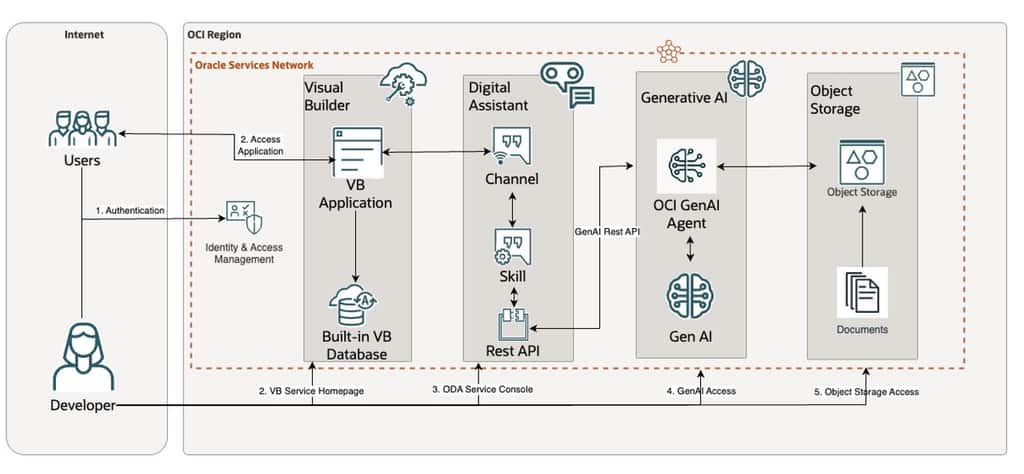
The LiveLabs workshop Deploy an ODA Chatbot Powered by Generative AI Agents demonstrates this architecture using custom PDF documents stored in OCI Object Storage.
How does it work?
The solution brings together several OCI services:
OCI Object Storage stores the PDF documents and manuals that serve as the enterprise knowledge source.
OCI Generative AI Agents provides knowledge bases and agents that ingest documents, retrieve relevant information, and support RAG-based responses.
OCI Functions provides a REST service used to connect the ODA chatbot to the Generative AI Agent service. The workshop also includes optional automation capabilities.
Oracle Digital Assistant provides the conversational interface through an imported ODA skill.
Oracle Visual Builder hosts the ATOM application, where users interact with the embedded ODA chatbot.
Example: An intelligent product support assistant
Imagine a company with hundreds of technical manuals and product guides.
Instead of requiring support representatives to search these documents manually, the organization could provide an ODA-powered assistant connected to a Generative AI Agent.
A representative might ask:
“What are the recommended troubleshooting steps for error code XYZ?”
The assistant can use the Generative AI Agent to retrieve relevant information from the uploaded manuals and generate a response grounded in that documentation.
Why it matters
This approach helps organizations make enterprise knowledge more accessible through natural-language conversations.
It can support scenarios such as:
- Technical support and troubleshooting
- Employee knowledge assistants
- Product documentation search
- Enterprise policy and procedure assistance
- Customer self-service applications
By combining ODA with OCI Generative AI Agents, developers can create conversational experiences that connect users to enterprise knowledge while leveraging OCI’s managed RAG capabilities.
Get hands-on: Deploy an ODA Chatbot Powered by Generative AI Agents — LiveLabs Workshop 4022
3. Build Intelligent Multi-Agent Conversations with OCI Generative AI Tools
Enterprise requests are not always limited to a single knowledge source or application.
A user may need information from different document repositories, databases, or external services. Handling these requests requires the ability to select the appropriate source and, in some cases, coordinate multiple operations.
This is where multi-agent architectures and intelligent tool orchestration become valuable.
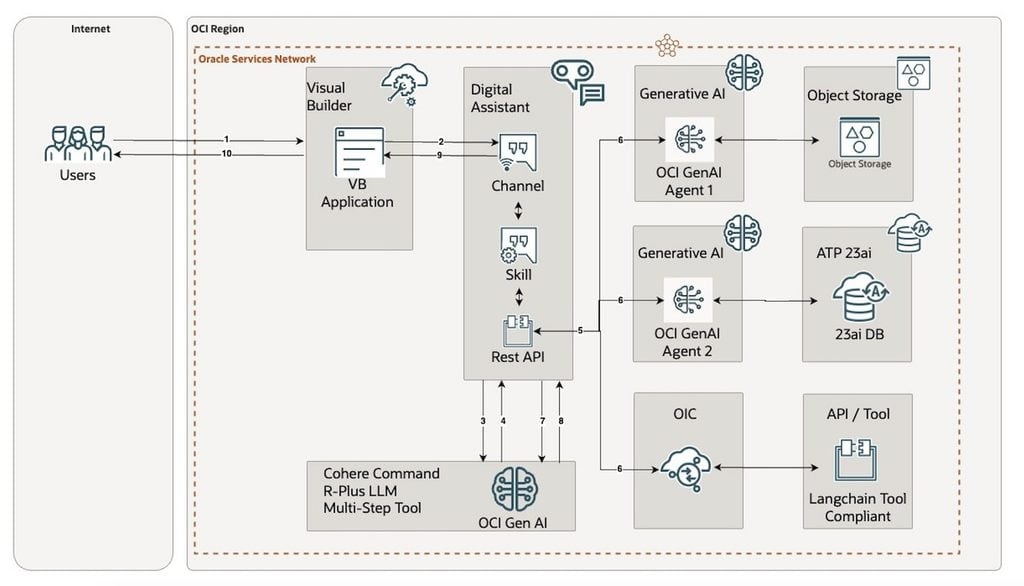
The LiveLabs workshop Deploy an ODA Multi Agent / API Orchestration Chatbot using LLM Tools demonstrates how Oracle Digital Assistant can provide a conversational interface to multiple OCI Generative AI Agents and enterprise APIs.
Bringing multiple agents together
In this architecture, developers configure multiple OCI Generative AI Agents with different knowledge sources.
For example:
- One RAG agent uses documents stored in OCI Object Storage.
- Another RAG agent uses vectorized document content stored in Oracle Autonomous Database 23ai.
- An external API is integrated through Oracle Integration Cloud (OIC).
Each agent or API provides a specialized capability.
When a user submits a natural-language request, the solution uses OCI Generative AI Tools to dynamically route the request to the appropriate agent or API.
Oracle Digital Assistant provides the user-facing conversational experience, while the integrated Generative AI Tools handle tool selection and orchestration.
Connecting to external enterprise services
The workshop demonstrates integration with a weather API through Oracle Integration.
For example, a user could ask:
“What is the current weather in San Francisco?”
The solution can select the appropriate integrated API and return the requested information through the ODA chatbot.
Although weather is used as a straightforward demonstration, the same integration pattern can be applied to enterprise APIs that provide access to business information and services.
Go further with multi-step tool calling
A particularly important capability demonstrated in this workshop is the OCI Generative AI Multi-step Tool.
This enables sequential tool execution, where the output of one tool can be passed as input to another.
Consider a hypothetical enterprise request:
“Find the warranty policy for this product and check whether replacement parts are available.”
Answering this request could require retrieving warranty information from a RAG agent and then calling an inventory API using information from the first response.
With multi-step tool orchestration, these operations can be coordinated as part of a conversational workflow.
Why it matters
This architecture demonstrates how developers can build assistants that access multiple knowledge sources and enterprise services without requiring users to know which system contains the information.
It also illustrates the potential for AI-powered conversations to evolve from answering individual questions to supporting more complex, multi-system requests.
Get hands-on: Deploy an ODA Multi Agent / API Orchestration Chatbot using LLM Tools — LiveLabs Workshop 4110
4. Enable Natural-Language Database Access and Multi-API Orchestration
Enterprise data often resides across databases, business applications, and external services. Accessing this information traditionally requires users to understand database queries, navigate multiple applications, or interact with different APIs.
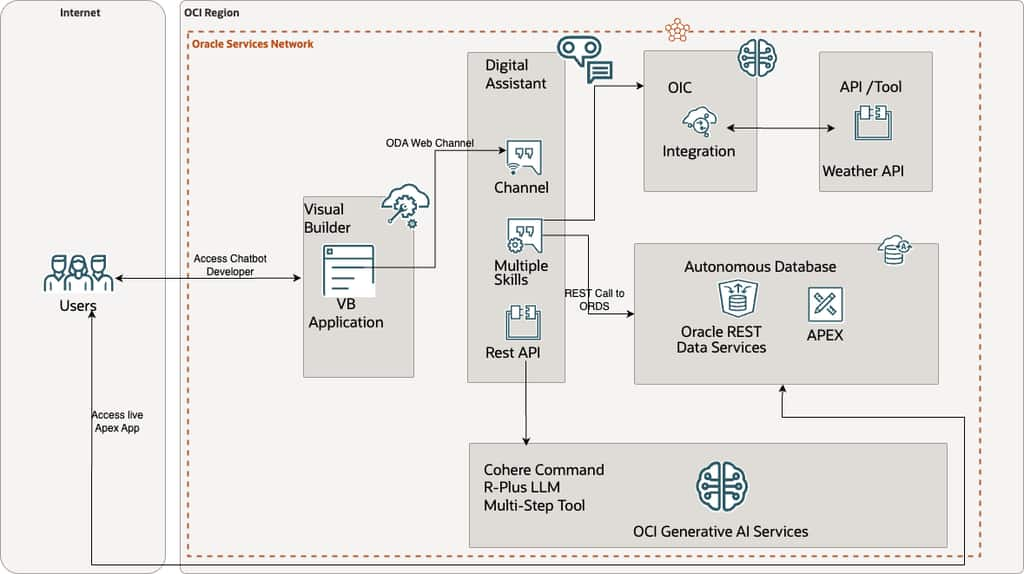
By combining Oracle Digital Assistant (ODA) with Oracle Autonomous Database Select AI, Oracle REST Data Services (ORDS), Oracle Integration, and OCI Generative AI Tools, developers can create conversational applications that make enterprise data and services accessible through natural language.
The Oracle LiveLabs workshop Deploy ODA Multi-API Orchestration Chatbot powered by GenAI Tools and ADB Select AI demonstrates this architecture.
Natural-language access to enterprise databases
Oracle Autonomous Database Select AI enables users to query database information using natural language.
Developers can expose these capabilities through ORDS-based REST APIs, allowing an ODA chatbot to retrieve database information without requiring users to write SQL.
For example, a user could ask:
“Which five products generated the highest revenue last quarter?”
The chatbot can use OCI Generative AI Tools to route the request to a Select AI-backed API that retrieves the relevant database information.
Connect multiple enterprise APIs
The workshop demonstrates how developers can create and integrate different types of APIs:
- Database APIs through ORDS: Retrieve information using Autonomous Database Select AI or perform database operations, including adding data.
- Third-party APIs through Oracle Integration Cloud (OIC): Connect external services and enterprise applications to the conversational solution.
Oracle APEX can also provide an additional application interface to the Autonomous Database.
Execute complex workflows with Generative AI Multi-step Tool
A key capability demonstrated in this workshop is the OCI Generative AI Multi-step Tool.
This enables the solution to dynamically select tools and execute multiple API calls in sequence, using the output of one tool as input to another.
For example, consider a user asking:
“Identify customers with overdue invoices and retrieve the status of their latest support requests.”
A multi-step workflow could:
- Query Autonomous Database using a Select AI-backed API to identify customers with overdue invoices.
- Pass the resulting customer identifiers to an integrated support system API.
- Retrieve the corresponding support request information.
- Present the combined results through the ODA chatbot.
This illustrates how conversational AI can support requests involving multiple data sources and enterprise systems.
Why it matters
This architecture demonstrates how ODA can provide a unified conversational experience for database queries, enterprise APIs, and multi-step operations.
Rather than requiring users to interact with individual systems, developers can build AI-powered applications that dynamically select and coordinate the appropriate services based on natural-language requests.
Get hands-on: Deploy ODA Multi-API Orchestration Chatbot powered by GenAI Tools and ADB Select AI — LiveLabs Workshop 4137
5. Oracle Digital Assistant: Bringing OCI AI Capabilities Together
Across these four workshops, a common architectural pattern emerges.
Oracle Digital Assistant provides the conversational interface through which users interact with AI-powered capabilities, while OCI AI services, databases, and integration technologies perform specialized tasks behind the scenes.
Different application requirements can be addressed by combining ODA with different services.
| OCI service or technology | Capability demonstrated |
|---|---|
| OCI Generative AI | LLM-powered conversations and document summarization |
| OCI Document Understanding | Optional AI-powered document processing |
| OCI Speech | Optional speech processing capabilities |
| OCI Generative AI Agents | RAG-based retrieval and enterprise knowledge access |
| OCI Generative AI Tools | Dynamic tool selection and multi-step orchestration |
| Oracle Autonomous Database 23ai | Database-backed knowledge and vectorized document content |
| Autonomous Database Select AI | Natural-language-to-SQL database queries |
| Oracle REST Data Services | REST API access to database capabilities |
| Oracle Integration | Integration with external and enterprise APIs |
| Oracle Visual Builder | Web application experience with embedded ODA chatbot |
These integrations illustrate the flexibility of using ODA as a conversational interface for different enterprise AI architectures.
A developer can start with an LLM-powered chatbot, introduce RAG to access enterprise documents, or build a more sophisticated application that coordinates multiple agents, database queries, and APIs.
Importantly, these are complementary architectural patterns rather than a required sequence of implementation steps. Developers can select the capabilities that best match their use cases.
6. Explore the Capabilities with Oracle LiveLabs
The four LiveLabs workshops provide practical, hands-on examples of how these technologies work together.
| Workshop | Key capabilities | Estimated time |
|---|---|---|
| 3924 — Deploy ATOM AI Powered Chatbot | OCI Generative AI, ODA, document interactions, optional Document Understanding and Speech | 1 hour 30 minutes |
| 4022 — Deploy an ODA Chatbot Powered by Generative AI Agents | RAG, OCI Generative AI Agents, Object Storage, OCI Functions | 2 hours 15 minutes |
| 4110 — Multi-Agent / API Orchestration with LLM Tools | Multiple RAG agents, Autonomous Database 23ai, Oracle Integration, multi-step tools | 5 hours |
| 4137 — Deploy ODA Multi-API Orchestration Chatbot powered by GenAI Tools and ADB Select AI | Select AI, ORDS, database APIs, Oracle Integration, sequential tool calling | See workshop |
Whether you are exploring generative AI for the first time or designing sophisticated enterprise conversational applications, these workshops offer practical starting points for learning how Oracle Digital Assistant integrates with OCI AI services.
Before you begin: The workshops require an Oracle Cloud account and access to the OCI services used in each solution. Some also require administrative permissions and access to specific OCI regions. Review the prerequisites for your selected workshop before starting.
Conclusion: From Conversations to Intelligent Enterprise Experiences
Conversational AI is moving beyond predefined chatbot interactions toward intelligent experiences that can access enterprise knowledge, interpret documents, interact with databases, and coordinate operations across multiple systems.
Oracle Digital Assistant helps bring these capabilities to users through a conversational interface.
By integrating ODA with OCI Generative AI, Generative AI Agents, Document Understanding, Speech, Autonomous Database Select AI, and OCI Generative AI Tools, developers can create solutions tailored to a wide range of enterprise requirements.
The four Oracle LiveLabs workshops demonstrate how these technologies can work together—from straightforward LLM-powered conversations to sophisticated multi-agent and multi-tool architectures.
The opportunity is not simply to build smarter chatbots. It is to make enterprise AI capabilities, data, and services accessible through natural conversation.
Explore the workshops, experiment with the integration patterns, and discover what you can build with Oracle Digital Assistant and OCI AI services.