
How a converged, multi-model database combines relational, JSON, vector, and graph data for hybrid search, transactional consistency, and less data movement
Companion notebook Concrete example: vectors, JSON, and event-streaming
Key takeaways
- A multi-model database is useful when related relational, JSON, vector, text, graph, or spatial data need to be queried or updated together.
- Hybrid queries can keep processing close to the underlying data, reducing application-side coordination and unnecessary data movement between separate systems.
- A shared transactional boundary reduces the coordination work for related data changes.
- One database platform can reduce duplication and operational overhead, though specialized databases may be a better fit for isolated or dominant workloads.
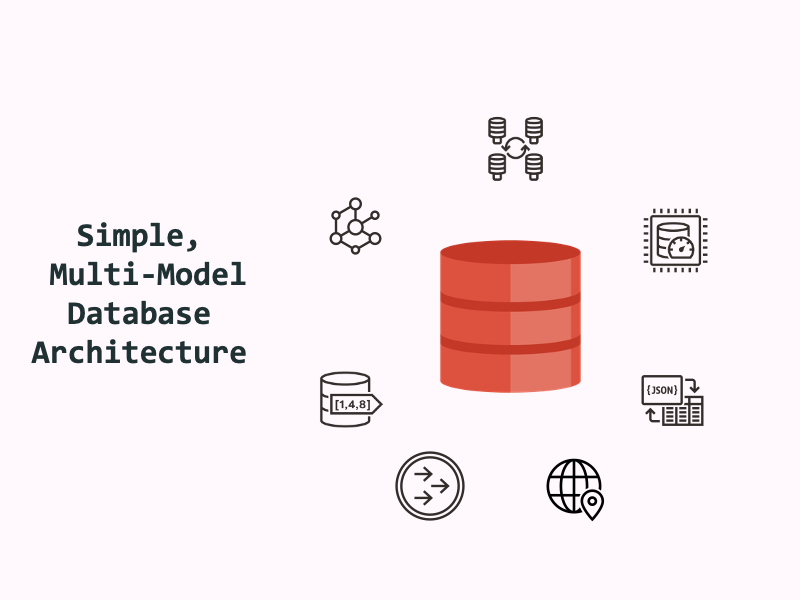
A multi-model database is a database that handles multiple data models and query methods, like vectors, graphs, documents, relational data, and more – in a single, converged engine.
Multi-model databases are most valuable when multiple data models are closely related and must be queried transactionally. When working with real-world, multi-model data, I’ve found this to often be the case.
Over time, systems grow in complexity
To help illustrate the utility of a multi-model database, let’s consider a fairly typical scenario:
Your engineering team builds and deploys a new service architecture around a NoSQL database like DynamoDB or similar. The initial deployment goes well, and NoSQL meets the initial requirements neatly.
Later on, a customer request requires you to add vector search capabilities, so your team bootstraps a vector database. All is well.
Then, user traffic picks up and you add a cache (such as Memcached or Redis). This new system is integrated into the stack.
As the system evolves, new capabilities continue to be added. Real-time event-streaming (through something like Apache Kafka) enables async order processing. Location-aware capabilities pull in a spatial database. Your team spins up and manages more and more disjoint data platforms. Not every component in this architecture is necessarily replaced by a multi-model database. Caches and event-streaming platforms may still serve important roles; the opportunity is to reduce the number of separate database systems used to store and query closely related application data.
If not managed, complexity leads to inefficiencies

Without careful planning and tight engineering controls, a few types of problems arise:
- Data duplication: For example, NoSQL data is copied to a graph or vector database, complicating the source of truth or risking stale data.
- Network overhead: To complete a task, clients must make network calls to different databases, joining the data in the application tier. The additional network round-trips add latency and network costs.
- Hybrid queries are complex: Queries that join multiple types of data (e.g., vector + graph) must query two databases, and then be joined at the application tier. This is usually custom logic.
- Transactions aren’t easy: It’s challenging to implement transactions over disjoint systems. Atomic, transactional work will require some sort of distributed transaction implementation, which is often heavyweight and complex.
- Experts for every system: Each data platform has different requirements for day-to-day operations, backups, upgrades, and failover. Even with managed systems, someone must own and maintain that component.
A converged, multi-model database can simplify and add value
Data de-duplication
Data lives in one engine, with one unified database platform. Vectors, text, spatial data, JSON, and more can live side by side in the same database. Keeping related authoritative data in one system reduces the need to copy and synchronize that data across specialized databases. Extract-transform-load (ETL) workloads created solely to move operational data between those systems can be dramatically reduced, or even eliminated, reducing unnecessary data movement.
One query, one round-trip: simple hybrid search
With hybrid search, vector and lexical retrieval can run close to the underlying application data instead of requiring that data to be copied into separate search systems. If you need to query vectors (similarity search) and text (lexical search), you can do this in one query statement. For example, a query that filters on vector distance and text CONTAINS may include both predicates in a single statement. When the query is executed, the results are returned to the client in one round-trip. This reduces the application-side orchestration and result-merging logic developers would otherwise need to build across separate systems.

Transactional boundaries
Because related data lives in one engine, the transactional boundary can encompass the data managed within that database. If I’m modifying JSON data and related graph edges, I can encapsulate this in a single, atomic transaction at the database server level.
Contrast this with a multi-database architecture: if a JSON update succeeds but a graph update fails, I must implement compensating transactions, retries, reconciliation jobs, or other error correction logic. Keeping those related changes inside one transaction reduces the risk of partial updates and the need for application-level reconciliation logic.
One system, less operational overhead
When one multi-model database handles several related application data models, you can reduce the operational overhead for your team. I don’t need to maintain, upgrade, back up, and manage separate database platforms for JSON, vectors, graphs, and other related data models. Other components, such as caches or event-streaming platforms, can remain where they provide value.
Scaling a converged, multi-model database
One common argument against multi-model databases is that single-purpose databases can be easier to scale for specific workloads. Serverless databases, for example, often make it simple and efficient to add read/write capacity as demand increases. However, scaling each database independently requires separate autoscaling policies, capacity planning, and budget management across the stack. For bursty or elastic workloads, that flexibility may still be worth the additional operational complexity.
Modern multi-model databases can support a wide range of workloads through horizontal and vertical scaling. Oracle Globally Distributed Database provides options for distributing a database deployment across regions, while Maximum Availability Architecture (MAA) provides guidance for resilience and high availability. These capabilities address geographic distribution and availability alongside the converged database capabilities used to support multi-model workloads.
The architectural trade-off is whether the benefits of scaling specialized systems independently outweigh the additional data movement, coordination, and operational complexity of managing them separately.
When I’d use a multi-model database
I’d use a multi-model database when an application needs several related data models and those models must work together. For example, an application may need relational records, JSON documents, vector embeddings, full-text search, or graph relationships over the same underlying data.
A multi-model database is especially useful when hybrid queries, transactional consistency, and low-latency access across data types are important. Keeping related data in one platform can reduce duplication and simplify application logic, while still supporting specialized ways to query that data.
FAQs
What is a multi-model database?
A multi-model database supports multiple ways of storing and querying data such as relational tables, JSON documents, vectors, text, graphs, and spatial data in one database platform.
When should I use a multi-model database?
I’d use one when the same application data needs multiple query styles and the results or updates must remain consistent. Hybrid search is a good example because vector, text, and structured data can be queried together without coordinating results across separate databases.
Does a multi-model database replace every specialized database?
No. A single-purpose database can be the better choice when one workload dominates, requires strict isolation, or needs a capability the unified platform does not provide.
How does it reduce application complexity?
It can keep related data and hybrid queries in one database request, reducing the need for application-side joins, synchronization pipelines, and compensating logic across independent systems.
Can a multi-model database scale?
Yes, but scaling choices still depend on the workload. Specialized systems may offer simpler independent scaling for a particular use case, while a unified platform reduces the number of separate scaling policies and operational components to manage.