
Database-enforced authorization keeps the data-access decision tied to the authenticated end user before results reach an AI application. In a .NET workflow, the important boundary is how that identity reaches the database and how its context is cleared when a connection is reused.
Protect .NET applications from over-broad agent access, prompt injection, and tool misuse with Oracle Deep Data Security and ODP.NET
Key Takeaways
- Agentic AI can perform complex tasks, but it often requires broad and dynamic data access, which increases security and compliance risk.
- Enforcing authorization in the database reduces duplicated application logic and keeps access rules consistent across applications, agents, and tools.
- Oracle Deep Data Security provides database-native policy enforcement. ODP.NET 23.26.2 adds support for passing end-user security context from .NET applications.
- .NET applications can adopt this model by integrating end-user security context into the data access layer.
Agentic AI changes how applications access data. Instead of following fixed application flows, agents can choose tools and generate actions at runtime.
When given relevant data, agents can further optimize workflows to meet objectives. However, broader access also increases the risk of unauthorized use and data exfiltration.
As organizations deploy agentic AI, keeping enterprise data protected and auditable becomes harder with the wrong security model. When agents access the database directly or through Model Context Protocol (MCP) server tools, authorization must still be enforced before data is returned. If the agent’s database access is broader than the end user’s authorization, it can expose sensitive data or modify protected records.
The key design question is where authorization should be enforced: in every application, or in the database. At scale, maintaining separate authorization logic in every application becomes difficult to validate and easy to get wrong. When requirements, queries, or schemas change, teams must update authorization logic across every affected application. This becomes unmanageable as more AI applications are deployed across the enterprise.
As attackers adopt AI-driven penetration testing tools to find application vulnerabilities faster than before, securing access control at every app level entry point becomes even more critical.
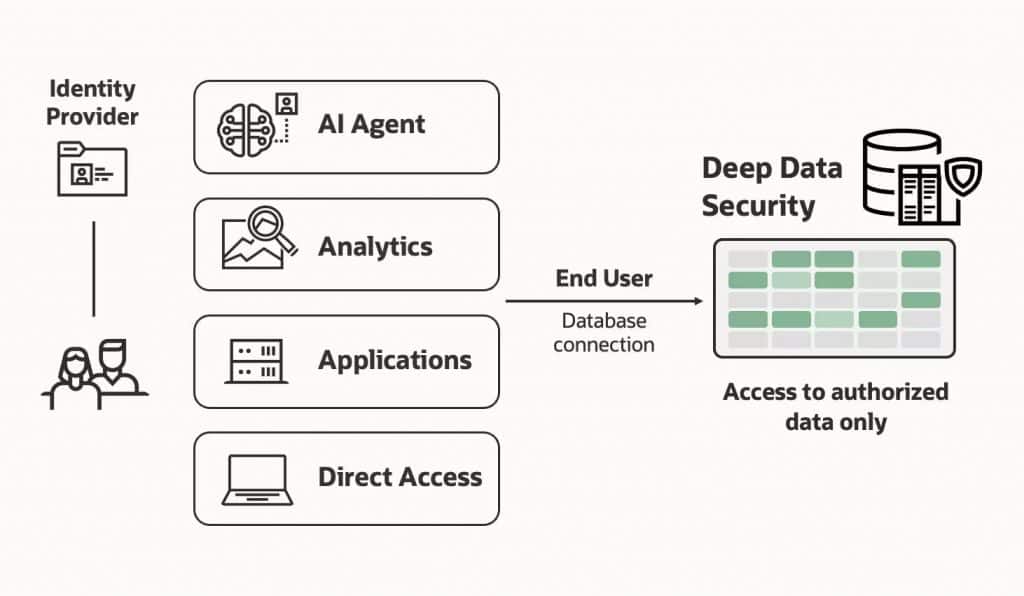
On the other hand, database-layer enforcement centralizes authorization and applies policies consistently before data is returned. Instead of relying on every developer to secure their part of the app perimeter, the same database policies can apply whether access comes from an application, an AI agent, or an MCP-based tool. Oracle AI Database 26ai (23.26.2) enables this capability with Deep Data Security.
Why Agentic AI Apps Need Deep Data Security
Oracle Deep Data Security is a database-native authorization model that extends traditional system and object privileges by using end-user, agent, role, and attribute context in authorization decisions. It is designed for workloads where users, applications, agents, and tools may access the same data through different paths.
Deep Data Security securely propagates end-user and agent identities, roles, and attributes to the database at runtime using an end-user security context. It is important to note that the end-users may not necessarily be database users. They can be any user type, such as Microsoft Entra ID or web application users. The database uses this context to enforce policies that define what users and agents can do — and when — and to generate audit records that capture activity. For example, a policy can allow a sales manager to see only customer rows for their assigned region, even if an agent generates a broader query.
The Deep Data Security authorization model enforces fine-grained security at the row, column, and cell levels, enabling least-privilege access so end-users and agents see only authorized data. The database can return only authorized rows and masks sensitive column values when the end-user or agent lacks the required entitlement. Because the database enforces these policies during SQL execution, authorization remains consistent even when different applications or agents access the same data.
Since policies are enforced in the database, developers do not have to duplicate the same authorization rules in every application or agent workflow. When requirements change, teams can update the database policy instead of rewriting authorization logic across multiple applications.
For sensitive workflows, access can be granted only for the duration and scope of that workflow, instead of giving the application broad standing privileges. This reduces reliance on shared high-privilege service accounts that can read or write more data than the end user should have access to.
Access boundaries must stay manageable, enforceable, and auditable as workflows change. Deep Data Security enforces least-privilege access for users and agents while preserving user identity in audit records to support safer, compliant AI adoption. .NET applications should incorporate Deep Data Security and pass end-user context to the database in a way they can manage consistently.
Develop .NET Apps with Deep Data Security
.NET applications can pass end-user identity, claims, roles, and application context to the database, where Deep Data Security evaluates policies during SQL execution before unauthorized rows, columns, or values can be returned. Managed ODP.NET and ODP.NET Core 23.26.2 add extension methods to use this context payload.
With minimal code changes, existing ODP.NET applications can use Deep Data Security’s protection with agentic AI. Applications do not need to map each end user to a separate database user. The database evaluates authorization using the supplied end-user security context. The database manages session lifecycles automatically based on OAuth2 tokens, which include user authorization claims for resources and applications.
To do this, you will set the end-user security context on the ODP.NET connection using OracleConnection.SetEndUserSecurityContext. The connection then executes commands on behalf of an end user identified by a token. The application supplies the end-user context separately from the database access token used by the mid-tier. Deep Data Security then evaluates policies using the end-user claims, roles, and attributes. Data roles and attributes allow Oracle AI Database to evaluate role mappings and token claims during authorization. This enables Deep Data Security to deliver fine-grained, end-user-aware access control in .NET without database user credentials.
Deep Data Security evaluates policies during SQL execution, before unauthorized rows, columns, or values are returned. By default, unauthorized data is masked as NULL, though SQL functions can apply other formats.
ODP.NET uses the OracleEndUserSecurityContext class to represent the security identity for an application end user’s database operations.
Putting it altogether, the following .NET code sample shows how to set a connection’s end-user security context and clear it after use.
OracleConnection conn = new OracleConnection(connStr);
conn.Open();
string userToken = GetUserToken();
string midTierToken = GetMidtierToken();

// Create security context using tokens
OracleEndUserSecurityContext securityContext = OracleEndUserSecurityContext.CreateWithTokens(midTierToken, userToken);

// Set security context on the connection
conn.SetEndUserSecurityContext(securityContext);

// Execute database operations

// Clear security context from connection
conn.ClearEndUserSecurityContext();

// Close connection
conn.Close();
Start Developing with ODP.NET Deep Data Security
With ODP.NET and Oracle Deep Data Security, you can build end-to-end agentic AI .NET applications while protecting data from current and emerging threats. Data protection rules can evolve with simple changes, and access can be centrally managed and audited.
Get started by downloading managed ODP.NET or ODP.NET Core 23.26.2 with Deep Data Security and reviewing the Oracle Deep Data Security web page and ODP.NET Developer’s Guide Deep Data Security section.
FAQ
- What is agentic AI?
It’s AI that can plan, reason, and execute multi-step tasks independently, often without human supervision. - Why is managing data security at the database-level preferred?
It centralizes data access control, making it easier to manage, update, and audit compared to securing each application individually. - How does Deep Data Security protect data?
It enforces policies at row, column, and cell levels, ensuring users and AI agents only access authorized data. - How do .NET apps use Deep Data Security?
They pass user and app identity via tokens into an ODP.NET connection security context, allowing the database to enforce access rules without exposing credentials.
What should the authorization test include?
Run the same operation as two users with different permissions, then reuse a pooled connection and repeat the checks. Include an attempted unauthorized read and verify that prohibited content never reaches the model. Successful authentication is not evidence that row or column authorization is correct.
Continue the implementation: How to Enforce Role-Based Data Access in AI Applications with Oracle Deep Data Security. Use the validation described above as the acceptance check for your next step.