
OCI GoldenGate continues to make real-time data movement easier to build and operate. New capabilities for ZeroETL Mirror pipelines, along with enhancements to disaster recovery workflows, help teams simplify pipeline initialization, scale deployments more flexibly, and validate disaster recovery readiness before planned switchovers and recovery events.
These capabilities are available in the latest OCI GoldenGate service release and are now generally available in all OCI regions.
For teams using OCI GoldenGate to support analytics, AI, operational reporting, and cloud architectures, these enhancements help simplify pipeline setup and improve disaster recovery readiness. New sizing controls and autoscaling options provide greater flexibility for ZeroETL Mirror pipelines, while Object Storage support streamlines initial-load workflows. Additional disaster recovery prechecks and failover activation options help teams validate readiness before planned switchovers and recovery events.
ZeroETL Mirror enhancements for faster pipeline operations
ZeroETL Mirror pipelines help users move data from operational Oracle databases to analytics and lakehouse environments without building traditional ETL jobs. The latest enhancements focus on two important aspects of production operations: deployment sizing and initial-load workflows.
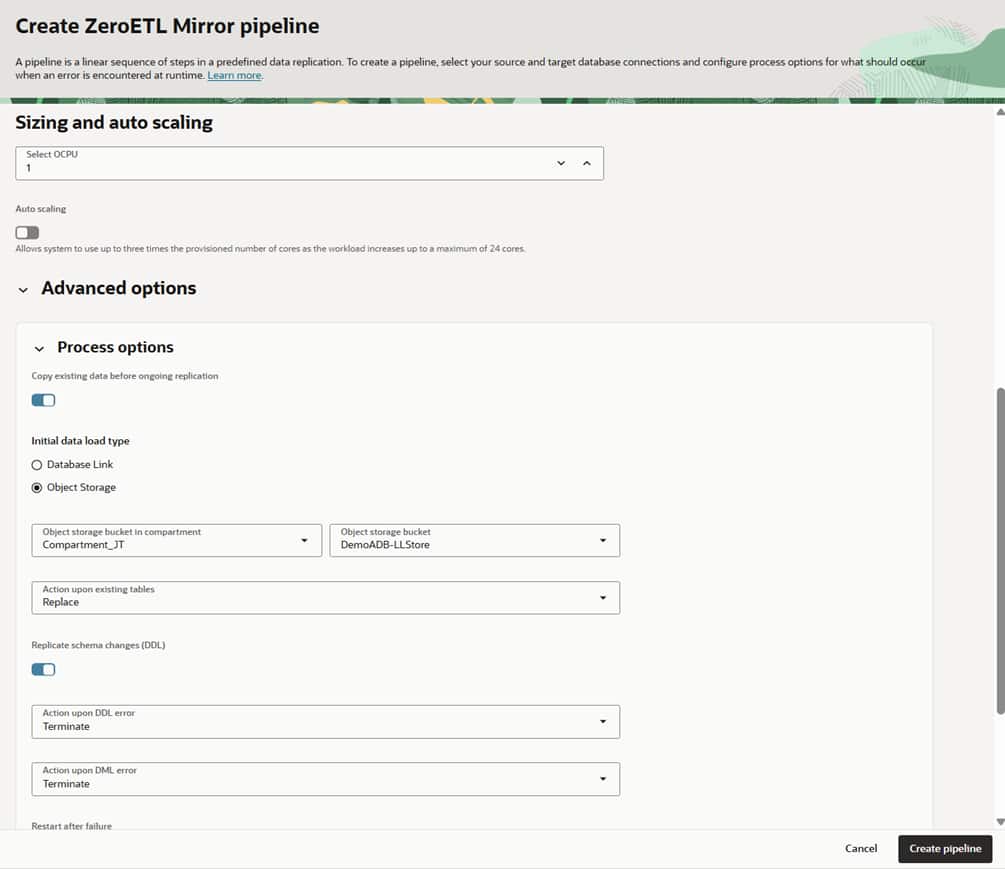
First, teams gain greater control over pipeline capacity. With sizing controls and autoscaling, users can better align resources with workload requirements. Development environments can start with smaller configurations, while production deployments can be sized for higher transaction volumes, larger initial loads, or sustained apply activity.
Second, initial-load workflows become more flexible. In addition to existing initialization options, OCI GoldenGate now supports Object Storage as part of the initial-load process. Data can be exported from the source database, staged in Oracle Object Storage, and then imported into the target environment. This approach is particularly useful for cross-region, cloud-to-cloud, and hybrid cloud scenarios where direct connectivity between source and target systems may be limited or unavailable.
Together, these enhancements provide greater flexibility when deploying and scaling ZeroETL Mirror pipelines across development, test, and production environments.
Disaster recovery enhancements for stronger readiness
Effective disaster recovery depends on validating standby readiness before a planned switchover or an unplanned recovery event. OCI GoldenGate peer deployments already help protect GoldenGate environments across availability domains and regions. The latest enhancements improve operational readiness through new precheck validations and additional activation options. Previously, teams were responsible for manually validating key disaster recovery prerequisites such as secret replication and connection configuration before recovery testing or activation.
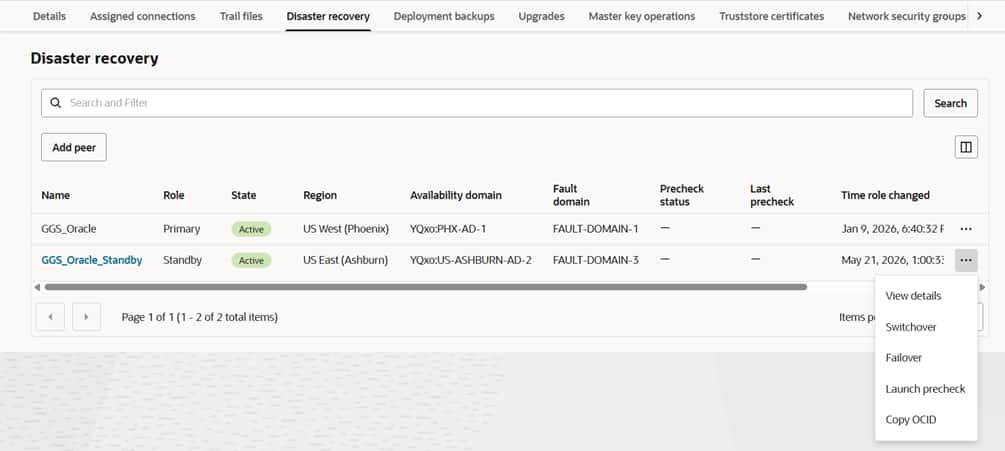
OCI GoldenGate can now warn users when required secrets have not been replicated to the standby region, helping teams identify and address a common readiness issue before a switchover depends on those secrets. It can also warn when a connection string does not include multiple hosts, an important consideration for database disaster recovery topologies where connectivity must continue after role changes.
These validations help reduce operational surprises by allowing teams to verify critical recovery prerequisites earlier in the process. Secrets, connection design, and database topology can be reviewed and validated before disaster recovery testing or production recovery procedures are executed.
The standby activation workflow also helps operators distinguish between planned and unplanned recovery scenarios through a new Failover option. A planned switchover assumes the primary region remains available and can participate in a controlled role transition. A failover may be required when the primary region is unavailable and the standby environment must be activated independently. Making that distinction explicit helps teams align recovery actions with established operational procedures.
Designed for operational confidence
Together, these enhancements help simplify deployment workflows and improve operational readiness for teams running real-time data movement at scale. ZeroETL Mirror pipelines become easier to size and initialize, while disaster recovery workflows become easier to validate before they are needed.
For architects, DBAs, and data engineers, the value is straightforward: greater flexibility during deployment and stronger readiness for business-critical data movement.
Conclusion
OCI GoldenGate continues to simplify real-time data integration for analytics, AI, operational reporting, and resilient cloud architectures. With these ZeroETL Mirror and disaster recovery enhancements, teams can deploy pipelines more efficiently, validate disaster recovery readiness more effectively, and simplify operational management as requirements evolve.
To get started, review your current ZeroETL Mirror pipeline configurations and deployment patterns, evaluate sizing and initial-load requirements, and validate OCI GoldenGate disaster recovery prerequisites before your next switchover or recovery test.