
We previously announced the availability of Oracle Deep Data Security in Oracle AI Database 26ai, a new approach to securing data access in the era of AI agents. Deep Data Security enforces the end user’s authorization model directly in the database, even when applications or AI agents query data on the user’s behalf.
“Oracle AI Database 26ai settles the issue with Deep Data Security, a new feature where the database, not the app tier, is the ultimate arbiter of who can see the data.”
—Tony Baer, Principal, dbInsight
Modern applications often access enterprise data across remote Oracle and non-Oracle databases, object stores, and data lakehouse platforms. Organizations therefore need end-user authorization to be enforced consistently across these access paths.
With Oracle AI Database Release Update 23.26.3 (DBRU 23.26.3), Deep Data Security (Deep Sec) extends end-user authorization to remote databases, object stores, and data lakehouse platforms. It also adds support for cross-table data grants and advanced SQL analytics, extends end-user authorization to the OCI Database Tools MCP service and natural-language queries through Oracle Select AI, expands support to the Node.js database driver, and adds MFA for direct database access.
Control access to remote data across databases, lakehouses, and object stores
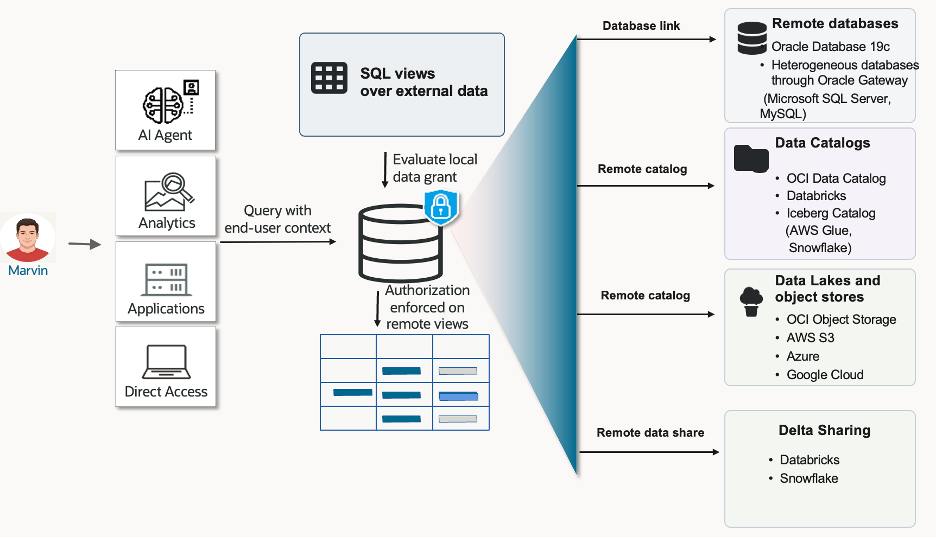
Oracle AI Database already provides SQL access to data stored outside the local database, including data in remote Oracle Databases, heterogeneous databases, object stores, and lakehouse platforms. Customers access that data through database links, Oracle Gateway, and supported catalog and object-store integrations. Views that use database links and Oracle Gateway support both queries and DML. Catalog-based access is read-only.
With DBRU 23.26.3, Deep Sec extends identity-aware authorization to these access paths. Customers can define data grants on local SQL views that reference remote tables, remote catalogs, and data shares. Remote tables can include Oracle Database 19c tables and supported heterogeneous database tables accessed through Oracle Gateway. When a query runs against one of those views, Oracle AI Database evaluates the data grants using the end-user context.
Consistent authorization across related tables
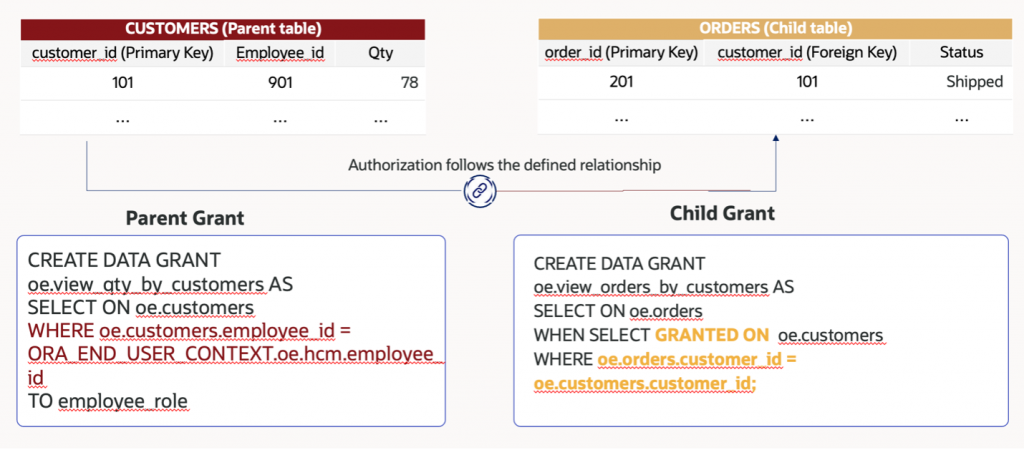
Enterprise applications typically rely on data from multiple related tables that together form a business object. A customer service workflow may combine account, order, entitlement, and region data across one or multiple schemas. A finance dashboard may join cost centers, transactions, approvals, and organizational hierarchies.
With newly added support for cross-table data grants, Deep Sec now allows customers to extend the same authorization policy across related tables. An authorization condition defined against a parent table can be reused for a related child table through a defined join relationship. Each data grant remains associated with a specific table or view, but related grants can reuse the authorization relationship rather than duplicate the grantee list and authorization condition. This allows organizations to model security policies around table relationships while reducing duplicated and potentially inconsistent authorization controls across tables.
Secure analytics workloads that use advanced SQL
Oracle Database supports in-database analytical SQL for real-time analysis, interactive decision support, and operational reporting for use cases such as financial reporting, dashboards, and sales analysis.
With DBRU 23.26.3, Deep Sec enforces data grants for queries that use analytic functions, including analytic clauses and window-frame specifications. It also enforces data grants for advanced aggregation, including the ANSI-standard GROUPING SETS, CUBE, and ROLLUP.
Calculations such as rankings, running totals, moving averages, trend analysis, and rollups are now computed only from the data each user is authorized to access. Developers do not need to reimplement the same authorization rules in their applications or analytics tools. Learn more about Oracle Analytical SQL and Functions.
Ensure Model Context Protocol tools operate within each user’s permissions
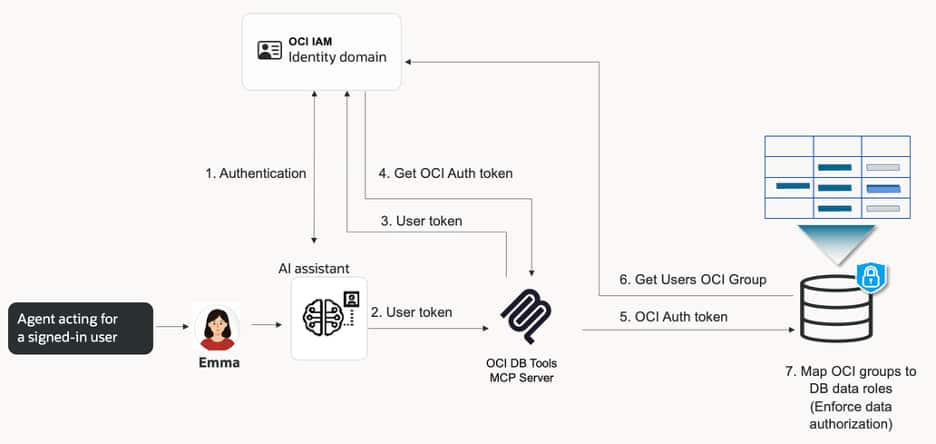
AI agents increasingly use Model Context Protocol (MCP) tools to query enterprise data systems. To limit each request to data the signed-in user is authorized to access, the database must evaluate access using that user’s identity and context.
Deep Sec already enforces data grants when an MCP server forwards the signed-in user’s OAuth 2.0 token to Oracle AI Database along with the MCP server’s own access token.
DBRU 23.26.3 extends that model to the OCI Database Tools MCP service, where the MCP server exchanges the end-user OAuth 2.0 token with Oracle Cloud Infrastructure Identity and Access Management (OCI IAM) for an OCI Auth token on behalf of that user. Oracle AI Database uses the end-user identity represented by the OCI Auth token to evaluate the applicable data grants for each request.
Enforce end-user authorization for Oracle Select AI
Oracle Select AI enables users to query databases in natural language by automatically generating the required SQL. When Select AI executes that SQL, Deep Sec now enforces the data grants applicable to the requesting user, so that the results are limited by the applicable data grants for the requesting user. Even when Select AI generates the same SQL for different users, the results reflect each user’s authorization.
Support for the Node.js database driver
Deep Sec can now be used with Node.js applications that connect to Oracle AI Database, in addition to applications that use the Java, Python, and ODP.NET drivers. The node-oracledb driver, together with its Node.js plugin, lets applications written in JavaScript or TypeScript propagate the end-user security context to Oracle AI Database. The database can then enforce the applicable data grants for that user. For a walkthrough with sample code, see Oracle AI Database Deep Data Security in Node.js Applications.
Strengthen direct database access with MFA
DBRU 23.26.3 adds multifactor authentication (MFA) support for Deep Data Security end users who connect directly to Oracle AI Database. MFA strengthens authentication for these local end users and makes their MFA status available in the end-user context. Data grants can then use that status as an authorization condition, allowing Oracle AI Database to return data covered by the grant only when the user has successfully completed MFA, where required.
Key takeaways: Governed data access for the AI era
With DBRU 23.26.3, Oracle Deep Sec broadens database-enforced end-user authorization across more data locations, table relationships, and access paths.
“Blocking data leakage at the source, before it ever reaches the agent, is the right architectural approach.”
—Stephen Catanzano, Senior Analyst, Omdia
As AI agents and applications create new ways to access enterprise data, Oracle AI Database enforces end-user authorization in the database before data is returned.
Get started with Oracle Deep Data Security
We have expanded Oracle LiveLabs resources to help you get started with Oracle Deep Sec.
Lab 1: Getting Started with Oracle Deep Data Security
Lab 2: Identity-Driven Data Access with Microsoft Entra ID and Deep Data Security
Lab 3: Cross-Table data grants