
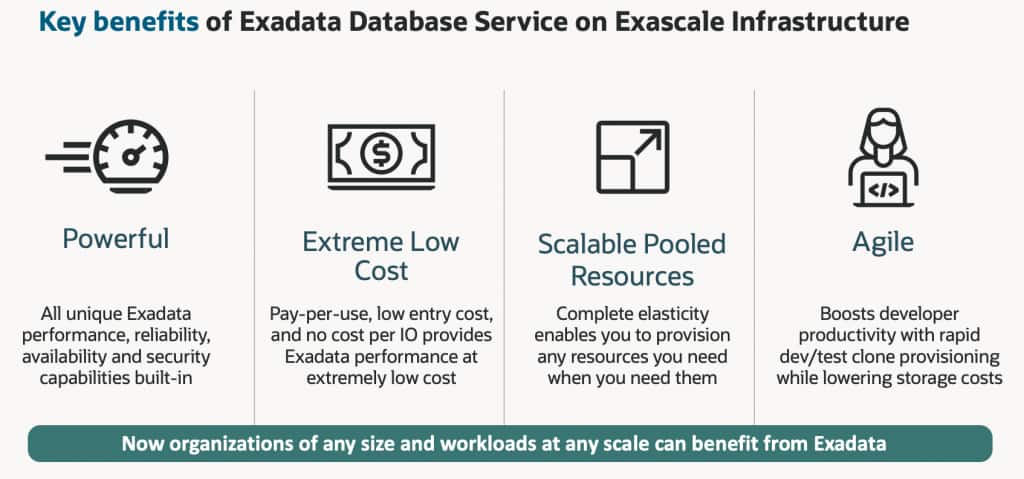
Exadata Database Service on Exascale Infrastructure brings the extreme performance, uncompromising availability, and proven security of Exadata to organizations of any size, with the flexibility to deploy across OCI and Oracle’s multicloud database services. It combines a low entry cost with the ability to scale seamlessly to mission-critical workloads, all while running on cloud-scale Exadata infrastructure that optimizes utilization and reduces costs.
Since its launch in 2024, the service has evolved rapidly with capabilities that make it even easier to deploy, manage, and scale. Recent innovations include:
- Oracle Database 19c support for simpler, lower-friction migrations
- Auto-scaling storage vaults that eliminate routine administration
- Pluggable database (PDB) and virtual machine (VM) snaphsots for faster development and point-in-time reference
- Cross-service Oracle Data Guard for right-sized disaster recovery
- Single-VM clusters that reduce costs for workloads that don’t require high availability
These enhancements, along with many others, are part of a steady stream of innovation that continues to expand what’s possible with Exascale Infrastructure. Every release delivers greater flexibility, improved operational efficiency, tighter cost control, and higher developer productivity.
Today, organizations are balancing AI initiatives with transactional, analytics, and application development workloads–all while keeping a close eye on infrastructure costs. They need database infrastructure that can scale with changing demand without adding operational complexity or unnecessary expense. The following customer stories show how organizations are using Exadata Database Service on Exascale Infrastructure to do exactly that.
Customer Successes
A leading European healthcare provider broke free from commodity on-premises infrastructure to move to the service, cutting operational costs and scaling seamlessly as demand surged for mission-critical OLTP systems and genomic data analysis. With full support for Oracle Database security features, including Transparent Data Encryption, partitioning, and Oracle RAC, they can now protect sensitive clinical and biobank data while meeting stringent regulatory compliance requirements.
A global digital and partner marketing leader operating in over 90 markets migrated to the service on OCI to lower costs, strengthen resilience, and speed up development. The results were immediate: thousands of dollars saved every month, with more savings on the horizon. Exascale thin clones now stand up development environments in minutes instead of days, while shared OCI infrastructure delivers disaster recovery that is faster and far more cost-effective.
A U.S.-based financial platform migrated its SaaS application to the service to better align database resources with its microservices architecture. Now it scales database infrastructure incrementally as it expands into new markets, so costs grow in step with revenue instead of demanding large upfront capacity investments.
From modernizing legacy environments to building cloud-native applications, customers are unlocking immediate operational and business value with Exadata Database Service on Exascale Infrastructure. This is all made possible by the unique architecture of Exadata and the innovations of Exascale Infrastructure.
Exadata Differentiation
While many cloud database platforms continue to improve performance by adding more compute, memory, flash storage, and network bandwidth, Exadata has always embraced a different philosophy: Bring intelligence to the data, rather than continuously adding resources without intelligence. Traditional database architectures and even modern database services move large volumes of data from storage to database servers where filtering, projection, aggregation, and other processing occurs. As workloads grow, these architectures often compensate by adding resources and cost to meet performance requirements.
Yet the adoption of AI and huge growth in data volume make intelligent data processing increasingly important to help lower costs. High-performance flash storage, large memory footprints, and premium infrastructure resources are among the most expensive components of modern cloud architectures, with costs rising dramatically in recent years. Simply continuing to add more hardware becomes an increasingly expensive strategy–and one that can only go so far before cost and complexity become limiting factors.
By intelligently filtering and processing data at the storage layer and automatically placing data on the most appropriate storage tier, Exadata delivers performance gains that cannot be achieved through raw infrastructure scaling alone. For AI workloads, Exadata AI Smart Scan extends this intelligence by offloading vector processing to Exadata storage servers, delivering up to 30x faster AI vector searches with no application changes. Exascale technology further simplifies storage management by making capacity expansion a lightweight, non-disruptive metadata operation, while enabling data sharing across VM clusters, instant space-efficient snapshots and thin clones, and pay-for-use storage consumption with little to no capacity planning. Together, Exadata’s intelligent architecture and Exascale’s elastic storage model deliver higher performance, greater scalability, and more predictable infrastructure costs than traditional architectures.
Simple Scalability
Exadata Database Service on Exascale Infrastructure delivers superior cloud economics, with pay-as-you-go infrastructure and license-included Oracle AI Database (BYOL is also available). Unlike most database platforms, the service allows active compute to scale all the way to zero when workloads are idle, eliminating database license charges while preserving data and configuration. Customers can also reserve additional compute capacity and dynamically enable and disable compute resources as needed, optimizing license consumption without disrupting applications. Memory associated with provisioned compute capacity remains available regardless of whether those resources are enabled or in reserve.
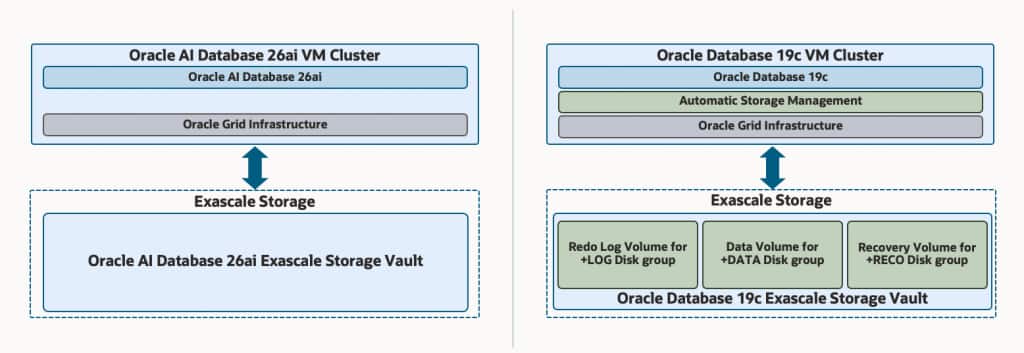
As requirements grow, customers can scale from small deployments to mission-critical environments without changing platforms, deployment models, or operational processes. Whether running Oracle Database 19c today or adopting Oracle AI Database 26ai, organizations can continue to leverage the same Exadata platform and operational model as their requirements evolve. This flexibility helps organizations avoid downtime, costly rearchitecting, and future scaling constraints while continuing to benefit from Exadata’s performance and efficiency.
Resiliency
Exadata Database Service on Exascale Infrastructure is designed to keep applications running during both planned and unplanned events, reducing operational risk and helping organizations maintain business continuity. The service delivers high availability (HA) with Oracle Real Application Clusters (Oracle RAC) and works seamlessly with Oracle Database disaster recovery (DR) capabilities like Oracle Data Guard, using sophisticated Oracle Cloud automation to simplify implementation and monitor the configuration. This includes cross-service Oracle Data Guard, where the standby database runs on Oracle Exadata Database Service on Dedicated Infrastructure and vice versa. The service also integrates with Oracle Zero Data Loss Autonomous Recovery Service to automate highly efficient backup and restore operations for data protection. These integrated HA, DR, and backup and recovery capabilities support local, in-region, and cross-region protection strategies so customers can choose the appropriate level of protection and easily implement it–with fine-grained control when needed. By simplifying backup, HA, and DR planning, deployment, and ongoing management, organizations can reduce operational risk while helping ensure continuous business operations.
Accelerated Development
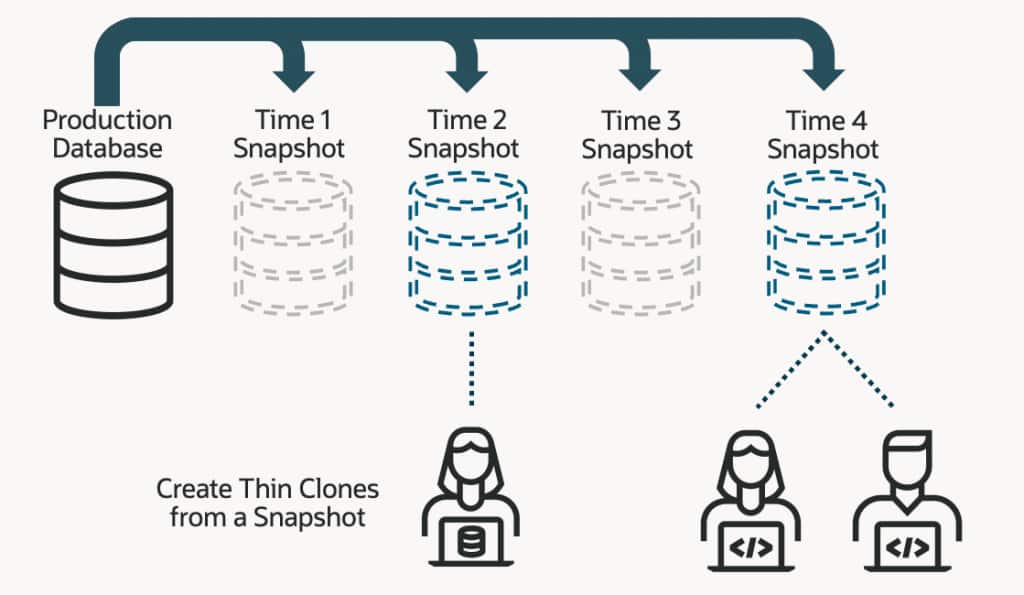
Modern development teams need the freedom to experiment with production-like data that can be provisioned and refreshed in minutes–without the cost of creating and maintaining full copies of production databases. Exadata Database Service on Exascale Infrastructure delivers on these needs with unlimited instant thin-clones and snapshots, providing cost-efficient development environments that benefit from full Exadata performance features for everyone who needs them. Oracle AI Database’s Data Masking and Subsetting Pack simplifies management of data access and sensitive data redaction, including across snapshots and thin-clones. With these capabilities, developers can experiment more freely, shorten development cycles, and deliver applications faster at a fraction of the storage cost.
Full Administrative Control
Unlike cloud database services that trade control for simplicity, Exadata Database Service on Exascale Infrastructure combines powerful cloud automation with full administrative control. Customers retain root-level access to their VMs, operating systems, and databases, along with managed capabilities such as VM snapshots. This approach enables administrators to use automation where it adds value while maintaining the flexibility to integrate with existing operational processes and protect mission-critical environments without compromises or custom workarounds.
Conclusion
With its low entry cost and scalability to support mission-critical workloads, Exadata Database Service on Exascale Infrastructure makes Exadata performance, reliability, and operational flexibility available for workloads of every size with no application changes. The service enables organizations to start small, accelerate development, control costs, and scale seamlessly to mission-critical workloads without sacrificing administrative control or changing architectures as requirements evolve. Exadata Database Service on Exascale Infrastructure is available today in OCI and in Oracle’s multicloud offerings in Microsoft Azure and Google Cloud. With minimal infrastructure commitments and the ability to scale compute to zero when workloads are idle, organizations can now adopt Exadata incrementally and expand as their requirements grow.
Additional resources
- Blog: Putting Customers First, Together: A Year of Oracle AI Database@AWS and What’s Next
- Blog: Introducing Oracle Exadata Database Service on Exascale Infrastructure
- Blog: Exadata for Everyone: Extreme Performance Meets Extreme Low Cost
- Blog: Advantages of Exadata Exascale
- Blog: Why Exadata Exascale is ideal for small enterprise customers