
Combining Conductor OSS durable orchestration, Oracle Database persistence, and distributed transactions into a resilient execution foundation for enterprise workflows and AI agents.
Enterprise workflows are expected to survive failures, infrastructure changes, and long-running execution without losing progress. In the previous post, I discussed why AI agents become fundamentally different once they move from prototypes into enterprise workflows. Once an agent starts invoking business services, updating systems of record, or coordinating long-running processes, the challenge stops being about picking the right model and becomes about keeping the overall business process correct when something fails partway through.
This article focuses on one of those runtime capabilities: durable workflow execution, the execution model that allows workflows to survive failures without losing progress.
Oracle MicroTx Workflows is built on the open-source Conductor OSS workflow engine, extending its durable orchestration model with Oracle Database persistence, AI-native execution, distributed transaction coordination, and enterprise runtime capabilities. Durability isn’t a feature bolted onto MicroTx; it’s the execution model that deterministic services, AI agents, human approvals, and distributed transactions all run on top of.
Recovering from where you left off
Consider a simple order-processing workflow:
Receive Order → Reserve Inventory → Authorize Payment → Generate Shipping Label → Notify Customer
If the Kubernetes pod running this workflow crashes right after payment succeeds, what happens next matters. Restart the whole process and you risk charging the customer twice. Rely on ad hoc recovery code in the application and you’re maintaining bespoke failure-handling logic for every workflow you ship.
Durable execution solves this by separating workflow state from the process currently executing it. Every time a task completes, the runtime persists what ran, what it returned, and what’s next, so the workflow can resume from exactly that point after a crash, a restart, or a redeploy.
The workflow’s execution graph, not any single worker process, is the source of truth.
In this example, when a replacement worker starts, it doesn’t re-authorize the payment because that step is already recorded as completed. Instead, execution resumes with Generate Shipping Label, avoiding duplicate business operations while continuing the order from its last known consistent state. The application doesn’t need to reconstruct what happened before the failure; the runtime already knows.
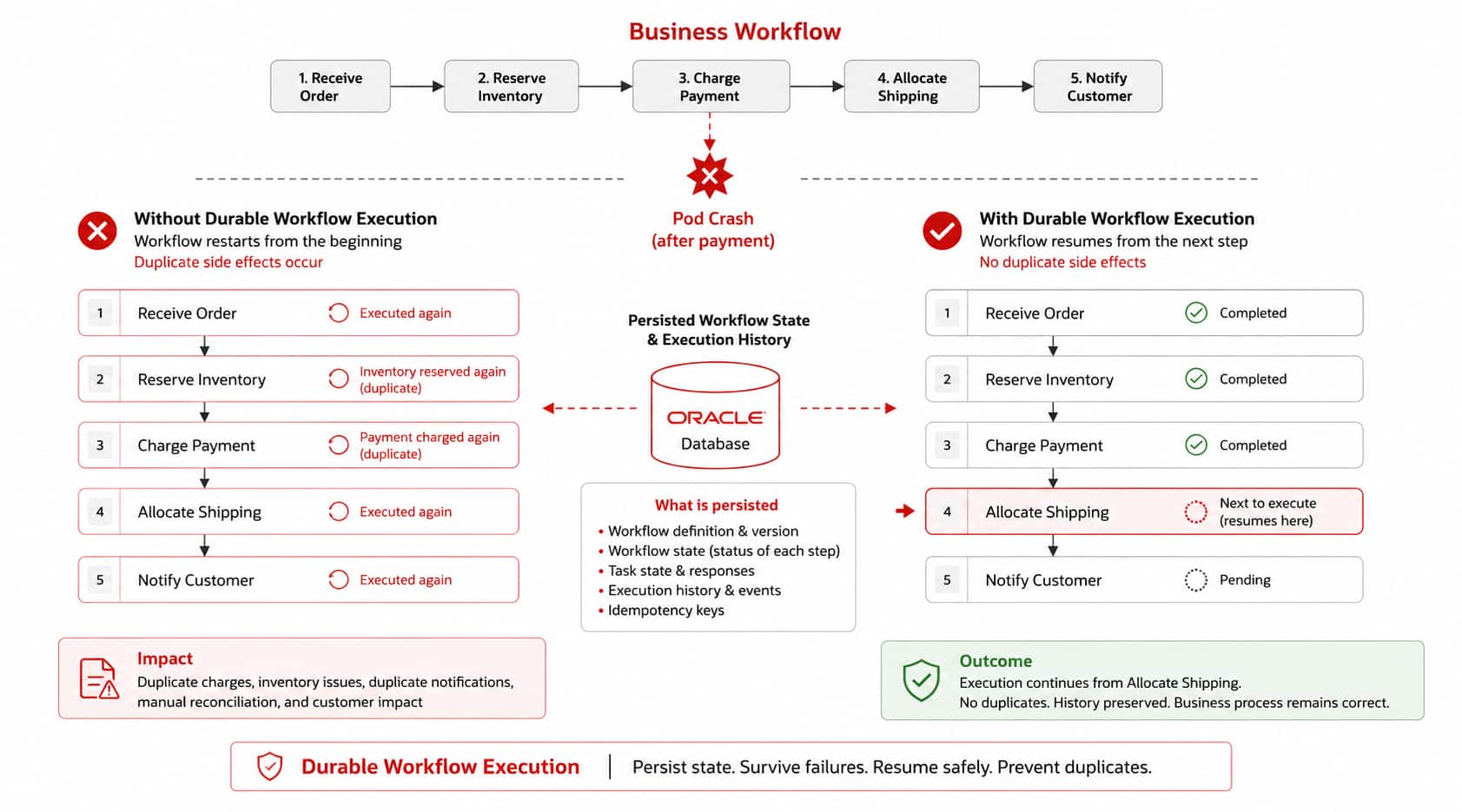
Without durable execution, a crash mid-workflow means restarting from the beginning and risking duplicate side effects. With it, the workflow resumes from the last completed step.
This matters because production interruptions aren’t rare edge cases; they’re routine: worker crashes, downstream timeouts, pod rescheduling, deployments rolling out while thousands of workflows are still running, approvals that take days. With durable execution, the runtime already knows which tasks completed, which failed, what they returned, and where to resume, so recovery is deterministic instead of something each application reconstructs on its own.
Without a durable execution engine, this retry-and-recovery logic gets hand-rolled: catch blocks, retry counters, idempotency checks, state flags written to some table, all built and tested by whichever team owns the workflow. Every failure mode (a duplicate message, a slow downstream call, a crash mid-step) becomes something the application has to anticipate and handle correctly on its own.
A durable execution engine takes that plumbing out of application code: incrementally persisting state, applying safe retry semantics, and handling the common failure scenarios as a tested, general capability of the runtime, so business logic can stay focused on the business problem instead of failure handling.
The same separation makes long-running workflows practical. A workflow waiting on a customer approval, a scheduled job, or a partner callback doesn’t need to hold a thread, a container, or any compute resource while it waits. It pauses with its execution graph persisted and resumes the moment the next event arrives.
Why Oracle MicroTx Workflows builds on Conductor OSS
Oracle MicroTx Workflows didn’t build a new workflow engine from scratch. It extends the durable execution model implemented in Conductor OSS, including:
- JSON-based declarative workflow definition with deterministic execution
- Persistent workflow and task state
- Worker-based execution with retries and timeout handling
- Long-running waits, branching, loops, and sub-workflows
- Explicit workflow versioning
These capabilities are validated across thousands of production deployments already running at scale, and they map naturally onto enterprise business processes that take minutes, hours, or days to complete.
Because workflow definitions stay independent of application code, teams can implement workers in one of the many supported languages without standardizing on a single stack.
Oracle Database becomes the durable persistence layer
Conductor provides the durable execution model; Oracle Database becomes the durable system of record for workflow execution. Every workflow execution continuously records what it needs for recovery: task state, retries, waits, execution history, version metadata, and idempotency information. Because that record lives in Oracle Database, it inherits the same transactional consistency enterprise applications already depend on: workflow state, task state, and idempotency records can’t drift out of sync with each other.
For organizations already running Oracle Database, this also simplifies operations: workflow persistence becomes one more workload on a platform they already deploy, secure, and monitor, rather than a new persistence technology to stand up from scratch. It runs the same way on Oracle RAC, Exadata, Autonomous Database, or Oracle Database@Azure, so teams can align it with whatever Oracle Database deployment they already standardize on.
Beyond durability, workflow execution also inherits Oracle Database capabilities such as high availability, backup and recovery, monitoring, performance tuning, scalability, and connection pooling. MicroTx Workflows can use these capabilities for workflow persistence without introducing a separate persistence platform.
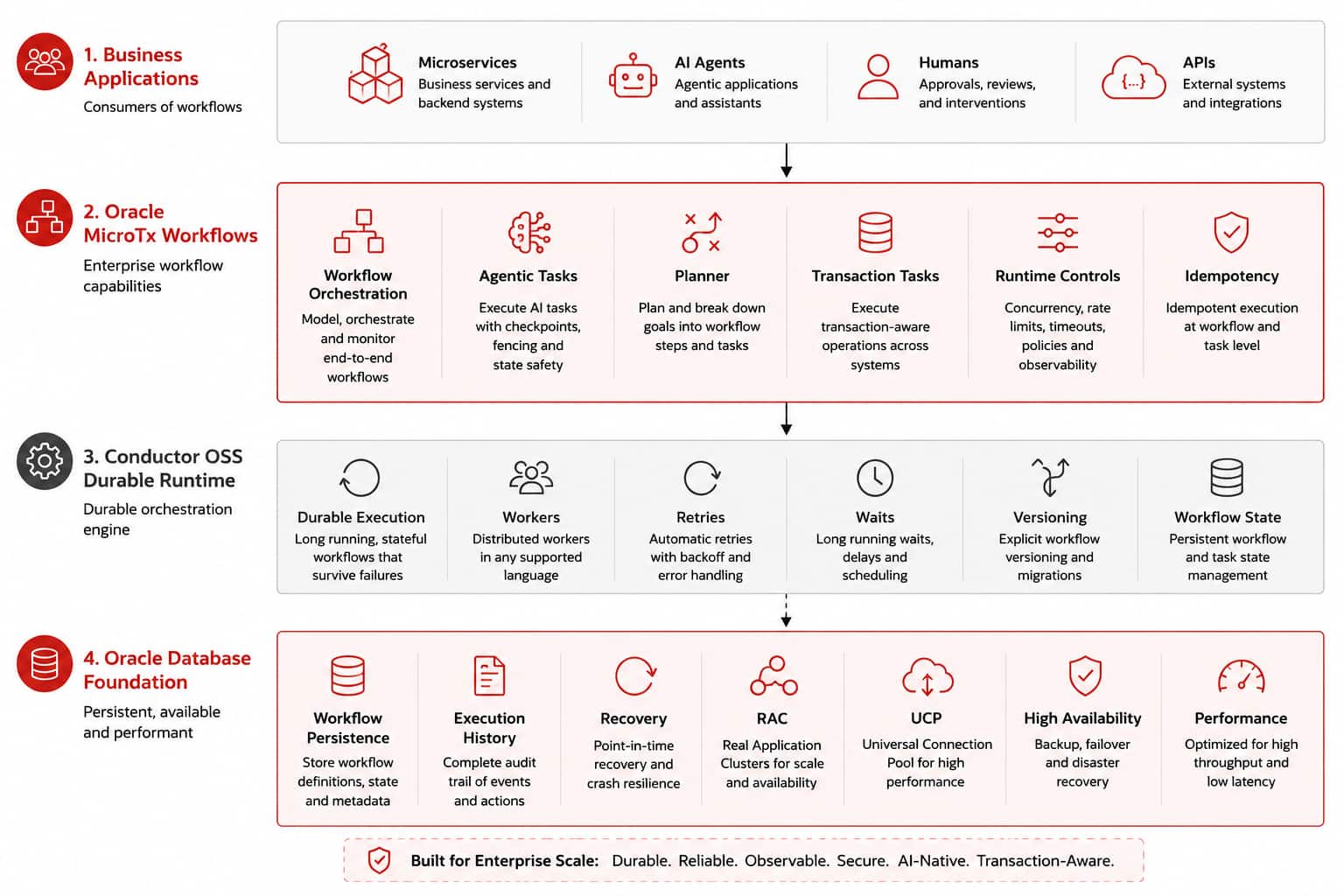
How Oracle Database persistence underpins workflow state, task execution, idempotency, and transaction coordination inside the MicroTx runtime.
Preventing duplicate work with built-in idempotency
Durable execution allows a workflow to resume safely after failures. Idempotency ensures that resuming execution doesn’t repeat work that has already completed successfully. The two capabilities solve different problems but are equally important for reliable workflow execution.
Retries are a normal part of distributed systems. They can be triggered by network interruptions, worker failures, client or webhook retries, scheduler retries, or an agent re-executing after a restart. Without idempotency, any of these retries can repeat business side effects such as charging a payment twice, reserving inventory multiple times, or creating duplicate downstream requests.
Oracle MicroTx enforces idempotency at two levels.
Workflow-level idempotency
Every workflow execution carries an idempotency key, supplied by the caller or generated automatically. A duplicate start request against a completed workflow returns the existing result, while a duplicate request for a workflow that is still running is rejected. This protects against client retries, webhook replays, and agents inadvertently starting the same workflow multiple times.
Task-level idempotency
Oracle MicroTx Workflows supports task-level idempotency through three mechanisms:
- Runtime-managed state for built-in logic such as agentic tasks and the planner: planning progress and tool results are checkpointed and resumed after interruption.
- Idempotency tables for transactional tasks, including SQL tasks: the idempotency state is stored in the customer database.
- Idempotency-token propagation for external integration tasks: end-to-end idempotency depends on the downstream service honoring the propagated token.
The engineering boundary is intentionally clear:
The workflow runtime owns execution state, retries, replay, and concurrency guarantees. Business services own business side effects.
Durable execution and distributed transactions complement each other
Durability and distributed transactions solve different problems. Durability is about resuming execution safely after an interruption; distributed transactions are about keeping multiple systems consistent when one business operation spans more than one of them.
Oracle MicroTx Workflows brings the two together by making the MicroTx Distributed Transactions coordinator a first-class part of the workflow graph. A transaction task begins, commits, or rolls back an XA transaction as an explicit workflow step, and any HTTP or SQL tasks between the BEGIN and the COMMIT automatically propagate that transaction context, so they’re enlisted without the workflow author wiring it through manually.
The broader MicroTx coordinator also supports Saga/LRA and TCC-style protocols, so teams can choose strong consistency (XA) or compensation-based consistency using Saga/LRA or TCC, depending on the workflow requirements.
Because transaction management is represented as a workflow node, its outcome becomes part of the execution graph regardless of the transaction protocol. Whether the node represents an XA transaction, a Saga, or a TCC operation, the workflow records where execution stopped and the outcome of each participant. Recovery then follows the semantics of that transaction model: rollback for XA or compensation for Saga, without requiring custom application logic.
Deployment resilience
Workflow execution state living outside any individual worker process is also what makes deployments safe. Workers can scale up or down, pods can restart, and Kubernetes can reschedule work without touching an in-flight workflow, because the workflow doesn’t depend on any specific process staying alive.
The same holds for new workflow versions: each running execution stays pinned to the definition version it started with, so shipping a new version of the order-processing workflow above doesn’t touch the thousands of instances already mid-flight on the previous version.
The engineering philosophy
Oracle MicroTx Workflows follows one architectural principle: the workflow runtime, not the application, is responsible for preserving execution state, coordinating recovery, tracking progress, and orchestrating distributed work.
Durable execution removes failure-handling plumbing from application code so teams can focus on business logic instead of recovery logic. Combined with Oracle Database persistence, built-in idempotency, and transaction-aware workflows, it gives deterministic services, AI agents, and human approvals one reliable execution model for enterprise automation, not three separate systems bolted together.
In the next post, I’ll move up the stack from the workflow foundation to the AI-native execution layer, showing how reusable agents, planner-based execution, retrieval, and runtime controls make AI a first-class participant in enterprise workflows.