

AI is rapidly becoming part of how businesses operate. It is answering questions, generating insights, building applications, and increasingly taking actions on behalf of people.
The potential gains in productivity and innovation are enormous. But there is a catch: businesses need to be able to trust AI outcomes.
What happens when AI hallucinates, misunderstand instructions, builds an application with a security flaw, or accesses data it should never reveal? In enterprise systems, mistakes like these can have massive consequences.
Making AI more trustworthy requires more than better models and stronger guardrails. Organizations cannot simply drop AI on top of architectures that were never designed for the new risks AI introduces. AI, data, and application development need to be designed to work together from the start.
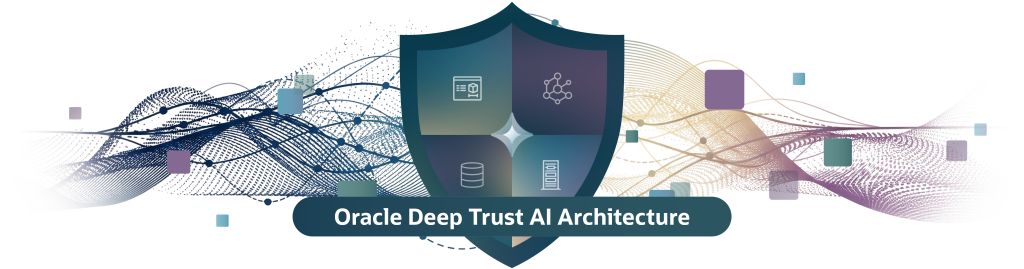
That’s the idea behind Oracle’s Deep Trust AI Architecture. We are building trust deep into the data and application development layers, where it can be consistently enforced regardless of which AI model, application, or agent is being used.
Deep Trust AI Architecture enables faster AI innovation with less risk
Oracle’s Deep Trust AI Architecture provides a practical blueprint for using AI to increase productivity and accelerate innovation with lower risk. It brings trust to the four critical layers of the technology stack: software platform, data, data access, and application development. Each layer addresses a different source of risk, and together, they create a consistent foundation for trusted AI.
The idea is similar to Oracle’s popular Maximum Availability Architecture (MAA). MAA gives customers a proven blueprint for designing systems that remain available even when failures occur. Deep Trust AI Architecture applies the same principle to AI: build trust into the architecture from the start, instead of trying to bolt it on later. And, because that trust is enforced in the underlying infrastructure, rather than buried inside each application, it can protect both the applications you already have, and the new applications you build.
Let’s take a closer look at each layer.
Software Platform: Stay ahead of AI cybersecurity threats
AI is changing cybersecurity for both attackers and defenders alike.
In the past, finding and exploiting a security vulnerability in enterprise software often required major effort and specialized expertise. AI has lowered that barrier. Today, a bad actor with limited technical skills can use AI to find new vulnerabilities and exploit published ones, and then launch attacks exponentially faster. The consequences of these attacks can be devastating.
Staying ahead of attackers starts with keeping your platform patched against the latest security threats. Ideally, this happens automatically before a vulnerability is publicly disclosed.
That’s exactly what Oracle Autonomous AI Database (ADB) does. It automatically applies the latest security updates across the full software and hardware stack, including the database engine, operating system, Exadata storage, and firmware. With rolling patching, the underlying infrastructure is updated one part at a time while application workloads continue to run.
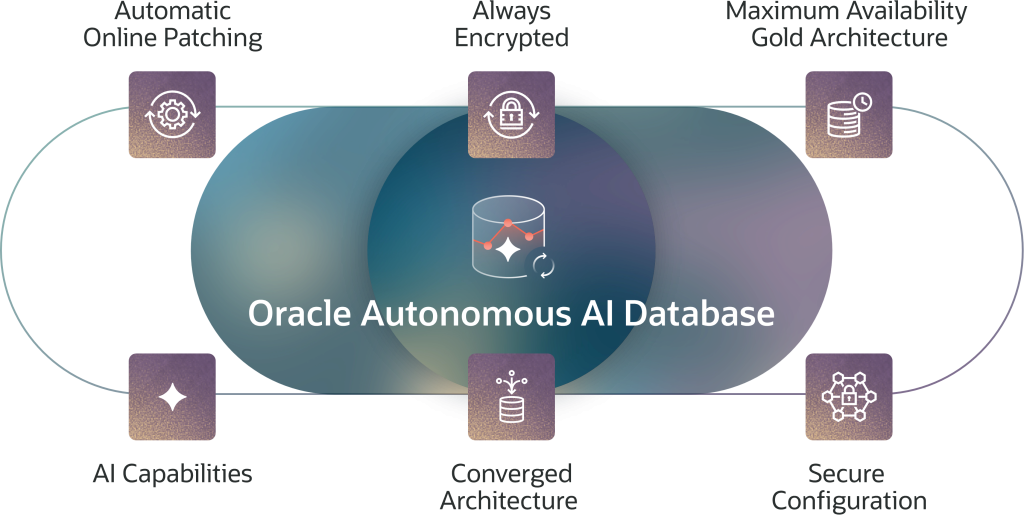
Autonomous AI Database uses always-on encryption to protect data both at-rest and in-motion. And, thanks to its converged architecture, ADB is ideal for all data and workload types.
Data Trust: Enforce security and business rules at the source
Data privacy becomes even more important in the age of AI. The financial, legal, and reputational consequences of exposing sensitive information can be catastrophic. That means AI-generated applications must apply an organization’s security and privacy policies correctly every time.
That’s harder than it sounds.
Data access rules can be complex and highly specific to each user. A manager, for example, may be allowed to see an employee’s performance review and compensation, but not that employee’s health benefits or Social Security number.
Enforcing Data Privacy in the age of AI
Today, most data privacy and access rules are implemented in the application itself using custom code. But this poses new risks. You can instruct AI to follow your organization’s privacy policies when it generates an application, but you can’t assume thousands of lines of generated code will implement every rule perfectly. A rule may be missed, applied in one part of the application but not another, or enforced incorrectly for a particular user.
And there is an even bigger challenge. Application security only protects data when it is accessed through that application. AI agents increasingly access data directly via tools like MCP servers and Natural Language to SQL. If an agent bypasses the application and sends a request directly to the database, it can also bypass the privacy rules that are only being implemented at the application layer.
For these reasons, data security needs to be enforced at the source—the data layer—where applications and agents cannot bypass it.
Oracle Deep Data Security enables organizations to define end-user data access rules directly in Oracle AI Database. The database then enforces those rules on the data itself, regardless of which application or agent makes the request. The database verifies each user’s identity from a cryptographically signed token issued by the corporate directory and determines what data the user is allowed to access.

Beyond data privacy, every enterprise must trust that its business rules for data are never violated by AI agents or AI generated apps.
Oracle SQL Assertions enforce those rules directly in the database to prevent incorrect actions or conflicting data from being recorded.
For example, many organizations set spending limits for employees. A SQL Assertion can enforce that limit directly in the database. If an application or AI agent tries to charge more than the employee’s authorized amount, the database rejects the charge.
CREATE ASSERTION prevent_excess_charges

CHECK (
 NOT EXISTS (

 SELECT 1
 FROM expenses exp, expense_limits lim

 WHERE exp.employee_title = lim.employee_title
 AND exp.expense_value > lim.expense_limit ));
These are examples of a fundamental principle behind Oracle’s Deep Trust AI Architecture: put critical security, privacy, and business rules in the data layer, where they can be consistently enforced, no matter which application, AI model, or agent accesses the data.
These and other Oracle AI Database security features help you protect your data in the age of AI.
Data Access: Control how AI works with enterprise data
AI generated application and AI agent access to data
Another major challenge in the age of AI is controlling how applications and agents access enterprise data. Giving AI arbitrary SQL access to mission-critical systems can pose significant risk. An agent can request more data than a task requires, bypass established business workflows, or make unexpected changes. Those risks are amplified when an agent is manipulated by a bad actor.
Oracle Trusted Data APIs provide a safer approach. Instead of giving AI unrestricted SQL access, Trusted Data APIs expose controlled read and write access to logical business objects, such as a complete purchase order.
The database enforces update rules, integrity, and evolvability on these high-level business objects.
The principle is simple: give AI access to the business objects it needs, not unrestricted SQL access to the underlying tables.
Improved accuracy of AI answers
Trusted Data APIs are a great way for Apps to access data, but for business users, AI enables a revolutionary new data access technology: Natural Language to SQL (NL2SQL). Users can ask data questions directly using Natural Language, and receive answers without needing to understand SQL or how the data is organized.
But there is a fundamental challenge: Natural language is inherently ambiguous and unbounded, and AI cannot always be trusted to interpret questions correctly. AI can return the wrong answer if it misunderstands the question or the business context.
To minimize AI misunderstandings and mistakes, AI needs to understand both your business and your data.
Oracle Deep NL2SQL addresses this challenge. It organizes an organization’s business knowledge into business topics and subtopics, giving AI the business context it needs to correctly interpret the question a user is asking. Each topic describes an area of the business, defines its relevant terminology and rules, and identifies the data needed to answer questions about that business topic.
But knowing which data to use is not enough.
AI also needs to understand what the data means, how it is organized and how it should be used. This is data knowledge. Since Database schemas can often be cryptic, Deep NL2SQL draws on a wide range of metadata to provide the necessary context. SQL Annotations help explain the meaning and purpose of tables, columns, views, and procedures. Analytic Views describe dimensions, facts, measures, and business metrics. Comments, constraints, views, ontologies, and data documentation can provide even more context.
When a user asks a question, Deep NL2SQL uses both business and data knowledge to make the question more precise, identify the required data, and generate the appropriate SQL.
But even with better context, AI can still make mistakes.
Oracle Deep NL2SQL addresses this challenge with two unique capabilities: Continuous Feedback Learning and Knowledge Change Verification.
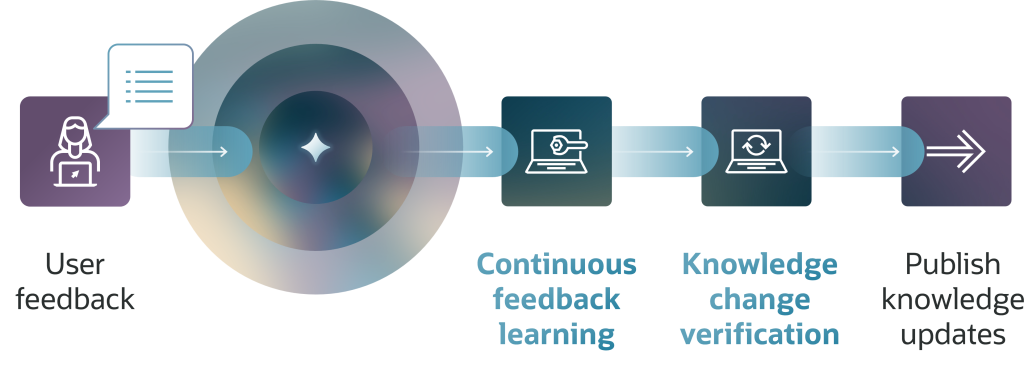
With Continuous Feedback Learning, users can flag an incorrect answer and suggest a correction. A knowledge expert, assisted by a specialized AI agent, investigates the root cause of the inaccuracy, and updates the relevant business or data knowledge.
But, a change that fixes one answer could negatively affect others. Knowledge Change Verification addresses this by reverifying previously validated “gold” answers before a knowledge change is published. This creates a controlled improvement cycle: learn from mistakes, correct the knowledge, and verify the change before putting it into production.
App Dev: Let AI build the app functionality, not the implementation
The final layer of Oracle’s Deep Trust AI Architecture is Trusted Application Development.
There are many ways to build enterprise applications, and the software platform, data, and data access layers described above can support all of them. For this discussion of application development, we will focus on low-code development, and I want to share an analogy that I think will help.
Applications never read and write database files directly. Instead, they use a SQL query to specify the data they want to access. The SQL engine executes the query and provides the concurrency, security, availability, scalability, and evolvability that enterprises depend on. These capabilities are implemented in millions of lines of proven, hardened database code. It would make little sense for AI to recreate all that infrastructure every time it generates a new query.
Oracle applies the same principle to AI-generated applications with Oracle APEX AI App Generator. Instead of asking AI to generate thousands of lines of custom application code, AI translates a user’s natural language description of an application into APEXlang, an open, declarative application language.
The APEX engine then executes that application definition while providing the security, scalability, availability, and evolvability required for enterprise use.
This creates an important separation of responsibilities. APEXlang describes what the application should do. The APEX engine provides the trusted infrastructure to implement it. The result is a simpler and more reliable approach to AI-generated applications: let AI generate the application functionality, while a proven engine provides the enterprise trust beneath it. Developers can use this approach wherever they already work, including VS Code, Codex, Oracle APEX, or directly through an AI agent.
Key Takeaways
The principle behind all of this is simple: AI should not have to implement enterprise trust every time it builds an application or accesses data. Trust should be built into the architecture.
That is how enterprises can move faster with AI, innovate with confidence, and deliver the productivity gains AI makes possible — all with less risk.
So, start your journey towards building AI you can trust by asking yourself: “Does my organization have complete trust in AI generated solutions?”
If not, start taking action now. You can run Oracle Deep Trust AI Architecture wherever you run Oracle—on leading hyperscalers, and on-premises.