
As a group of companies AIOS is an auditing and tax consulting firm with a strong IT consulting focus on Business Intelligence (BI)in Germany. Around 10 developers create customized solutions for planning, reporting, and financial statement reporting—for customers of all sizes in the public sector and private industry. AIOS employs around 70 people in total across its locations in Berlin (headquarters), Düsseldorf, and Munich.
AIOS consolidates data from a wide variety of upstream systems with heterogeneous data structures into a database and then models it so it can be analyzed individually and a fully automated planning solution can be provided. To meet different customer requirements (commercial and functional), AIOS offers a selection of software solutions (based on different tools from various vendors).
Due to the rapid development of many cloud platforms—and especially their advantages such as simplified administration and maintenance, as well as flexible compute power and infrastructure—and in order to expand its offering, AIOS looked for an alternative solution with the following requirements:
- Reduction of the administration and maintenance effort of classic on-premises setups (patching, upgrades, infrastructure, support)
- Fast provisioning of new project and customer environments
- Security and compliance requirements—certain certifications (BSI)
- Cost-effectiveness: a compelling price-performance ratio compared to hyperscalers and alternatives
- Simple integration of heterogeneous data sources including modern interfaces and scalable data processing
Why Oracle
AIOS initially started in a commercial Oracle Cloud environment and already developed there with Oracle APEX. However, during go-to-market activities it became clear: for many customers—especially in the public sector—EU-based data hosting is crucial. As a result, Oracle EU Sovereign Cloud became the strategic target architecture.
“For us, success means that our cloud solutions can manage data centrally, scalably, and securely within the EU. The special feature that the data remains within the EU increases acceptance among customers.”- Thomas Buchholz, Manager BI AIOS
Decisive factors were:
- EU data residency and security as a central criterion in tenders and a strong sales argument
- Price/performance: from AIOS’s perspective, Oracle APEX on Autonomous Database is more attractive than alternatives such as AWS, Microsoft, or Google, or other comparable BI tools
- Simplicity of single application experience (combining reporting, workflows, and data entry in one platform)
- Lower overall cost (no additional per-user BI licensing)
- Integrated database security model that avoids duplication and ensures consistent access control.
- Oracle APEX as a powerful low-code platform with low entry and ongoing costs and good scalability
- Broad integration options, e.g., via REST APIs and data transfer
- Simple and practical handling of authorization concepts
- Modern cloud services and an enterprise ecosystem (including community and support)
Implementation: AIOS Insights—“all-in on Oracle APEX”
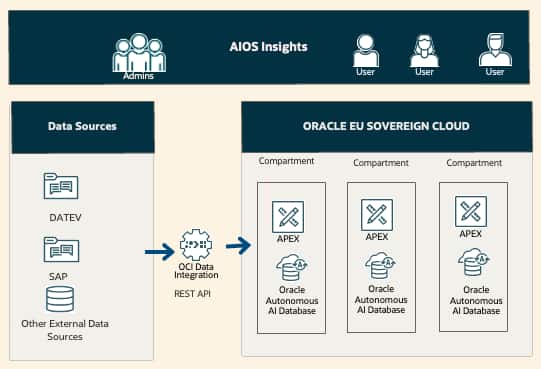
AIOS developed the AIOS Insights platform entirely in Oracle APEX—as a solution for financial reporting with charts, tables, as well as data entry and consolidation processes.
A key use case is the integration of data from upstream systems, in particular:
- DATEV (widely used in Germany), via export/import and REST API
- Additional interfaces to other systems such as SAP
The migration from the commercial cloud environment to the Oracle EU Sovereign Cloud was seamless using Zero Downtime Migration, in order to avoid interruptions for ongoing projects and customers.
Results and added value
With Oracle EU Sovereign Cloud and Oracle APEX, AIOS achieves significant improvements in speed, operations, and scaling:
- Very fast provisioning: for new customers, an Autonomous AI Database and a running application can be provisioned within 4–5 hours
- Simplified operations: 30 – 40 % less administrative effort due to cloud operations (updates, patching, infrastructure)
- Strong integration: reliable connectivity to upstream systems via REST APIs and data transfer
- Clean separation & governance: clear separation of environments via permissions and compartments
- Simplified architecture: no external web server/web service required
- Supports sales: EU data hosting as a compelling argument—according to AIOS, a contributing factor in winning a tender
Learnings from the customer perspective
AIOS recommends paying particular attention to the following when evaluating cloud solutions:
- Costs and a predictable cost structure
- Scalability
- Certifications/requirements (e.g., BSI)
- Data residency
- Available cloud services (e.g., Document Generator) as well as integration and security functions
For many use cases, AIOS views Oracle APEX in combination with Oracle EU Sovereign Cloud as a particularly compelling option—for delivering modern reporting and planning solutions in a secure, compliant, and cost-effective way.
Learn more about Oracle APEX, Oracle Autonomous AI Database, and/or Oracle EU Sovereign Cloud