
Cryptographic protection behaves like a depreciating asset: an algorithm or protocol that once met expectations can become inadequate as cryptanalysis advances, computing power grows, and standards change. Yet knowing what a database actually uses takes work. Its protections are spread across data at rest, network protocols, certificates, wallets, keys, backups, and exports, each with its own algorithms, key sizes, and lifecycle. Across a fleet, security teams must piece together that picture from settings in different places.
Protection also depends on every route to the data. Strong database encryption offers less assurance if the wallet holding its master key is protected by an older algorithm. A TLS 1.2 connection may negotiate a weak cipher suite. And even a TLS 1.3 connection with strong cryptography cannot protect data in an inadequately secured backup.
Determining whether a database is well protected cryptographically therefore takes more than checking whether encryption is enabled. Security leaders need to see how widespread a potential cryptographic risk is across the fleet; DBAs need to see how the protections fit together in each database and where a gap might expose data.
Quantum computing raises another concern: encrypted data collected today could be decrypted later if it depends on vulnerable public-key cryptography.
Today, we’re introducing Cryptographic Posture Assessment in Oracle Data Safe. It provides security teams with a fleet-wide view of cryptographic findings and the databases affected, while giving DBAs the detail they need to investigate each database. They can examine the algorithms and protocols in use, key lengths, certificate expiration dates, and encryption settings for data at rest, network connections, backups, and exports. The assessment also reports whether FIPS mode is enabled and highlights post-quantum readiness. Alongside Data Safe’s Security Assessment and User Assessment, it makes cryptography visible as a distinct part of database risk—and shows both how far a finding extends and the settings behind it.
From scattered cryptographic settings to an assessment
Readers who want the broader background on where Oracle Database uses cryptography can refer to the earlier Cryptographic Bill of Materials article. An inventory answers, “What is here?” An assessment answers, “Which of these choices may be weak, aging, or inconsistent with recommended practice?” Both are needed when a security leader asks how much of the estate is affected, or a DBA asks what to inspect in the database.
For an individual database, the starting point is a record of the cryptography it is configured to use. Network connections may use Transport Layer Security (TLS) or Oracle Native Network Encryption (NNE), each with its own protocols, algorithms, and key sizes. Transparent Data Encryption (TDE) can encrypt stored data using multiple algorithms and key sizes. Certificates with different key sizes and expiration dates support authentication, while wallets and keystores could protect cryptographic material using yet another algorithm. RMAN backups and Data Pump exports introduce still more encryption settings. The fact that one of these protections is enabled tells only part of the story.
Cryptographic Posture Assessment in Oracle Data Safe brings those settings into one assessment of a target database. This makes common blind spots visible: a database can have strong encryption for stored data while allowing weaker network settings, and a secure network configuration can still depend on a certificate nearing expiration. A certificate may still be valid even though it uses a public key whose size is below the required minimum. A wallet can hold strong keys while relying on an older algorithm for its own protection. The assessment keeps these answers separate, so that a strength in one area does not hide a weakness in another.
The assessment evaluates reported settings against Oracle recommendations and identifies findings that may warrant further investigation or remediation. Each finding shows its severity and the observed configuration, along with guidance for addressing it. This turns a list of cryptographic components into an assessment of their condition.
The fleet view shows where cryptographic risk is concentrated
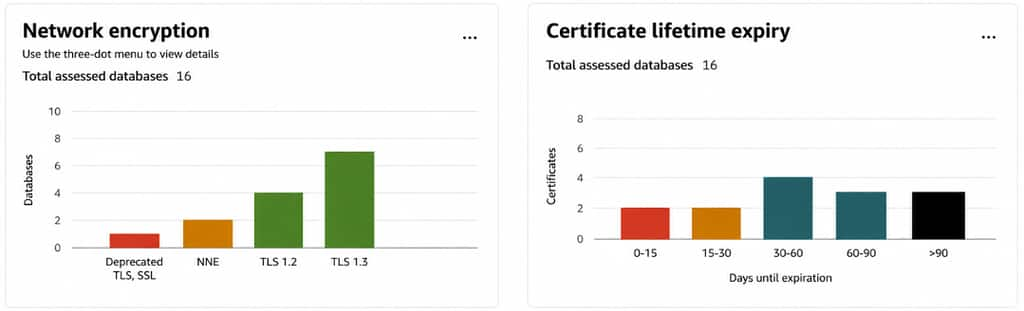
A CISO needs more than a collection of individual database reports. The fleet overview brings assessments together and shows how databases are distributed across network encryption choices, certificate lifetimes, FIPS mode, and quantum readiness. Figure 1 shows the number of assessed databases with TLS 1.2, TLS 1.3, NNE, or deprecated protocols enabled, alongside certificate expiration windows.
The immediate action and findings view below in Figure 2 adds another layer. It highlights issues that should be addressed first, such as the use of deprecated TLS protocols. It also groups issues across certificates and key management, network encryption, data encryption, and backup and export encryption.
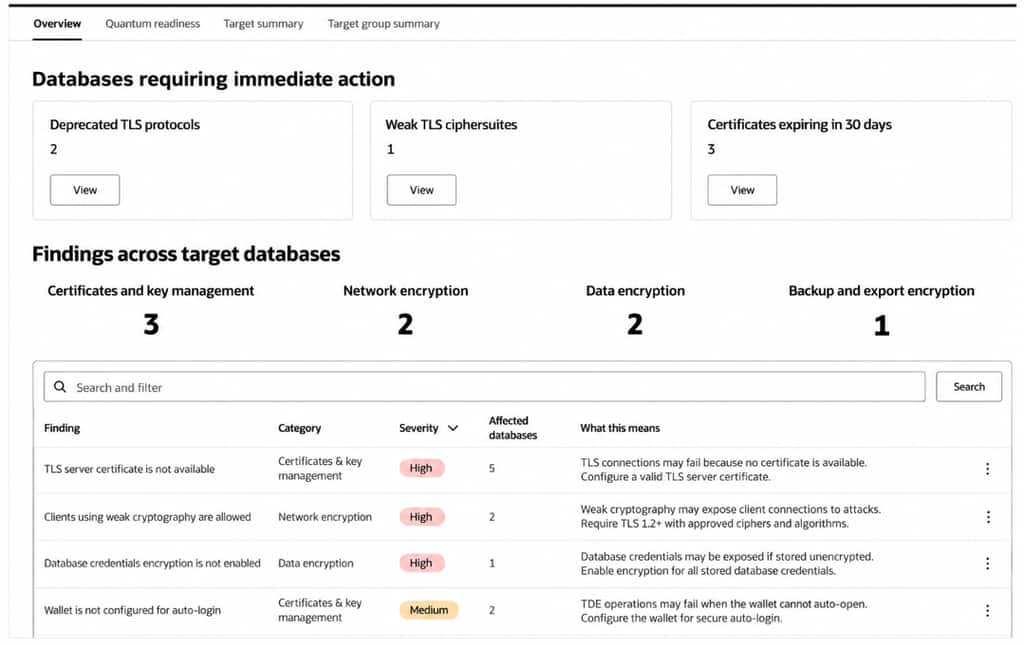
Each finding includes its severity and the number of affected databases as shown. In this example, two databases are configured to accept TLS connections using cipher suites identified by the assessment as weak.
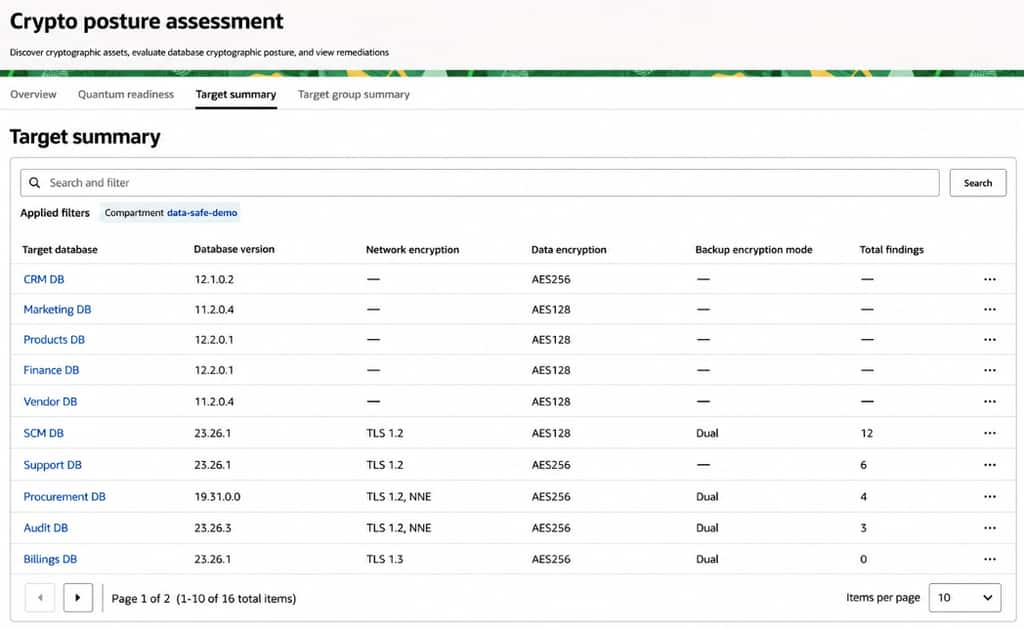
Figure 3 moves from fleet summaries to a target list, showing each database’s network, data, and backup encryption settings alongside its finding count.
Multiple predefined reports give teams another way to focus on conditions such as expiring certificates or weak TLS configurations across the fleet.
The database view explains each finding
The database view provides the detail a DBA needs for network encryption, data encryption, wallets, and backups. It shows the configured values behind a summary rather than leaving the DBA to infer them from a fleet count or database release number.
For network encryption, those details can include the TLS version and cipher suites, NNE encryption and integrity algorithms, and key-exchange information. Other parts of the target view show TDE settings, wallet protection, and the certificates used by the database. A finding can then be read alongside the observed value and Oracle’s recommendation. Figure 4 shows the TLS details for a sample target.
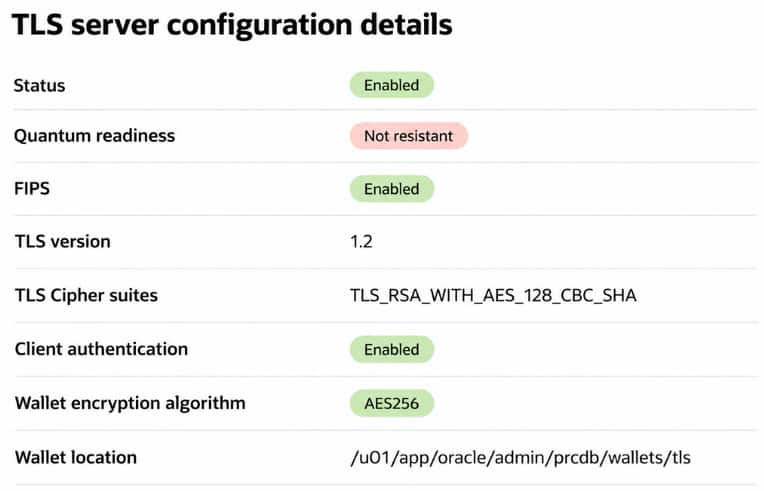
The view reports the TLS version, cipher suites, client authentication setting, and wallet protection algorithm. Those values give the DBA more to work with than a single overall score and help explain the result to a security reviewer. In this example, FIPS mode is reported as enabled while TLS quantum readiness is marked “Not resistant”—two distinct assessments.
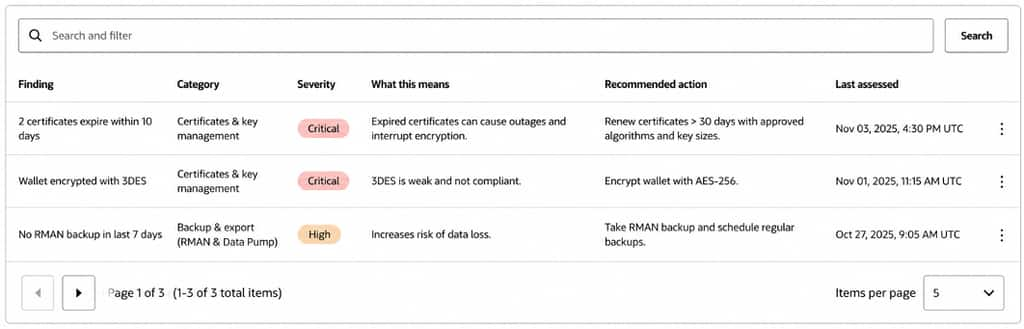
Like the fleet-level view, the database-specific view helps DBAs prioritize findings by explaining their severity, meaning, and recommended actions. Figure 5 shows an illustrative example.
Planning for quantum readiness
The quantum risk begins before a sufficiently powerful quantum computer exists. An attacker could record encrypted traffic today and attempt to decrypt it years later if the connection used a public-key method vulnerable to quantum attacks to establish its session key. NIST calls this the “harvest now, decrypt later” threat. The distinction matters: a TLS connection may use strong AES encryption for its traffic while still relying on a vulnerable method to establish the key.
NIST-standardized ML-KEM addresses key establishment. Oracle AI Database 26ai supports ML-KEM for TLS 1.3, including a hybrid option that combines ML-KEM with classical ECDHE. Starting with RU 19.32, Oracle Database 19c can also use ML-KEM with the next-generation cryptographic provider and compatible TLS 1.3 configurations. Before planning that transition, teams need to know which databases are ready and which cryptographic choices need attention. Data Safe’s quantum readiness view provides that starting point across the fleet.
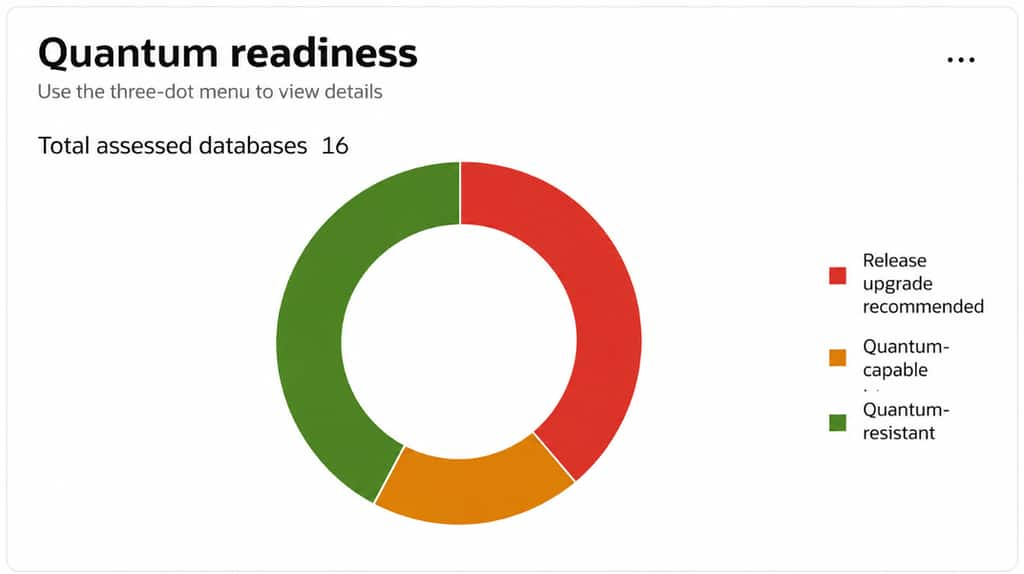
Figure 6 separates databases classified by the assessment as quantum resistant from those rated quantum capable and those for which a release upgrade is recommended. These classifications reflect the assessed configurations and should not be interpreted as guarantees of protection against future cryptographic attacks. Teams can drill into each category to identify the affected databases and investigate the relevant findings.
Do not let cryptography break quietly
Cryptography will continue to age. Managing that risk starts with knowing what a database uses, where it is used, and whether it still meets current expectations. Cryptographic Posture Assessment gives Oracle Data Safe users that view, from the whole fleet down to the setting behind an individual finding.
For feature details, see the Cryptographic Posture Assessment overview, and learn more about the Oracle Data Safe free promotion program.