
A contract-renewal workflow shows how an OpenShell-based agent can use Oracle AI Agent Memory to recover durable business context across sessions.
Enterprise agents increasingly work across sessions, teams, and business systems. Trust in those agents depends in part on having appropriate context. An agent must recover the right facts, from known sources, when a task requires them. If that context lives only in a transient session or full transcript, the agent may rely on stale facts, miss updates, or repeatedly process irrelevant history.
Consider a contract-renewal agent preparing an agreement for signature. It must confirm that the contract is active, the correct document was approved, the recipient is right, and the requesting employee has authority. Those are business decisions that depend on current records, not on whatever text happens to remain in the agent session.
Oracle AI Agent Memory supplies the durable context layer for this workflow. NVIDIA OpenShell is one runtime that can consume that context. The example demonstrates an AI Agent Memory integration with OpenShell; OpenShell is not a prerequisite for using AI Agent Memory with other agent frameworks or execution environments.
Why enterprise agents need a shared memory layer
Without a shared memory layer, every agent runtime must rebuild persistence, extraction, retrieval, and update logic. Replaying full histories also increases input volume and lets current records compete with stale or unrelated text. Oracle AI Agent Memory can help address those challenges on Oracle AI Database. It applies tenant, actor, and workflow scopes before retrieval and supplies context aligned with the current task.
Context is the information selected for the current task. Provenance identifies the source of a record, when it was created, and which version it represents. AI Agent Memory can return relevant records with this metadata, allowing applications to distinguish current business evidence from an agent-generated summary.
Applications can reuse this persistence and retrieval layer across agents and runtimes. They can avoid restructuring memory separately for every framework, and they can update shared records as business events occur.
Oracle AI Agent Memory provides the context layer
Oracle AI Agent Memory provides a unified memory core for enterprise agents. Applications can store records from conversations and business events, retrieve records relevant to a task, and preserve source, version, and time metadata with the result. Tenant, actor, and workflow scopes can help keep retrieval aligned with the caller and current process.
NVIDIA OpenShell is one runtime that can consume this context. In the contract-renewal workflow described below, a WayFlow-based workflow authenticates the caller, derives the request scope, retrieves relevant records from AI Agent Memory, and returns the result to OpenShell. AI Agent Memory supplies scoped context, while Oracle Database and OpenShell apply their respective documented data-access and runtime controls.
How OpenShell integration uses AI Agent Memory
The contract-renewal workflow connects a Hermes customer agent running in OpenShell with Oracle AI Agent Memory, a contract API, and an external signature service. A WayFlow-based workflow orchestrates the business steps and the memory request. A narrow bridge carries the approved result back to OpenShell.
When the agent needs to read a contract, the WayFlow-based workflow authenticates the caller, derives tenant, actor, and workflow scopes, and queries AI Agent Memory. AI Agent Memory retrieves records containing the contract status, approved document hash, recipient, user authority, applicable guidelines, and reviewed preferences. Where available, the records include provenance, version, and time metadata. Agent-generated summaries are not treated as authoritative business records.
Figure 1 How OpenShell-based agents use Oracle AI Agent Memory
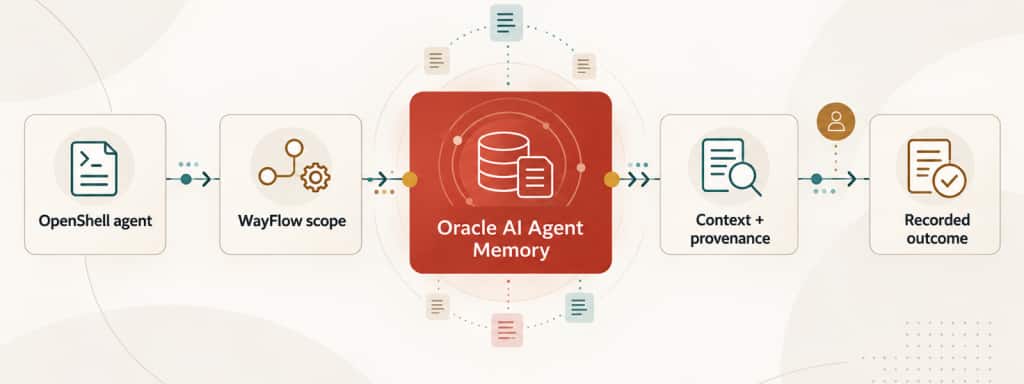
AI Agent Memory preserves context across the workflow
Oracle AI Agent Memory is the persistent center of this flow. The workflow derives the request scope before retrieval, retrieves context for the current task, and records the outcome for later work. The agent can continue from durable contract and workflow state instead of reconstructing that state from a full transcript.
For contract reading, AI Agent Memory supplies current records for the exact agreement. Signature submission remains a human-approved action. A reviewed preference can shape the packet, but it cannot replace document-integrity or business-authority checks. In Oracle’s engineering validation of this example, the workflow retrieved the intended contract context and was configured to require human approval before signature submission.
With NVIDIA OpenShell generally available, this workflow demonstrates one way to connect Oracle AI Agent Memory to an agent runtime. The same memory pattern can support other agent frameworks and execution environments.
AI Agent Memory product results
Oracle has published a separate evaluation of the AI Agent Memory product. On the LongMemEval benchmark, AI Agent Memory scored 93.8 percent, or 469 of 500, under the published configuration. In an 80-turn scripted conversation, AI Agent Memory held input near 1,300 tokens per request while a flat-history baseline grew above 13,900 by the final turn. See the published Oracle AI Agent Memory results.
These results measure AI Agent Memory accuracy and context efficiency, not OpenShell or end-to-end integration performance. They matter to this workflow because an agent needs current business context without replaying its full history on every request.
Durable context for coordinated enterprise agents
As organizations deploy groups of specialized agents, each handoff creates a memory problem. A customer-service agent may need current contract, billing, and fulfillment records. A financial-close workflow may need the evidence behind each reconciliation. An operations workflow may need to carry decisions from investigation into remediation. Shared, scoped memory can provide each agent the records required for its step without forcing every agent to reconstruct the full history.
Get started with Oracle AI Agent Memory
Start with the Oracle AI Agent Memory documentation and install the package from PyPI.
The demonstrated integration uses WayFlow as a supporting orchestration framework and NVIDIA OpenShell as the runtime.