
How Oracle MicroTx brings XA transaction coordination into durable workflow orchestration
Durable workflows let a business process survive interruption. XA transaction coordination drives its short, business-critical portion to a single atomic outcome. Oracle MicroTx Workflows brings both together without holding an entire long-running process inside a distributed transaction.
Modern enterprise applications rarely complete important work inside one process, database, or synchronous API call. A funds transfer, for example, may validate a request, update two accounts, write a ledger entry, and notify downstream systems. These steps form a business commitment, not merely a sequence of tasks.
Durable orchestration answers, “Can the process continue after a failure?” For workflows that update systems of record, a second question is equally important: “Will related business updates commit or roll back together?”
Oracle MicroTx Workflows addresses both concerns by combining durable workflow orchestration, based on the Conductor OSS project, with MicroTx distributed transaction capabilities across services, databases, and heterogeneous systems. [1]
This blog focuses on XA transaction support within Oracle MicroTx Workflows.
Durable execution solves continuity. XA solves atomicity.
Durable execution is an important architectural pattern for modern distributed applications. It allows a workflow to survive service restarts, pod failures, timeouts, retries, delayed responses, and infrastructure changes.
A durable workflow runtime records workflow progress independently from any one worker process. If a worker crashes or a deployment restarts, the workflow can resume from persisted state instead of starting over or relying on scattered application logs.
Oracle MicroTx Workflows records task state, input and output data, logs, and status transitions so teams can monitor, troubleshoot, retry, restart, and audit workflow executions. It supports system and worker tasks, operators, human tasks, schedules, events, and AI-powered tasks. Persisted execution history also gives operators a coherent view of what ran, what failed, and what action is available next. [2]
XA addresses a complementary problem: whether related updates across transactional participants reach one atomic outcome.
In the XA protocol implemented by MicroTx, services enlist in a global transaction and the transaction manager coordinates prepare, commit, or rollback. During prepare, each participant confirms that it can make its work durable. If every participant prepares successfully, all are asked to commit; otherwise, they roll back. [6] The comparison is straightforward:
| Enterprise concern | Durable workflow orchestration | XA transaction coordination |
| Main question | Can the workflow continue after interruption? | Can related updates commit or roll back atomically? |
| Primary scope | Long-running business process execution | Transaction-sensitive work across participants |
| Failure response | Resume, retry, restart, inspect, audit | Prepare, commit, rollback |
| Enterprise value | Process continuity | Business-state correctness |
| MicroTx capability | MicroTx Workflows | MicroTx Distributed Transactions through Transaction Tasks |
MicroTx Workflows can therefore use durable execution for the end-to-end process and a precise XA boundary for the steps that require atomic finality.
The problem: workflow success is not the same as business correctness
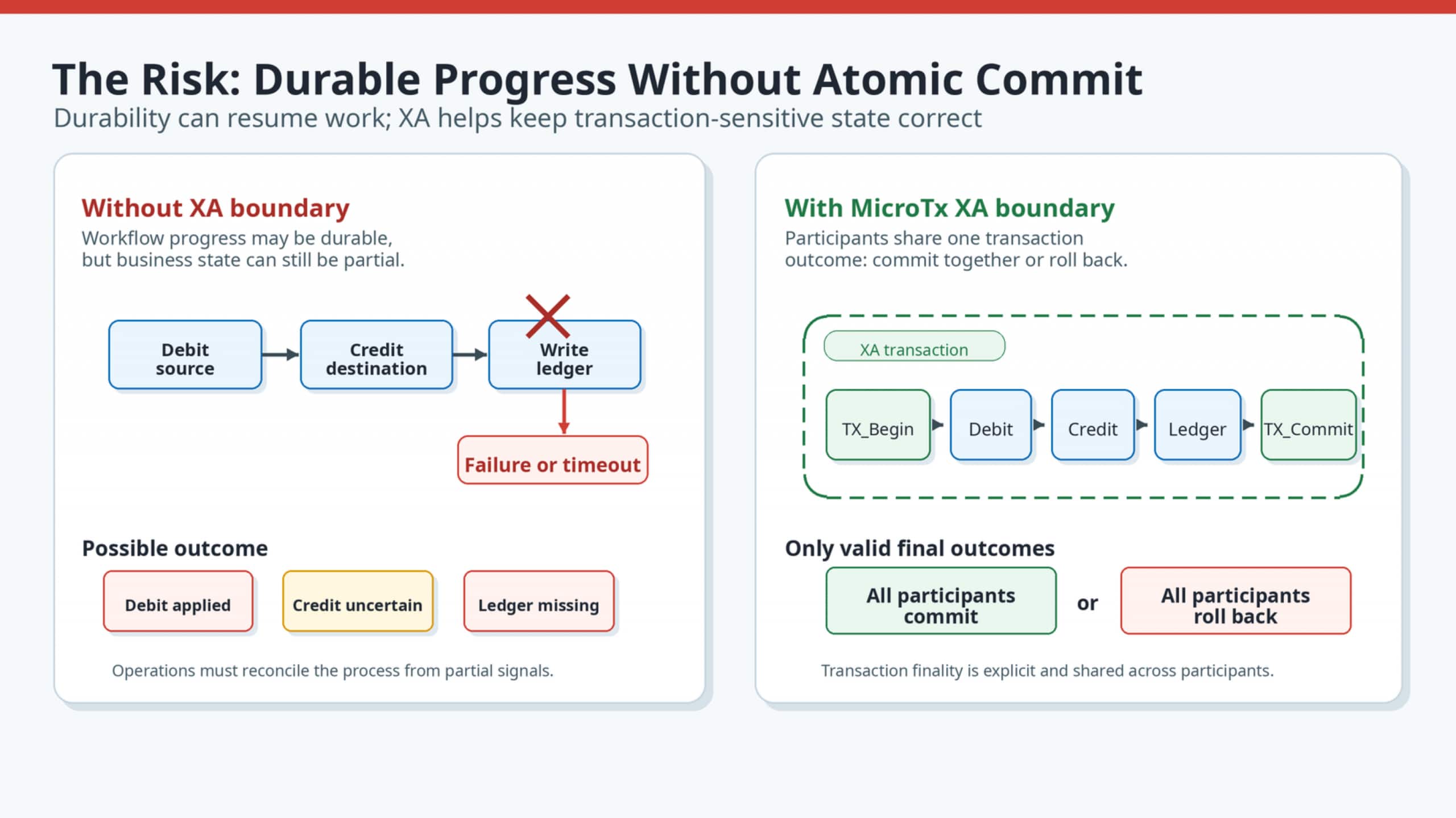
Consider a funds-transfer workflow that verifies a balance, debits one account, credits another, and writes a ledger record. From the workflow’s perspective, each task may have clear inputs, outputs, status, and retry policy.
Those controls make execution observable and recoverable, yet failures between tasks can still leave an uncertain business state. A task marked complete proves that the workflow recorded an outcome; it does not automatically prove that every related system reached the same or desired outcome.
A service may update its database and time out before responding; a worker may retry after an ambiguous network failure; a pod may restart between two updates; or a later participant may reject its work because of a constraint.
Durability lets the workflow resume, but it does not by itself determine whether an earlier side effect should be retained, repeated, compensated, or rolled back. That uncertainty is especially risky when the participants maintain authoritative financial, inventory, entitlement, or audit data.
The business needs an unambiguous outcome: all related updates commit, or all roll back. It should not have to infer finality from a mix of task status, application logs, and manual reconciliation.
XA coordination supplies that atomic boundary while the workflow continues to define and track the broader business process. Figure 1 shows the difference between tracking workflow progress and ensuring that all participating systems commit or roll back together.
XA inside MicroTx Workflows: the Transaction Task
Oracle MicroTx Workflows includes a Transaction Task, a system task that communicates with the MicroTx Transaction Coordinator through HTTP REST APIs and supports XA distributed transactions. This makes the transaction lifecycle part of the workflow definition instead of leaving it implicit inside participant code. [3]
A workflow can begin an XA transaction, execute participating SQL and HTTP tasks inside that transaction context, and then commit or roll back the transaction based on the task outcome.
The Transaction Task supports three transaction actions: [3]
| Transaction Task action | Purpose |
| BEGIN | Starts the XA transaction |
| COMMIT | Commits the XA transaction |
| ROLLBACK | Rolls back the XA transaction |
When a transaction starts, MicroTx maintains the transaction context, txCtx, within the workflow instance and shares it across tasks called between the begin and commit actions. At present, txCtx propagation is implemented for HTTP tasks and SQL tasks. When an HTTP task or SQL task runs within this transaction context, the related link headers are propagated in the outgoing request. [3]
The workflow owns process progress; the MicroTx Transaction Coordinator owns the XA outcome.
How the MicroTx Transaction Task works
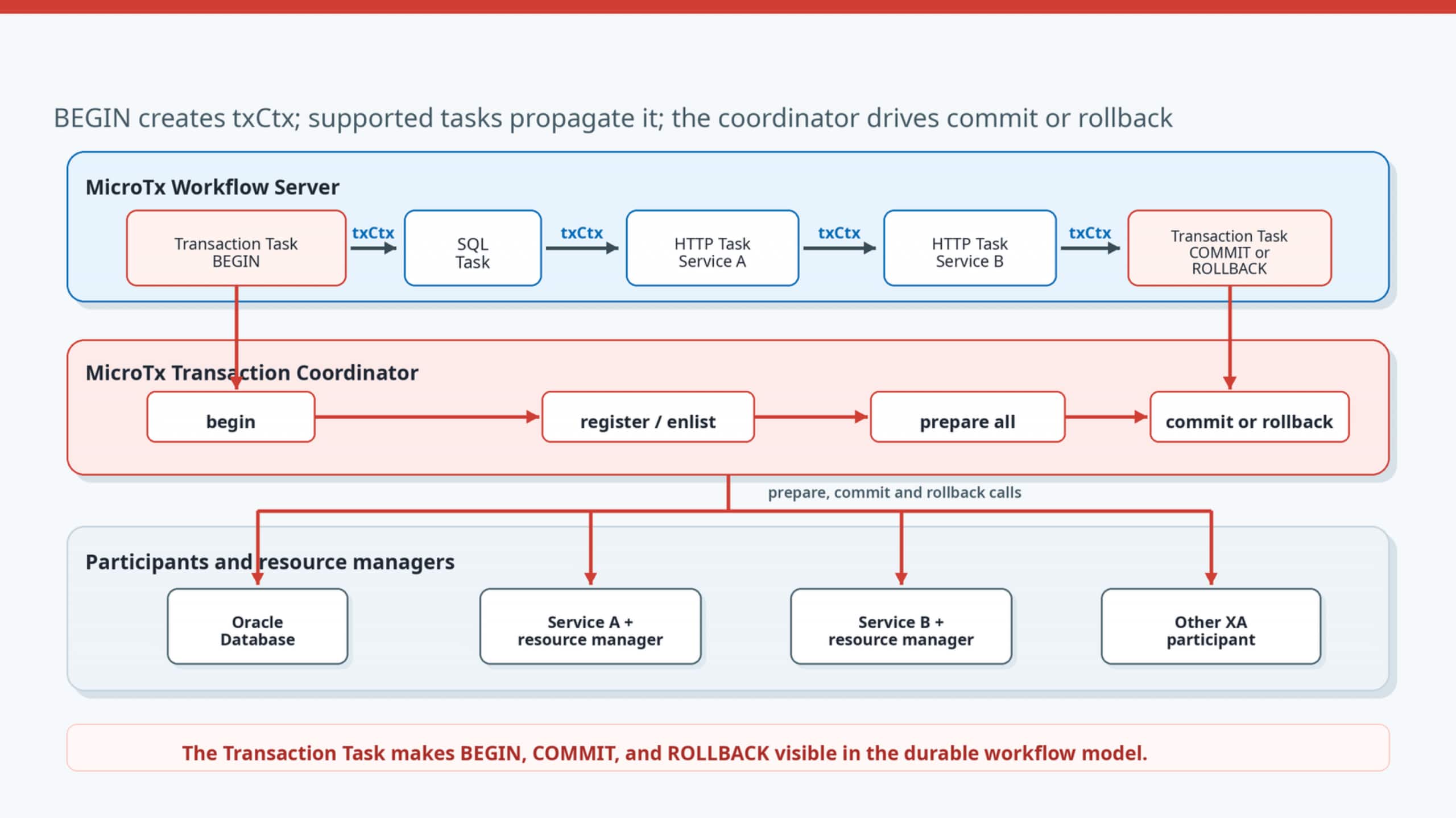
A Transaction Task with BEGIN starts the XA transaction and creates txCtx. Supported SQL and HTTP tasks placed within the boundary receive that context, allowing their services and resource managers to join the same global transaction by registering or enlisting with the transaction coordinator. The workflow remains responsible for task order and control flow; the coordinator tracks the enlisted participants. [3]
When the protected work succeeds, a Transaction Task with COMMIT asks the coordinator to make the updates final. If the work fails, ROLLBACK aborts the transaction. Figure 2 shows txCtx flowing through the supported tasks while the coordinator drives prepare, commit, and rollback across participants. The result is explicit transaction finality that operators can see in the workflow model. [3]
Integrating XA participants
XA-capable participant services integrate the Oracle MicroTx XA client library so the Transaction Coordinator can enlist them and coordinate prepare, commit, or rollback. [7]
A workflow can include one non-XA resource through Logging Last Resource (LLR) or Last Resource Commit (LRC). LLR is preferred when the resource can store a recoverable commit record; LRC is available when it cannot, with weaker recovery characteristics. [8]
The architecture pattern: durable outside, atomic inside
The workflow may be long-running, but the XA boundary should be precise.
Human approvals, external waits, notifications, and AI reasoning benefit from durable orchestration but generally belong outside a distributed transaction. They may take minutes, hours, or days and can depend on actors that do not support XA. The XA boundary should instead surround the short section in which participating systems must agree on one atomic outcome.
A common pattern is:
Durable workflow begins
    Receive request
    Validate input
    Enrich data
    Run policy checks
    Run AI-assisted tasks
    Wait for human approval if needed
    Prepare transaction inputs

    TRANSACTION BEGIN
        Verify current state
        Update system of record A
        Update system of record B
        Write ledger or audit entry
    TRANSACTION COMMIT / ROLLBACK

    Send notification
    Publish completion event
Durable workflow completes
This avoids holding a distributed transaction across a long-running process while also avoiding a design in which every critical update is an independent side effect protected only by retries.
Use durable orchestration for the complete business process and XA coordination for the bounded section that requires atomicity. This keeps long-running work flexible while making the critical system-of-record update deterministic.
Why transaction-aware durable execution matters
When workflows update systems of record, continuity and atomicity must work together. Durable execution preserves process state and history; XA participating updates commit or roll back as a coordinated unit. The combination reduces the gap between knowing where a process stopped and knowing whether its protected business changes are correct. A platform for business-critical workflows should make five questions explicit:
1. Can the workflow survive failures and resume from known state?
2. Can the workflow expose execution history for monitoring, troubleshooting, and audit?
3. Can the workflow make transaction boundaries explicit?
4. Can participating systems commit or roll back as a coordinated unit?
5. Can the final business outcome be trusted?
MicroTx Workflows provides persisted state, retries, timeouts, pause and resume, restart and retry actions, and execution history. Its transaction-aware tasks add explicit consistency controls for distributed workflows and microservices. [5]
The XA Transaction Task extends durable orchestration from process recovery to atomic business outcomes where systems of record are involved. The five questions above become part of one operating model rather than separate concerns handled by workflow code, service code, and manual procedures.
What this means for agentic workflows
AI agents can assist with classification, reasoning, routing, and recommendations, but updates to systems of record still need deterministic workflow policy and transaction semantics. MicroTx Workflows can place GenAI and agentic tasks in the broader durable process while protecting the bounded atomic update with XA Transaction Tasks. [5]
A conceptual example: transaction-aware funds transfer
A funds-transfer process may include validation, fraud checks, policy rules, human approval, account updates, ledger recording, and notification. Validation and a high-value approval can take place durably before the transaction begins; notification can follow after it finishes. Only the compact system-of-record update needs to sit inside the XA boundary:
Conceptual workflow:
Workflow: ProcessFundsTransfer

1. Receive transfer request
2. Validate request format
3. Retrieve customer and account context
4. Run policy checks
5. Run fraud-risk classification
6. If high risk, wait for human approval
7. Prepare transaction inputs

8. TRANSACTION BEGIN
      SQL Task: verify source account balance
      HTTP Task: debit source account service
      HTTP Task: credit destination account service
      SQL Task: write ledger entry
   TRANSACTION COMMIT

9. Send confirmation notification
10. Complete workflow
The workflow can wait, retry, pause, resume, and retain history outside the transaction. Inside the boundary, the account and ledger updates commit together or roll back together, producing a clear final business state.
Designing transaction-aware workflows: key principles
- Keep the XA boundary focused. Protect only the smallest set of updates that truly requires atomic commit or rollback.
- Make transaction boundaries visible. Show BEGIN, COMMIT, and ROLLBACK explicitly so the design is easy to review, operate, and audit.
- Place participants inside the boundary. Put supported SQL and HTTP tasks between the Transaction Tasks that begin and commit the transaction. [3]
- Use SQL Tasks intentionally. When SQL Tasks are used between BEGIN and COMMIT Transaction Tasks, they participate in workflow-defined transaction boundaries instead of controlling their own transactions. [4]
- Treat rollback as a first-class outcome. Define the failure path and the final state when the atomic section cannot complete.
Conclusion: durable execution needs transaction-aware finality
Enterprise applications are distributed, workflow-driven, AI-assisted, and connected to systems of record. Reliability must mean more than resuming: the process must restart from a known state, and protected systems must reach a trusted outcome.
Oracle MicroTx Workflows combines durable execution with XA coordination for bounded atomic updates, making long-running work auditable and critical outcomes dependable. Durable execution answers continuity; XA answers atomicity. [3]
References
[1] Oracle MicroTx 26.1 is now generally available
[2] MicroTx Workflows: Workflow
[3] MicroTx Workflows: Transaction Task
[4] MicroTx Workflows: SQL Task
[5] Fundamental Features of MicroTx Workflows
[6] MicroTx Distributed Transactions: XA Transaction Protocol
[7] MicroTx Distributed Transactions: Supported Resource Managers
[8] MicroTx Distributed Transactions: Optimizations for a Non-XA Resource