What Apollo 11 can teach CTOs about deep research AI
Dashboards answer questions we anticipated. Specialists answer questions that clearly belong to their domain.
But many important leadership questions sit between those two systems. They are rare, cross-functional, and difficult to route. No one built a dashboard because no one expected the question. No single specialist owns all the evidence.
These are the gaps leaders become accustomed to living with. They are also where AI can be most useful: as an on-demand researcher for questions the organization was not prepared to ask.
One of the most important ad hoc tasks is learning from failure.
Was an incident caused by a systemic weakness, a bad procedure, human judgment, or random chance? Could it happen again? Did our controls fail, or did they prevent a worse outcome?
The evidence usually exists. It is simply scattered across policies, logs, tickets, transcripts, technical reports, and later investigations.
A successful mission with a serious incident
Apollo 11 was not a failed mission. But its final descent produced one of history’s most consequential incident-response decisions.
As Eagle approached the Moon, its guidance computer generated a series of 1201 and 1202 alarms. The automatic approach was leading toward a crater and boulder field. Fuel was declining. Mission Control had to decide, in seconds, whether to continue or abort.
The landing succeeded. NASA and MIT engineers then worked through the night, identifying enough of the radar-related cause to protect the lunar ascent less than a day later. The complete official Mission Report was published on November 1, 1969, just over three months after the landing. NASA’s account and the Apollo 11 Mission Report record show the difference between rapid operational diagnosis and a complete, documented retrospective.
What if those engineers had also had a deep research agent?
The agent would support the retrospective, while engineers retained responsibility for the decisions. It could help reconstruct the incident faster, more completely, and with every conclusion tied to evidence.
Recreating the investigation
We assembled six official NASA documents, all freely available online:
- the final flight plan;
- the formal mission rules;
- the onboard voice transcript; and
Together, they contain 2,583 pages.
We then asked Oracle’s Deep Data Research Agent one deliberately simple question:
Did NASA make the right decision to continue the Apollo 11 landing after the computer alarms, or did they simply get lucky?
The concise answer was that continuing was a defensible, controlled recovery with genuine residual risk.
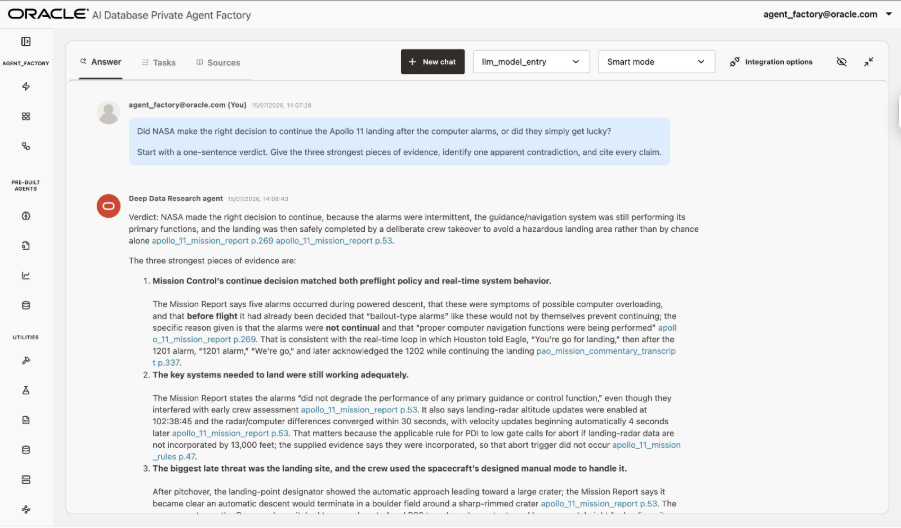
The research path made the verdict useful.
It discovered that:
- The computer event record shows five alarms, while the live transcripts do not contain five equally clear verbal exchanges.
- The alarms represented an overloaded computer Executive, but the restart design preserved critical guidance and control work.
- Mission Control’s famous “30 seconds” call was not the same as a measurement showing exactly 30 seconds until empty tanks. The Mission Report’s post-flight analysis estimated approximately 45 to 50 seconds to propellant depletion at engine cutoff.
- A general mission rule appeared to make a computer program failure temporarily “no-go,” while the Mission Report documented a preflight decision to continue through intermittent bailout-type alarms when navigation remained valid. The agent surfaced the tension instead of hiding it.
That is the a-ha moment.
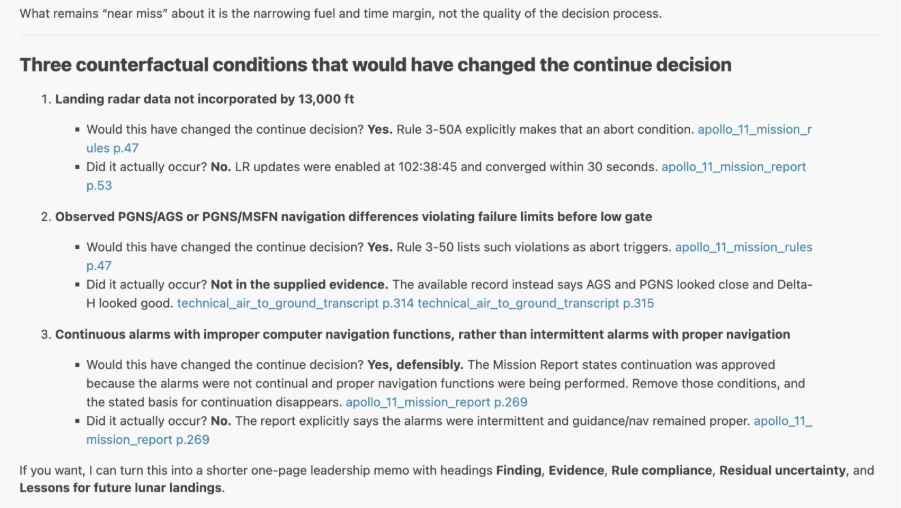
A conventional search system can find a paragraph explaining a 1202 alarm. Deep research must determine which events occurred, reconcile records created at different times for different purposes, distinguish what was known during the incident from what was learned afterward, and show its sources.
The enterprise version of Apollo 11
Most organizations already possess the equivalent evidence:
| Apollo record | Enterprise equivalent |
| Mission rules | Policies, contracts, and control standards |
| Flight transcript | Tickets, calls, chat, and operator notes |
| Computer event record | Application logs and observability data |
| Mission Report | Audit findings and post-incident reviews |
The unanswered questions are familiar:
- Was the failure systemic or isolated?
- Did the control fail, or did it save us?
- Were teams following a flawed procedure?
- What did decision-makers know at the time?
- Which corrective action will actually prevent recurrence?
These questions rarely fit a dashboard. They demand research across the organization’s evidence.
Why Oracle
Oracle AI Database Private Agent Factory provides a prebuilt Deep Data Research Agent for complex research across enterprise files. It retrieves relevant material, synthesizes findings, and returns source-linked answers that users can verify.
For CTOs, its more important advantage is architectural. Private Agent Factory can run close to enterprise data in OCI, on-premises, or in supported multicloud environments, while the organization retains control of security, identity, deployment, and approved model choices. Oracle positions it specifically as an alternative to copying sensitive data into unmanaged AI tools.
With private deployment and private or local model and embedding endpoints, an organization like NASA could conduct this research without sharing its incident corpus with a third-party AI service. Oracle AI Database can provide the vector store, hybrid search, runtime data, and governance within the organization’s controlled environment. Oracle supports controlled and air-gapped deployment options, but data residency remains an architectural choice: using an external model endpoint changes that boundary.
Oracle has spent nearly five decades protecting and operating mission-critical enterprise data. The company was founded in 1977, and its first commercial database arrived in 1979. That history matters when AI moves from public experimentation to private institutional memory.
The opportunity for CTOs is larger than answering questions faster. It is closing the investigative gaps we have learned to tolerate.
The next important insight may already be in your systems. You simply have not had a practical way to assemble the evidence and ask the question.
Try it yourself
See Private Agent Factory in action with Oracle’s free The Private Agent Factory: Turn Data into Action LiveLab. Bring an ad hoc question that your dashboards cannot answer and see how an agent can assemble the evidence behind it.