
Enterprise AI agents do not fail because they cannot talk. They fail when they act without the right business context.
Most AI strategy conversations focus on models: which one reasons best, which one is fastest, and which one can handle the largest context window. Those questions matter. But as agents move from demonstrations into real business processes, another question becomes just as important:
Who manages the context those agents depend on?
Every useful action an agent takes is shaped by context. Who is asking? Which customer, facility, account, or case is involved? What happened before? Which policies apply? What changed yesterday? Which source reflects the current state of the business?
That is enterprise context.
It is not simply a longer chat history. Enterprise context is the combination of business facts, policies, preferences, prior decisions, relationships, work in progress, and current operational signals that gives an agent’s task meaning.
Managing it is not merely a chatbot problem. It is a data-management problem—with an AI-shaped hat on.
Context is becoming shared enterprise infrastructure
A single agent pilot can hide the context problem. A portfolio of production agents cannot.
As agents spread across customer service, finance, supply chain, human resources, and operations, context begins to cross sessions, business units, applications, and operational systems. Questions about relevance, consistency, ownership, and systems of record stop being implementation details. They become platform decisions.
If every application team assembles its own memory stack, search tools, integration logic, and operating model, the organization has not created an enterprise context strategy. It has created a new category of technology sprawl.
That is why enterprise context management belongs on the CTO agenda. The architecture chosen now will shape how consistently agents operate, how much duplicated infrastructure the enterprise must maintain, and how quickly teams can move from isolated pilots to repeatable production patterns.
A simple logistics request shows the problem
Consider a factory with three ordinary requirements:
- Factory A needs three large truck shipments every Thursday.
- Drivers must be certified to transport regulated chemicals.
- Delivery must be completed before midnight.
None of this is difficult to say. Applying it correctly across weeks of conversations, schedule changes, supplier disruptions, and multiple logistics systems is where things get interesting.
When a logistics agent is asked whether Carrier 17 can handle Thursday’s chemical loads, it needs two different kinds of information.
First, it needs the business context: Factory A’s delivery schedule, the hazardous-material certification requirement, and the applicable receiving deadline. Second, it needs current operational facts: carrier capacity, driver qualifications, routes, inventory, and shipment status.
Those sources are related, but they are not interchangeable.
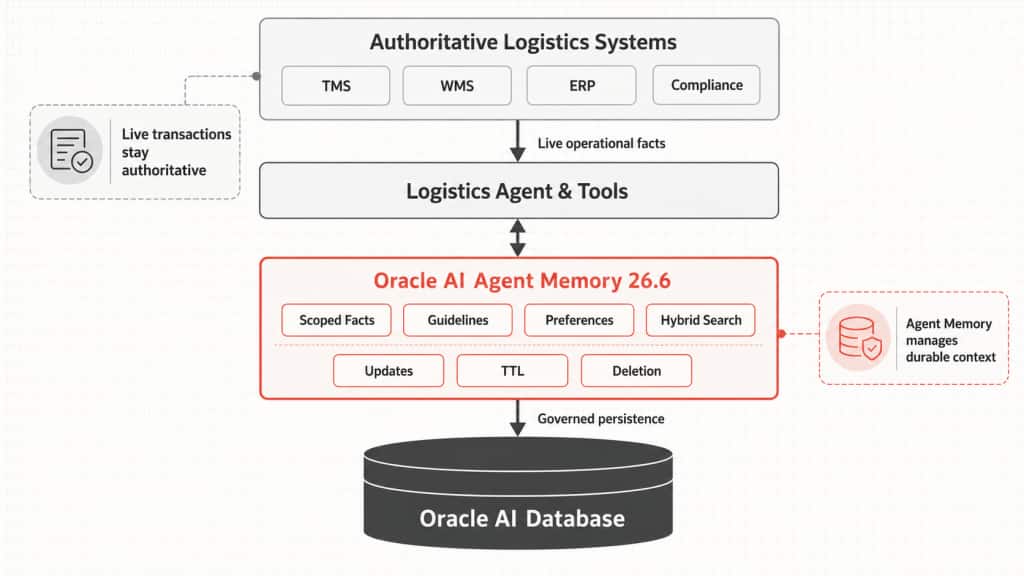
A sound enterprise architecture establishes which applications are authoritative for current transactions and how an agent should use context when interpreting those facts. Yesterday’s conversation may help today’s decision, but it should not quietly become today’s system of record.
Getting that boundary wrong can mean a rejected load, emergency rescheduling, detention charges, or a production interruption. For regulated cargo, it can create a compliance event—not merely an inconvenient answer from a chatbot.
When memory becomes another system to reconcile
Many agent architectures begin innocently. Conversation state is handled in one place. Semantic search is handled in another. Shipment rules come from an operational application. Facility identities come from somewhere else.
Then Factory A changes its Thursday receiving hours.
The transportation application reflects the new deadline, while another part of the agent architecture may still surface the old one. The application team adds an instruction telling the model to prefer recent information, which is a bit like resolving a general-ledger discrepancy by asking everyone to think newer thoughts.
This is how promising agent projects become integration projects, then data-management projects, and eventually presentations titled “Lessons Learned.”
Enterprise context cannot be an accidental by-product of an agent interaction. It needs a deliberate architecture.
What an enterprise context strategy must answer
Before standardizing on an agent-memory architecture, CTOs should expect clear answers to four questions.
What context does the agent actually need?
Similarity alone is not enough. Enterprise work also depends on exact names, identifiers, dates, policies, and business metadata. Teams need a shared definition of the context required for each workflow and a way to test whether the agent receives the information that matters.
Which source is authoritative?
The architecture should distinguish business context from live transactional facts. Teams should know which application answers “What is true now?” and how contextual information should shape the agent’s interpretation without replacing that authority.
How will the architecture handle change?
Factory hours change. Policies are superseded. Customer and supplier relationships evolve. A credible context strategy must account for stale or conflicting information instead of assuming that adding more history will make the answer clearer.
How many systems will the enterprise operate?
Every additional service brings integration work, synchronization, monitoring, and cost. CTOs should evaluate the complete context architecture, not merely the convenience of adding one more component to an agent prototype.
These questions point toward a shared context layer rather than a separate memory design for every agent.
Oracle AI Agent Memory as an enterprise context solution
Oracle AI Agent Memory is a Python library for building agents that can remember, reason, and act with enterprise context. It is part of Oracle’s Unified Agent Memory Core and is designed to bring facts, relationships, business context, state, and similarity into a more unified approach for enterprise agent applications.
For CTOs, the significance is architectural. Oracle AI Agent Memory offers teams a common approach to memory across agent projects instead of requiring each project to invent its own pattern. That creates an opportunity to establish a repeatable enterprise context strategy while agent adoption is still taking shape.
In the Factory A scenario, that strategy starts with a clear division of responsibility: logistics applications answer questions about current capacity and shipment status, while the agent application uses the relevant business context to understand why certification, timing, and facility-specific requirements matter.
The goal is continuity without confusing context with authority.
Availability note (July 2026): Oracle AI Agent Memory 26.6.0 is publicly available as the oracleagentmemory Python package on PyPI. PyPI lists the package’s development status as Alpha. This article discusses the currently published package and does not describe planned functionality.
Why the decision matters now
The next generation of enterprise AI will be judged less by whether an agent can produce a charming first answer than by whether it can sustain a useful thousandth interaction.
That requires more than giving each agent a memory feature. It requires an enterprise context strategy: a consistent way to determine which context matters, which sources are authoritative, how changing business conditions are reflected, and how many supporting systems the organization is willing to operate.
Agent memory should not become another isolated technology choice made independently by every application team. Enterprise context is shared infrastructure, and the architecture used to support it will shape consistency, operating complexity, and trust across the agent portfolio.
Start with one high-value workflow. Identify the decisions the agent must make, the context those decisions require, and the applications that remain authoritative. Measure answer quality, context freshness, response time, and the number of human interventions avoided. Then use what you learn to define an enterprise pattern before disconnected agent pilots create disconnected memory stacks.
- Explore the Oracle AI Agent Memory product page.
- Get the Oracle AI Agent Memory Python package on PyPI or install it with
pip install oracleagentmemory.