
Your data is one of your most critical assets. For Indian enterprises, it is now also one of the most regulated.
With the Digital Personal Data Protection Act (DPDPA) moving toward enforcement, organizations have limited time to answer a basic but uncomfortable question: is personal data protected where it lives—or is security still being applied mostly around it?
That question matters because DPDPA is not just about policy language or governance intent. It is about whether organizations can show that personal data is encrypted, access is controlled, sensitive fields are masked when needed, and activity is logged in a way that stands up to scrutiny. In other words, it is about demonstrating that controls work reliably in practice.
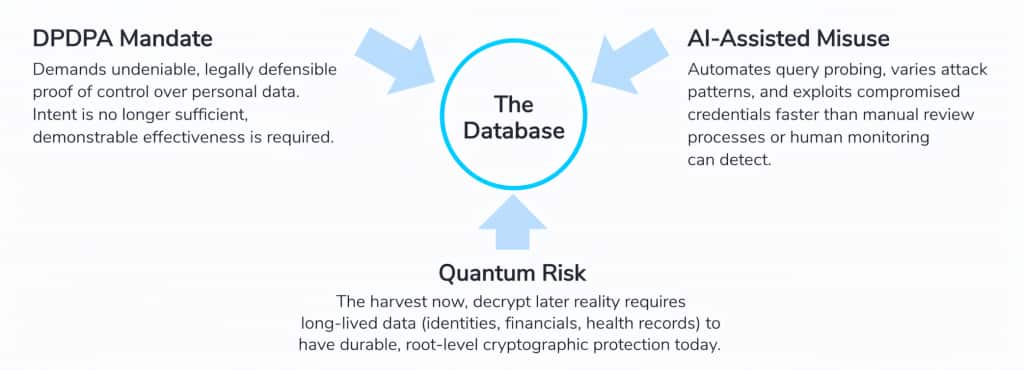
And DPDPA is arriving at a moment when the threat environment is also changing. AI-enabled attacks allow threat actors to develop exploits faster and with greater adaptability, increasing pressure on organizations to strengthen privacy protections rather than rely on compliance checkbox approaches. Quantum risk is also pushing security leaders to think beyond today’s control gaps and toward the durability of long-lived encryption. Together, these pressures are reshaping the database security conversation for Indian enterprises.
The real issue is no longer whether an organization has security tools in place. It is whether the database itself can and should enforce protection at the point where data is stored, queried, and exposed.
Why DPDPA Changes the Conversation
For years, many organizations have approached database security indirectly. They have invested in perimeter controls, monitoring tools, and application-layer protections. Those investments help. However, they do not always protect the areas where sensitive data is most vulnerable: over-privileged access, bypassed security controls, unprotected database connections, copied backups, nonproduction environments, and fragmented audit trails.
That is where DPDPA raises the bar.
The law pushes security teams beyond broad assurances toward enforceable controls that cannot be bypassed. Can personal data be encrypted at rest and in transit? Can access be restricted not just by role, but by authorized business purpose? Can sensitive fields be masked outside authorized use? Can organizations produce reliable audit evidence to prove who accessed what and when?
For organizations working to meet security compliance objectives, these are not simply policy considerations. They are mandatory capabilities and architecture decisions that shape the foundation of the environment. They are not optional. They are required controls.
What the Law Really Demands
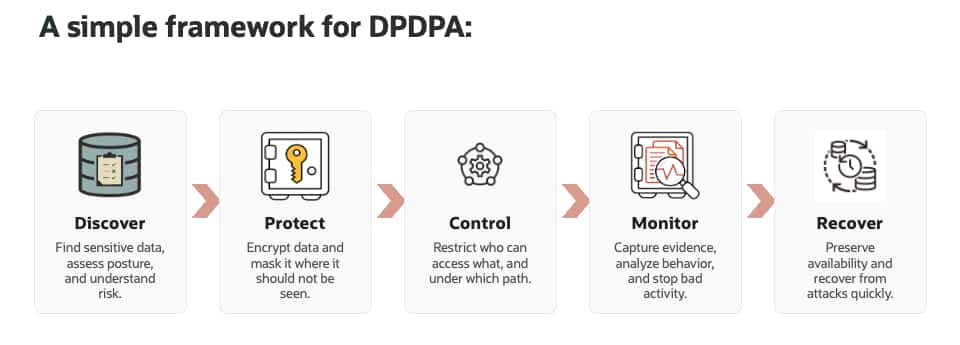
At a practical level, DPDPA forces organizations to focus on a handful of controls that matter most at the data layer.
First, discover sensitive data and identify risks. This means finding personal data across databases, production and nonproduction environments. Assess the current security posture, access patterns, and user risk associated with that data. Use this visibility to prioritize protection, governance, and compliance efforts based on actual exposure.
Second, personal data must be protected both at rest and in transit. That includes not only production storage, but also backups, exports, and the network paths through which data moves.
Third, access must be limited—even for privileged users. It is not enough to assume that administrators or operators will exercise restraint. Sensitive data must be protected through technical controls, not only through process.
Also, nonproduction environments can no longer be treated casually. Development, testing, analytics, and outsourced workflows often carry the same data exposure risk as production, especially when real records are copied without masking.
Fourth, access must be continuously monitored and behavior analyzed to detect and stop unwanted activity. Audit trails should be durable, trustworthy, and detailed enough to support investigations, identify suspicious access patterns, and demonstrate that security controls were operating as intended. Additionally, audit data should be stored in a tamper-resistant format to maintain evidentiary integrity.
Fifth, personal data must remain recoverable and available through reliable backups, disaster recovery, and high availability. Recovery plans should protect against data loss, outages, ransomware, and operational failures, ensuring personal data can be restored quickly while maintaining business continuity and compliance obligations.
Finally, organizations need confidence that their controls are in place and operating effectively. DPDPA does not reward vague security intent. It favors demonstrable control effectiveness.
Why Native Database Controls Matter
This is why security at the source matters.
When personal data is protected only outside the database, gaps remain. A copied backup may sit unencrypted. A privileged user may have broad visibility into records they do not need to see. A test environment may inherit production data with no masking. A monitoring system may generate alerts yet still fail to prevent the action that created the risk.
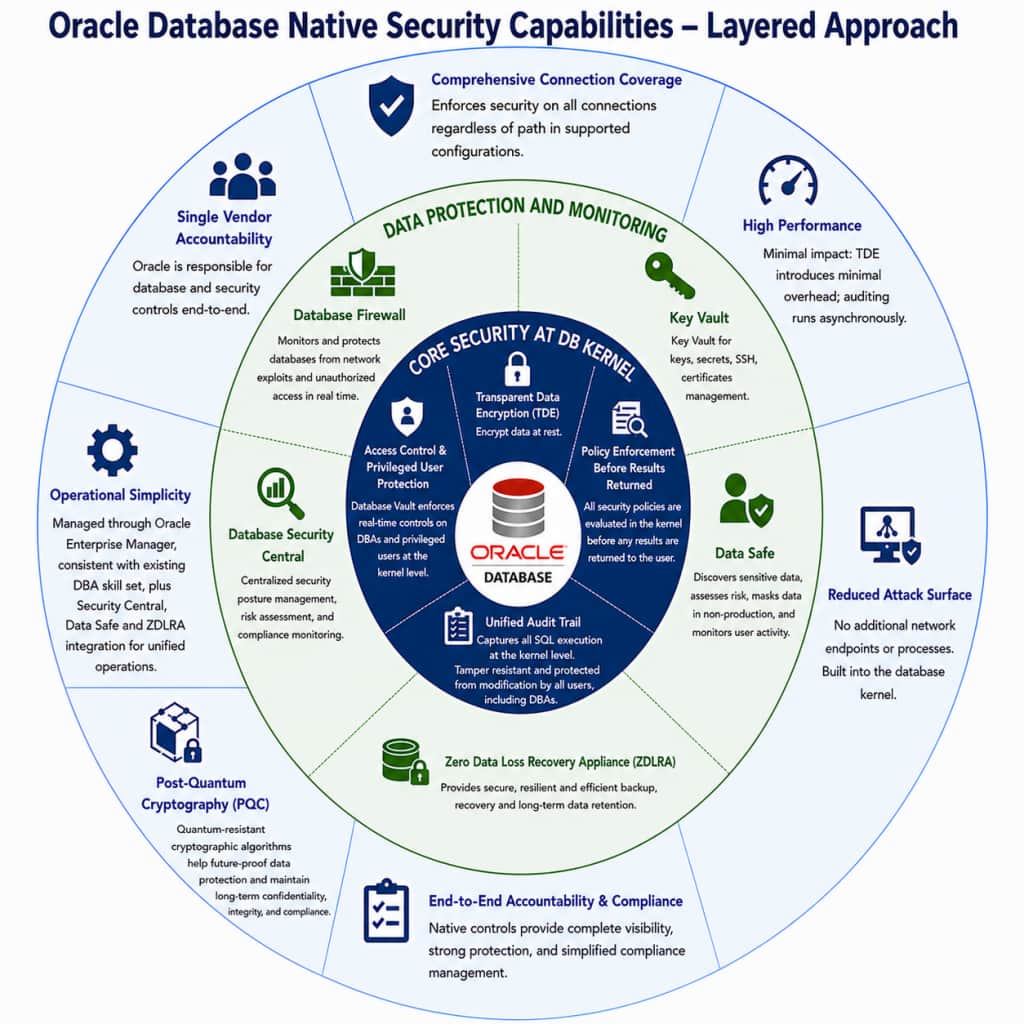
Native database security changes that model by enforcing controls where data is handled.
Oracle Transparent Data Encryption protects data files, tablespaces, backups, and exports at rest. Access controls can separate administrative privilege from data visibility. Dynamic Masking can prevent unauthorized users from seeing sensitive values even when queries are allowed. Data Redaction can reduce risk before records ever leave production. And database-native auditing can provide the evidence needed for investigations, internal reviews, and regulatory response.
That is the shift DPDPA encourages: from describing protection to enforcing it at the data layer.
The Broader Pressure: AI and Quantum Risk
DPDPA may be the compliance trigger, but it is not the only reason this matters now.
AI is already accelerating misuse. Attackers can automate probing, vary query patterns, and exploit compromised credentials far more quickly than manual review processes can keep up. Security teams are under pressure not just to observe abnormal behavior, but to stop it early.
At the same time, quantum risk is forcing a longer view. Sensitive data with a long shelf life, such as customer identity information, financial records, and health-related data, may remain valuable long after it is collected. That makes ‘harvest now, decrypt later’ a real planning problem today—not a future-dated concern.
Seen together, DPDPA, AI-assisted misuse, and quantum-era risk point in the same direction: the closer security is to the data, the more durable and defensible the security model becomes.
How Oracle Helps Address the Gap
DPDPA Section 6, read with the November 2025 final rules, translates the DPDPA’s general security rule into six specific technical requirements, each of which can be mapped directly to Oracle Database Security capabilities:
| Rule | Technical Mandate | Oracle Capability |
| 6(a): Encryption | Personal data encrypted at rest and in transit; key management documented and auditable; current cryptographic standards | TDE with AES-256; Oracle Key Vault with HSM integration, TLS 1.2/1.3 (26ai) network encryption; FIPS 140-2/140-3-certified modules |
| 6(a): Anonymization and Masking | Personal data used for non-identification purposes must be anonymized or masked; consistent across all access paths | Oracle Data Redaction; Oracle Data Masking and Subsetting |
| 6(b): Access Control | Access restricted to authorized personnel by purpose; privileged access subject to additional technical controls; separation of duties enforced technically | Oracle Database Vault; Oracle SQL Firewall; Label Security; Virtual Private Database |
| 6(c): Logging & Audit | Tamper-resistant logs of all personal data access; user identity, timestamp, data accessed, and operation recorded; retained for evidentiary periods | Oracle Unified Auditing; Fine-Grained Auditing; Oracle Data Safe/Oracle Audit Vault and Database Firewall (AVDF) centralized repository |
| 6(d): Availability | Personal data systems resilient to failure; documented RTO/RPO appropriate to processing criticality; tested continuity plans | Oracle Active Data Guard; Oracle RAC; Zero Data Loss Recovery Appliance/Service |
| 6(e): Monitoring | Continuous monitoring for unauthorized access and anomalous activity; alerts generated and acted upon in a timely manner | AVDF; Oracle SQL Firewall; Oracle Data Safe |
The point is not simply that these are security features. It is that they help move security enforcement closer to the place where DPDPA risk exists: the database itself.
What Leaders Should Do Now
The organizations that will be best prepared for DPDPA are not the ones that treat it as a checklist exercise. They are the ones that use it as an opportunity to modernize how personal data is protected.
A practical starting point is straightforward. Begin by identifying where personal data resides across the database estate. Then map current controls against core DPDPA expectations, including: encryption coverage, privileged access restriction, masking in nonproduction, and audit trail integrity. From there, prioritize gaps using a risk-ranked assessment, such as those available through Oracle Data Safe Security and User Assessments.
For many organizations, that sequence will reveal the same pattern: security exists, but enforcement is uneven; controls are present, but evidence is fragmented; policy is clear, but protection at the data layer is incomplete.
That is exactly why the database has become central to the DPDPA conversation.
Closing the DPDPA gap is often framed as a compliance deadline. It is better understood as a design test.
Can your organization protect personal data where it is stored, queried, copied, and used? Can you prove that protection holds up under review? And can your control model remain effective as threats become more automated and cryptographic expectations evolve?
Those questions do not start at the perimeter. They start at the source.
Get started:
- Read the full DPDPA technical brief: Oracle AI Database DPDPA Technical Brief
- Explore hands-on labs at livelabs.oracle.com
- Learn more about Oracle Database Security: oracle.com/security/database-security/
- Contact your Oracle account representative for a personalized DPDPA readiness assessment
Copyright © 2026, Oracle and/or its affiliates. This document is for informational purposes only and does not constitute legal advice.