

As resiliency expectations for mission-critical databases continue to rise, organizations need solutions that go beyond basic disaster recovery. Infrastructure failures or regional disruptions demand architectures that meet strict Recovery Point Objective (RPO) and Recovery Time Objective (RTO) targets without impacting day-to-day operations.
Why this matters more now
Recent global disruptions highlight a key lesson that organizations are better prepared when their disaster recovery systems are built, tested, and ready to act quickly. Oracle Exadata Database Service and Base Database Service address this need by supporting multiple standby databases with Oracle Data Guard. Oracle Data Guard delivers industry-leading data protection with real-time synchronization, seamless role transitions, and minimal to zero data loss, thereby enabling organizations to reduce risk and maintain continuous operations. With this capability, instead of relying on a single standby, customers can deploy multiple synchronized standby databases across different locations to strengthen resilience. A local standby can provide fast failover for routine incidents, while additional remote standby databases help protect against larger regional outages, thereby supporting business continuity across a wide range of scenarios.
These standby databases are not just passive copies. With Active Data Guard, customers can offload read-only workloads such as reporting, analytics, and backups on the standby database while the standby database is being synchronized with the changes from the primary database in real-time, reducing the load on the primary so it can focus on critical transactional processing. This improves overall efficiency and return on investment, while maintaining a separate backup of the primary as a recommended best practice.
Multiple standbys also simplify maintenance and testing. Operations like software updates can be performed on standby databases first and then on the primary, minimizing or eliminating downtime. In addition, a standby can be temporarily converted into a read-write environment for testing using Data Guard snapshot standby capability, allowing teams to validate changes against real data before safely reverting and resynchronizing with the primary.
By combining high availability, operational flexibility, and efficient resource utilization, multiple standby databases provide a resilient, distributed database foundation engineered to support modern, always-on mission-critical enterprise applications.
Streamlined automation for multiple standbys
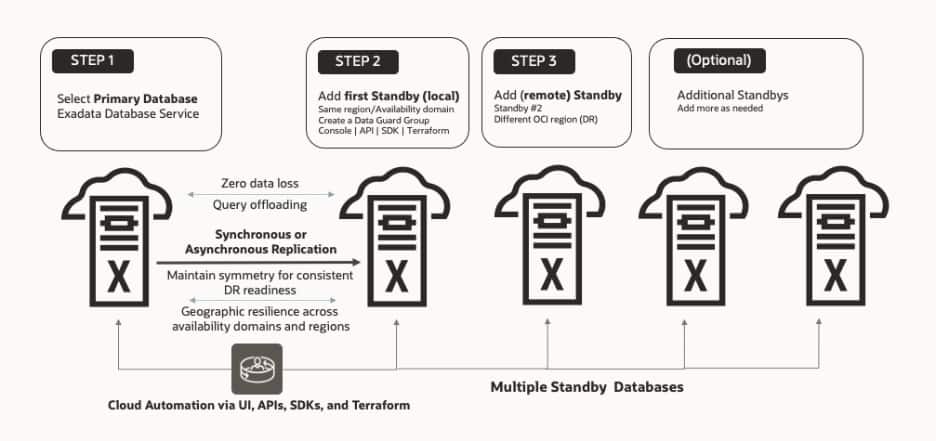
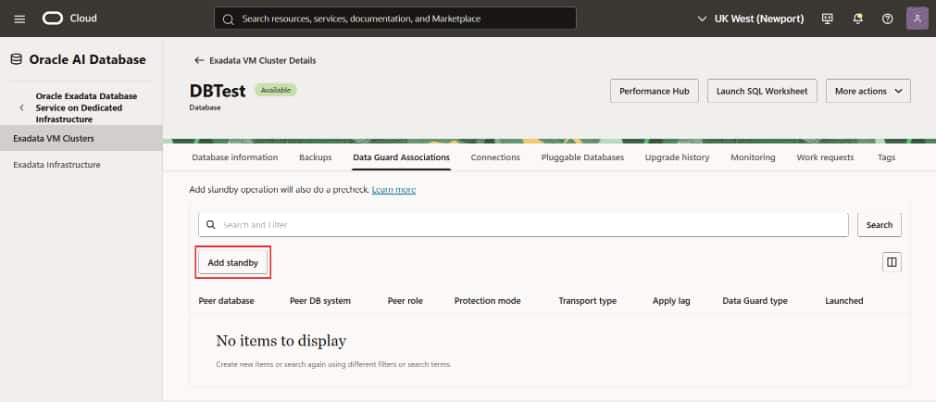
Oracle Cloud enhances Data Guard by providing extremely simple, managed automation for multiple standby databases. Customers can configure and manage multiple local and remote standby databases using the OCI Console, as well as APIs, SDKs, and Terraform. With OCI-managed automation and guided workflows, setting up and managing Data Guard is simple and easy, eliminating the manual steps typically involved in provisioning and operating multiple standby databases.
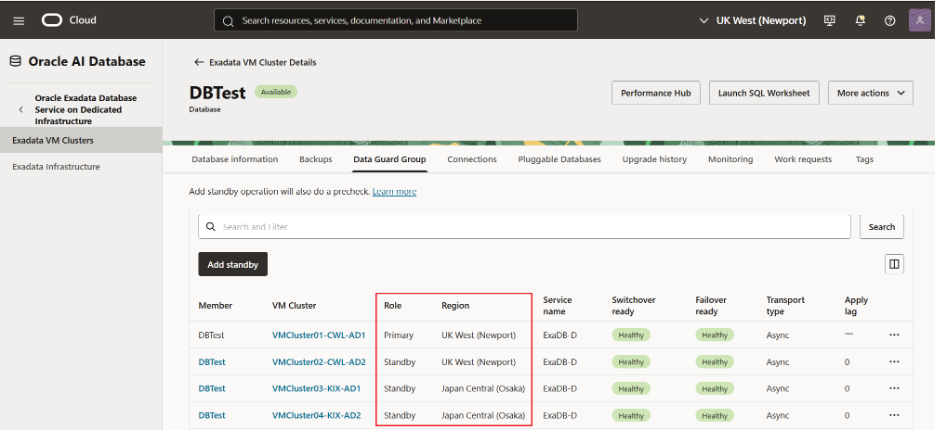
Multiple standby databases are organized into a Data Guard Group, an automation model that simplifies configuration and lifecycle operations across several standbys. This model currently supports up to six standby databases per primary, within a region and/or across regions. This provides a scalable way to design beyond a simple primary/secondary model.
A typical configuration would consist of:
- One local standby (same region) for fast recovery from any infrastructure events
- One remote standby (different region) for disaster recovery and regional survivability
Key Takeaways
For customers running Oracle Database on Oracle Exadata Database Service and Base Database Service, Data Guard automation for multiple standby databases enables a stronger and more flexible high availability and disaster recovery posture. It supports:
- Geographic resilience across availability domains and regions
- Multiple standbys allow separation across failure domains. For example, combining local high availability with regional disaster recovery. Each standby can be configured to meet specific recovery and latency requirements.
- Flexible role transitions for planned and unplanned events
- Administrators can perform switchover or failover to the standby that best fits the situation, rather than relying on a single predefined target.
- Performance-aware offload options for reporting and backups
- Standbys can be used to reduce load on the primary by offloading activities such as reporting, analytics and backups.
- Consistent disaster recovery readiness across regions
- Symmetric architectures ensure every region is production-ready, not just serve as a backup. This reduces risk during regional disruptions, prevents uneven protection after failover, and helps meet compliance requirements for consistent disaster recovery across locations.
- Simplified updates and migrations with reduced risks
- Administrators can create new standby databases on newer infrastructure (for example, moving from Oracle Exadata X9M to Oracle Exadata X11M), keep them in sync with the primary, and switch over when ready. This lowers upgrade risk and downtime while preserving a fallback option during the transition.
The result is a deployment that is better aligned with real-world outage scenarios, continuity requirements, and production performance expectations without having to treat disaster recovery as an afterthought.
Oracle Data Guard multiple standby support (via Cloud automation) is available on:
- Oracle Exadata Database Service on Dedicated Infrastructure
- Oracle Exadata Database Service on Cloud@Customer
- Oracle Exadata Database Service on Exascale Infrastructure
- Oracle Base Database Service
Learn more https://docs.oracle.com/en/learn/multi-standbydb/.