
Co-author: Md. Aminul Islam, Principal Sales Consultant md.aminul.islam@oracle.com
How Oracle AI Database Private Agent Factory helps finance teams reduce manual effort, improve consistency, and strengthen compliance through no-code agentic automation.
Invoice quality control rarely draws attention until it becomes an operational bottleneck.
In many organizations, teams still rely on manual review to validate invoice amounts, payment terms, tax treatment, supporting documents, and foreign exchange details. The work is necessary, but it is also slow, inconsistent, and difficult to scale. In the workflow behind this blog, that review process was estimated to take roughly 15 minutes per invoice, depending on complexity and document completeness. At enterprise volume, that translates into delayed processing, dependence on experienced reviewers, and limited auditability when questions arise later.
Private Agent Factory offers a more effective model.
We used Private Agent Factory to build a Tax Analyst Agent for invoice tax validation and quality control. The use case is specific, but the pattern is broadly applicable. The solution combines Oracle AI Database Private Agent Factory, Oracle Autonomous Database 26ai, Oracle AI Vector Search, MCP tools, and multimodal document understanding to automate invoice interpretation, regulatory retrieval, tax reasoning, status updates, exception handling, and audit logging in a compact no-code workflow.
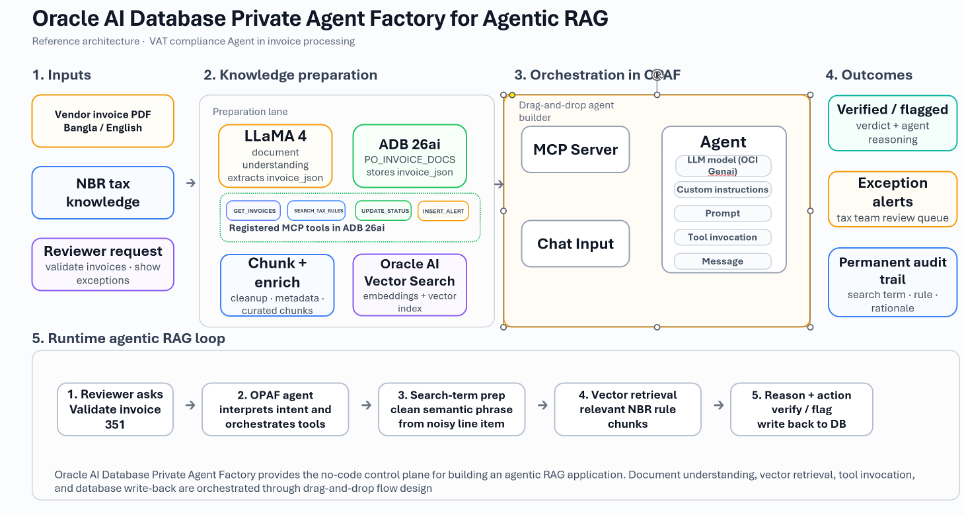
The business value is straightforward. Instead of treating invoice control as a manual checkpoint, organizations can redesign it as an intelligent, governed workflow. That means less manual effort, faster cycle times, more consistent decisions, and a stronger compliance posture.
A visual, no-code approach to enterprise AI
One of the most important advantages of Oracle AI Database Private Agent Factory is time to value. Traditionally, building this kind of solution would require a custom application stack: orchestration logic, tool wrappers, middleware, integrations, and runtime components. Private Agent Factory replaced much of that complexity with a visual, drag-and-drop design. The workflow was assembled using a small set of connected nodes, including chat input, an agent, an MCP server, and chat output. The result is an agentic Retrieval Augmented Generation (RAG) application that is easier to prototype, explain, govern, and extend.
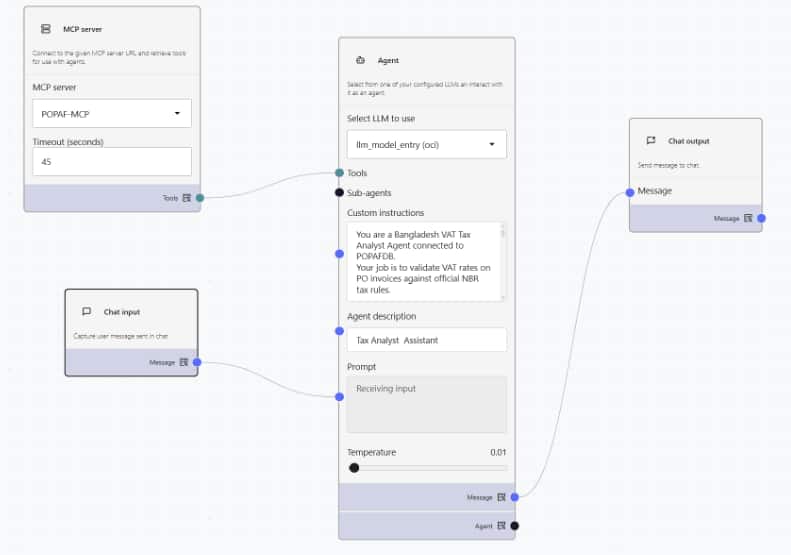
That simplicity matters to the business. It reduces implementation overhead and makes the architecture easier for both technical and non-technical stakeholders to understand. Business teams can focus on the control logic and desired outcomes rather than the plumbing required to connect multiple services.
Oracle AI Database at the core
Another strength of the design is that Oracle AI Database serves as both the data platform and the MCP server. Invoice records, vectorized regulatory knowledge, MCP tools, and the audit trail all live in the same environment. PL/SQL functions are exposed as MCP tools, which the agent can discover and invoke directly. Private Agent Factory orchestrates those capabilities.
This architecture reduces sprawl and supports a more governed approach to enterprise AI. It also allows teams with Oracle Database expertise to extend functionality using PL/SQL rather than building and maintaining a separate middleware layer.
Tax Analyst Agent: Deep Dive
The Tax Analyst Agent created in Private Agent Factory orchestrates the following high-level components:
- Document understanding using LLMs
- Knowledge base with Oracle AI Vector Search for searching tax rules
- Oracle AI Database MCP servers for PL/SQL functions calls
The agent workflow begins with document understanding. Instead of relying on an OCR-only approach, we use a multimodal LLM to interpret invoice PDFs and return structured JSON containing invoice metadata, line-item details, tax amounts, and confidence indicators.
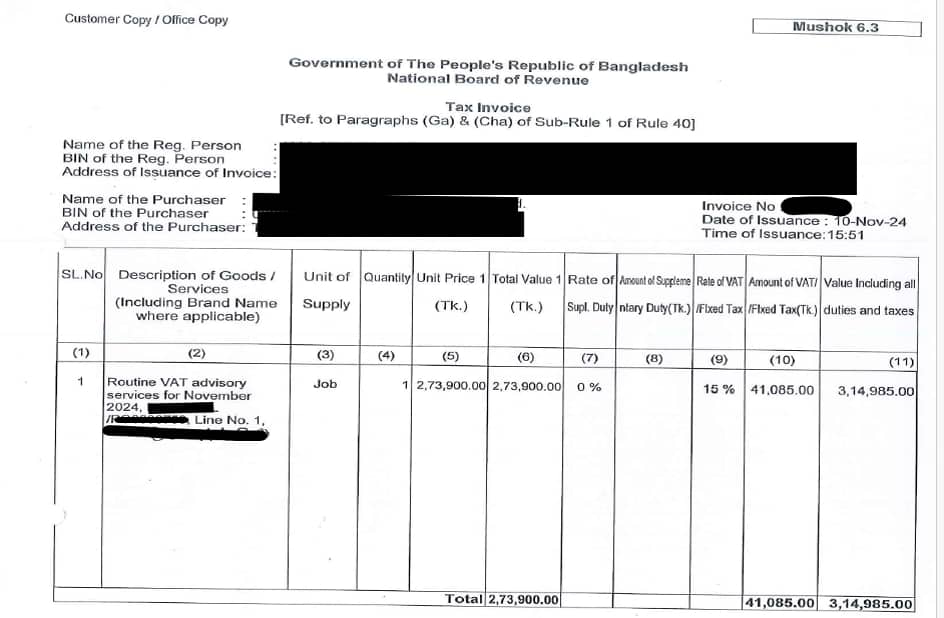
That metadata is then stored directly in Oracle Autonomous AI Database as native JSON, preserving traceability and making it available for downstream reasoning and action. From there, the agent retrieves the most relevant tax rules using Oracle AI Vector Search. The knowledge base includes statutory text, rules, tariff references, and a curated rate-reference set designed for precise retrieval in invoice validation scenarios.
Invoice line descriptions are often written for business context, not semantic retrieval. Dates, reference numbers, durations, and vague qualifiers can dilute the actual service meaning. By transforming noisy line-item descriptions into compact search terms that preserve the core tax meaning, retrieval quality improved significantly. That small design decision, to optimize search terms had significant impact on the quality of rule matching and final decisions.
| Raw line item | Cleaned search term |
| Routine VAT advisory services for November 2024 | VAT advisory consultancy services |
| Telecom Equipment (setup at BTA site) | telecom equipment installation construction BTA |
| Other Misc. Services (Monthly Call Carrying Charges) Duration: 2902389.85 | telecom call carrying interconnection services |
| Acceptance Commission, SWIFT, VAT charges against LC#072420XYZ | bank acceptance commission SWIFT financial services |
Select AI tools were created in Private Agent Factory and exposed through ADBS MCP Server for our agent.
| Select AI Tools | PL/SQL Function | Purpose |
| GET_INVOICES | GET_INVOICES(status_filter, offset, limit) | Reads invoice records and returns full invoice_json |
| SEARCH_TAX_RULES | SEARCH_TAX_RULES(p_search_term, p_top_n) | Retrieves relevant VAT/TAX rule chunks using vector similarity |
| UPDATE_INVOICE_STATUS | UPDATE_INVOICE_STATUS(p_doc_id, p_agent_status, p_agent_reasoning) | Stores the verdict and supporting reasoning |
| INSERT_NOTIFICATION | INSERT_NOTIFICATION(p_doc_id, p_po_number, p_invoice_number, p_issue_summary) | Creates review alerts for the tax team |
Auditability built in, not added later
Just as important, the solution does not stop at classification. Every processed invoice stores the decision rationale in Oracle AI Database, including the supporting rule and the justification behind the result. That creates a reviewable and auditable trail that can support accounts payable, tax review, and later audit. In compliance-focused workflows, that level of explainability is essential. Users need both a verdict and a reason.
This is where Oracle AI Database Private Agent Factory demonstrates real business value. It helps enterprises automate a control-heavy process without sacrificing governance. Instead of producing a black-box answer, it enables accountable automation.
| Invoice: 351 | Line: Telecom Equipment setup at BTS site Search Term: telecom equipment installation construction BTS Applied VAT: 7.5% | NBR Rule: SRO 214-AIN/2012 construction contractors Correct VAT: 7.5% | Decision: VERIFIED Justification: Equipment setup at a BTS site constitutes installation or construction work subject to the 7.5% reduced rate under SRO 214-AIN/2012. Invoice: Inv71 | Line: NTBN Service Search Term: NTBN national telecom transmission network ITES Applied VAT: 5% | NBR Rule: SRO 02-AIN/2019 IT-enabled services Correct VAT: 5% | Decision: VERIFIED Justification: NTBN is classified as an IT-enabled service attracting 5% VAT under SRO 02-AIN/2019. |
Broader Opportunity and a new model for operational efficiency
This pattern extends far beyond invoice tax validation scenario. The same approach can support withholding tax checks, payment-term verification, coding-file alignment, foreign-exchange validation, and exception routing. More broadly, it can be applied to ERP, procurement, customer support, and regulatory workflows where document understanding, grounded reasoning, and auditable outcomes are required.
Oracle AI Database Private Agent Factory is not just a way to build AI agents. It is a practical way to redesign manual business processes into scalable, traceable workflows. With the right combination of no-code orchestration, database-native tools, grounded retrieval, and multimodal understanding, enterprises can move beyond isolated AI experiments and start delivering measurable operational value.