
Database migrations often feel like open-heart surgery—necessary for survival, but fraught with operational risk. For architects looking to modernize their estate by moving to Autonomous AI Database @ AWS (ADB@AWS), the goal isn’t just to “move” data; it is to transition with minimal downtime and zero friction.
Whether you are migrating a single mission-critical instance or orchestrating a fleet-wide modernization, we provide the tooling to match your specific uptime requirements and cloud-native workflows.
The “Easy Button”: Oracle Zero Downtime Migration (ZDM)
For a standardized, automated approach, Oracle Zero Downtime Migration (ZDM) is the premier choice. It encapsulates Oracle’s Maximum Availability Architecture (MAA) best practices into a streamlined workflow, reducing the complexity of migration to a near “single-button” experience.
- Zero Cost, High Value: ZDM is available at no additional cost, allowing you to leverage advanced automation without licensing hurdles.
- Flexible Workflows: Whether you need a Logical Online Migration (utilizing Oracle GoldenGate for near-zero downtime) or a Logical Offline Migration (for planned maintenance windows), ZDM can handle the orchestration.
- Modernize as You Move: ZDM supports moving between different platforms and versions, allowing you to upgrade to the latest Autonomous AI Database capabilities seamlessly.
The Cloud-Native Approach: S3 and EFS Integration
For organizations deeply embedded in the AWS ecosystem, flexibility is key. We have engineered ADB@AWS to integrate natively with the storage services you already use, acting as efficient staging areas for data ingestion and backups.
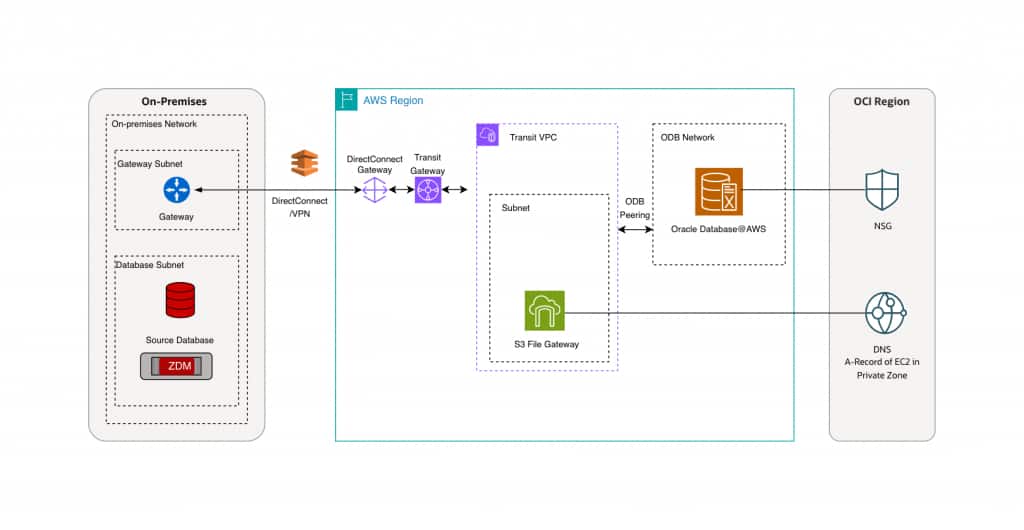
1. Migration via Amazon S3 File Gateway You can now eliminate complex ETL pipelines by using Amazon S3 File Gateway as a staging area. By mounting S3 buckets as file shares, you can seamlessly export dump files from your source system and import them directly into Autonomous AI Database using the DBMS_CLOUD package. This simplifies data ingestion while leveraging the virtually unlimited scalability of S3.
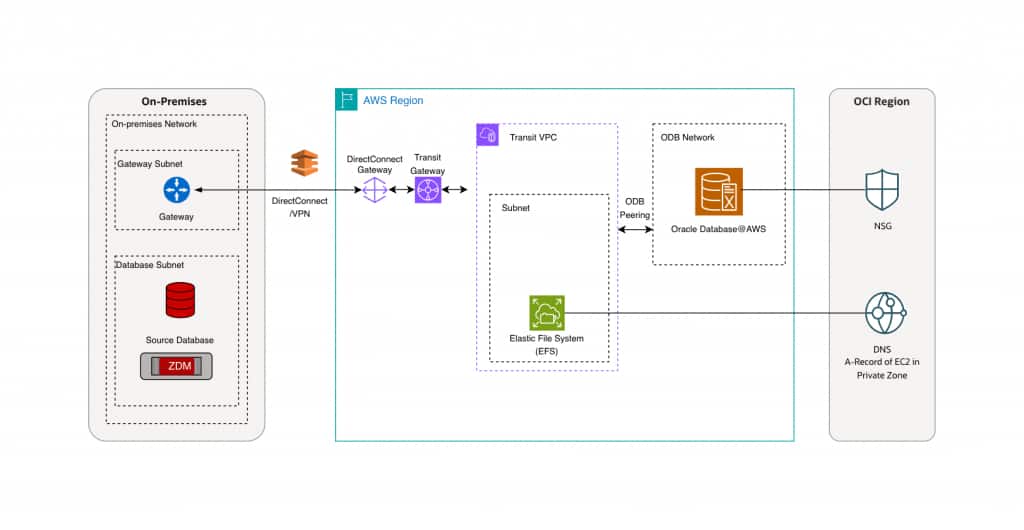
2. High-Performance Staging with Amazon EFS For workloads requiring shared storage for large-scale analytics or rapid schema exports, Amazon Elastic File System (EFS) integration offers a robust solution. You can mount EFS directly to your Autonomous Database on Dedicated Infrastructure using NFSv4. This enables high-performance read/write operations and creating external tables without compromising database security or performance.
Get Started
Modernizing to the Autonomous AI Database shouldn’t require reinventing your operational wheel. Whether you choose the automated orchestration of ZDM or the cloud-native flexibility of S3 and EFS, the path to ADB@AWS is open.
Review the comprehensive technical guides below to start your migration:
- [Documentation: Oracle Zero Downtime Migration for Autonomous AI Database]
- [Documentation: Configuring Amazon S3 File Gateway with Oracle Database@AWS]
- [Documentation: Integrating Amazon EFS with Autonomous Database]