
Ask five people inside an organization who owns cloud cost and you may get five different answers.
Finance may say IT. IT may point to individual application teams. Application teams may say the business owns the workloads. Procurement is looking at the commercial agreement and overall commitment. Meanwhile, leadership may simply want to understand why this month’s cloud spend is higher than last month’s.
None of them are necessarily wrong. They are just looking at the same environment from different perspectives.
This is one of the reasons I believe Cloud Financial Management (CFM) needs to be viewed as more than a cost optimization exercise. Organizations need the right tools, data, and reporting, but those things alone don’t create good financial management. You also need the right people having the right conversations. Having a FinOps team is ideal, however many organizations can make progress even before having a formal team in place.
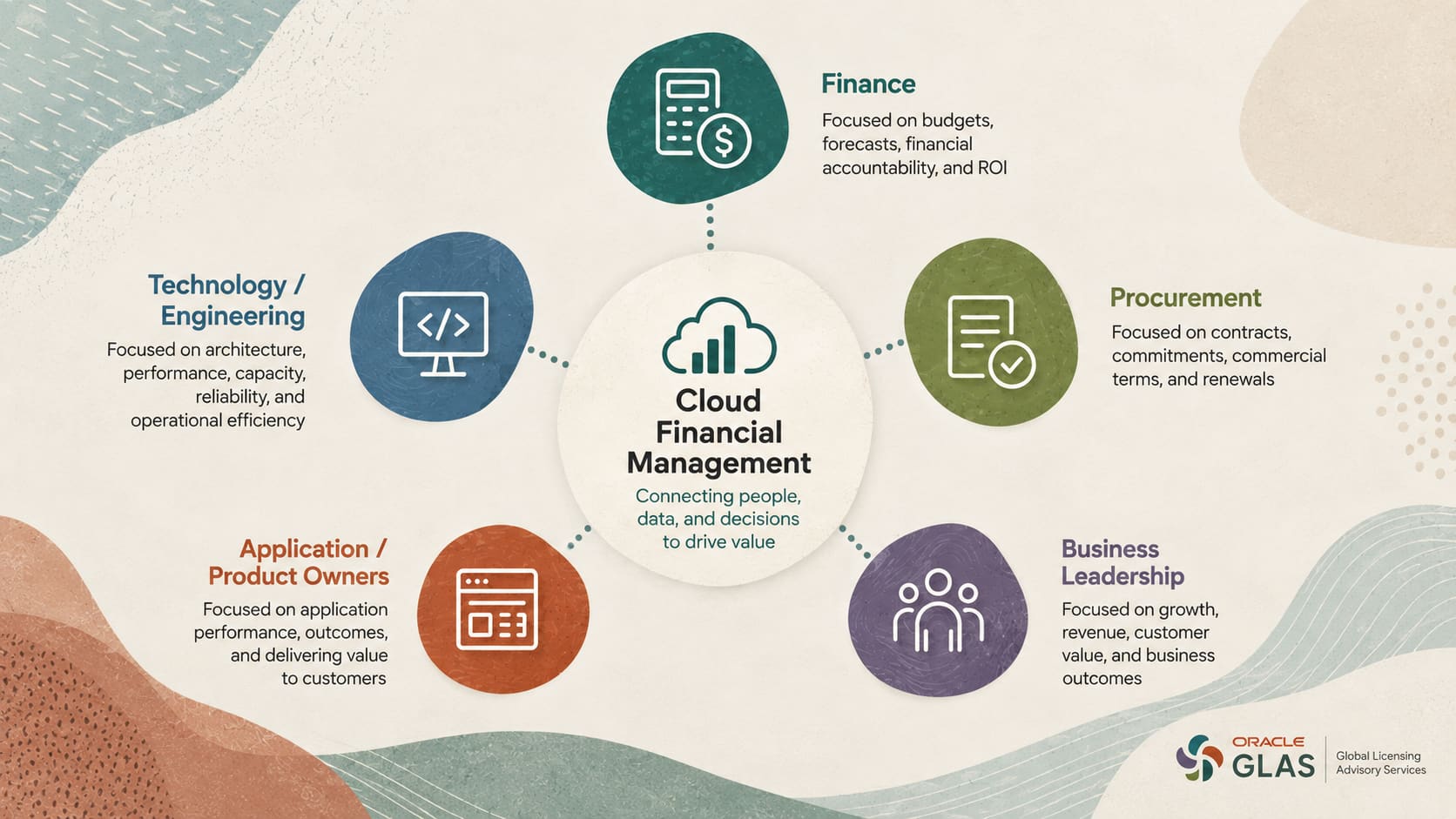
Everyone sees a different cloud
Think about what happens when cloud consumption increases by 15%.
Finance may see a budget variance. Engineering may see increased transaction volume. Procurement may think about commitments, while application owners are focused on performance and business leaders want to know what the additional spending produced.
These are all reasonable perspectives. The challenge is connecting them.
Cloud has made it relatively easy for organizations to consume technology. Someone creates a resource, an application scales, a new project launches, or customer demand increases. Each decision may make perfect sense on its own, but collectively they show up on a cloud bill.
Visibility is important, but it isn’t the same as understanding
Organizations need to understand what they are spending, where they are spending it, how consumption is changing, and where there may be opportunities to optimize. But visibility only gets you so far.
A dashboard might tell you that compute spending increased 20% last month. That’s useful, but it probably won’t tell you why.
Maybe a successful product launch drove considerably more customer traffic than expected. Maybe an application team increased capacity to address a performance issue. Or maybe a workload was simply overprovisioned.
Those situations could look very similar on a cost report while requiring completely different responses.
The data tells us where we should look. The people responsible for the technology and the business help us understand what the data actually means.
Creating a common language
CFM can help create a common language between these groups. FinOps managers specialize in translating these concepts across stakeholders.
Instead of simply saying, “Cloud spending increased 20%,” what if the organization could say, “Cloud spending increased 20%, but transaction volume increased 35%, reducing our infrastructure cost per transaction”?
That’s a very different conversation.
Now we aren’t simply talking about whether cloud costs went up or down. We’re talking about efficiency and business value.
Getting there requires organizations to think about cost allocation, ownership, tagging, forecasting, optimization, and eventually unit economics. More importantly, stakeholders need to agree on what those things mean and how they will use them.
Who actually owns cloud cost?
This sounds like a simple question, but I don’t think the best answer is necessarily a single person or department.
Finance shouldn’t be expected to determine whether infrastructure is appropriately sized, just as Engineering shouldn’t independently determine how cloud spending should be allocated across the company. Each group owns a piece of the answer.
That makes CFM a shared responsibility. FinOps teams often facilitate those connections, however they still need buy-in and cooperation across stakeholders.
The more important question is whether the organization has created a process for bringing those responsibilities together.
Sometimes the most valuable part of an assessment is the discussion
I’ve spent much of my career working with customers around technology investments, and one thing I’ve learned is that sometimes the question itself is more valuable than the answer.
A recent CFM engagement reinforced this for me. The customer already had a solid financial management foundation, including cross-cloud cost management, commitment tracking, and cost-aware cloud design. This wasn’t an organization starting from scratch.
As we looked more closely at their OCI environment, however, we identified opportunities around tagging, shared-cost allocation, and mapping resources back to owners and products.
The interesting part wasn’t simply that some tags needed improvement. The larger question was who needed to agree on how those resources should be classified, allocated, and managed going forward.
Answering that required more than the cloud platform team. Finance, application and product owners, engineering, and the teams responsible for cloud reporting all had a role.
That changed the conversation from “How do we fix the tagging?” to “How do we create an approach everyone can trust and use?”
The technical analysis identified the issue. Bringing the right stakeholders together allowed the organization to decide what to do about it.
That’s one of the areas where I see value in a structured CFM assessment. The goal isn’t for everyone to become an expert in everyone else’s job. It’s to establish enough shared understanding that the organization can make better decisions together.
Moving from cloud cost management to cloud financial management
There is an important distinction between managing a cloud bill and managing the economics of cloud.
Managing the bill asks: Where are we spending money and where can we save?
Cloud Financial Management asks broader questions:
- What are we spending?
- Why are we spending it?
- Who owns it?
- Is the spending expected?
- Are we using our resources efficiently?
- What business outcomes does the spending support?
Those questions can’t be answered by a single team, and they probably shouldn’t be. An experienced FinOps team may have a sense of what they’ve done in the past, but getting consensus across teams ensures on-going buy-in.
Cloud has become too closely connected to how organizations operate, serve customers, develop products, and generate revenue for its economics to sit entirely within either Finance or Technology. CFM provides an opportunity to connect the two.
Start with the conversation
Organizations should absolutely continue investing in better cloud visibility, automation, cost optimization, forecasting, and financial management capabilities.
But a recommendation still needs an owner. A forecast still needs business context. A cost allocation model still needs agreement. And a dashboard still needs someone to ask what the numbers mean.
That’s why one of the first questions I would ask an organization looking to improve its Cloud Financial Management practice isn’t about which tools it uses.
I’d ask: Who is part of the conversation today?
The answer can tell you quite a bit about where to start.
Because in many cases, improving cloud economics doesn’t begin with another dashboard. It begins with getting the right people around the same table, looking at the same information, and asking the right questions.